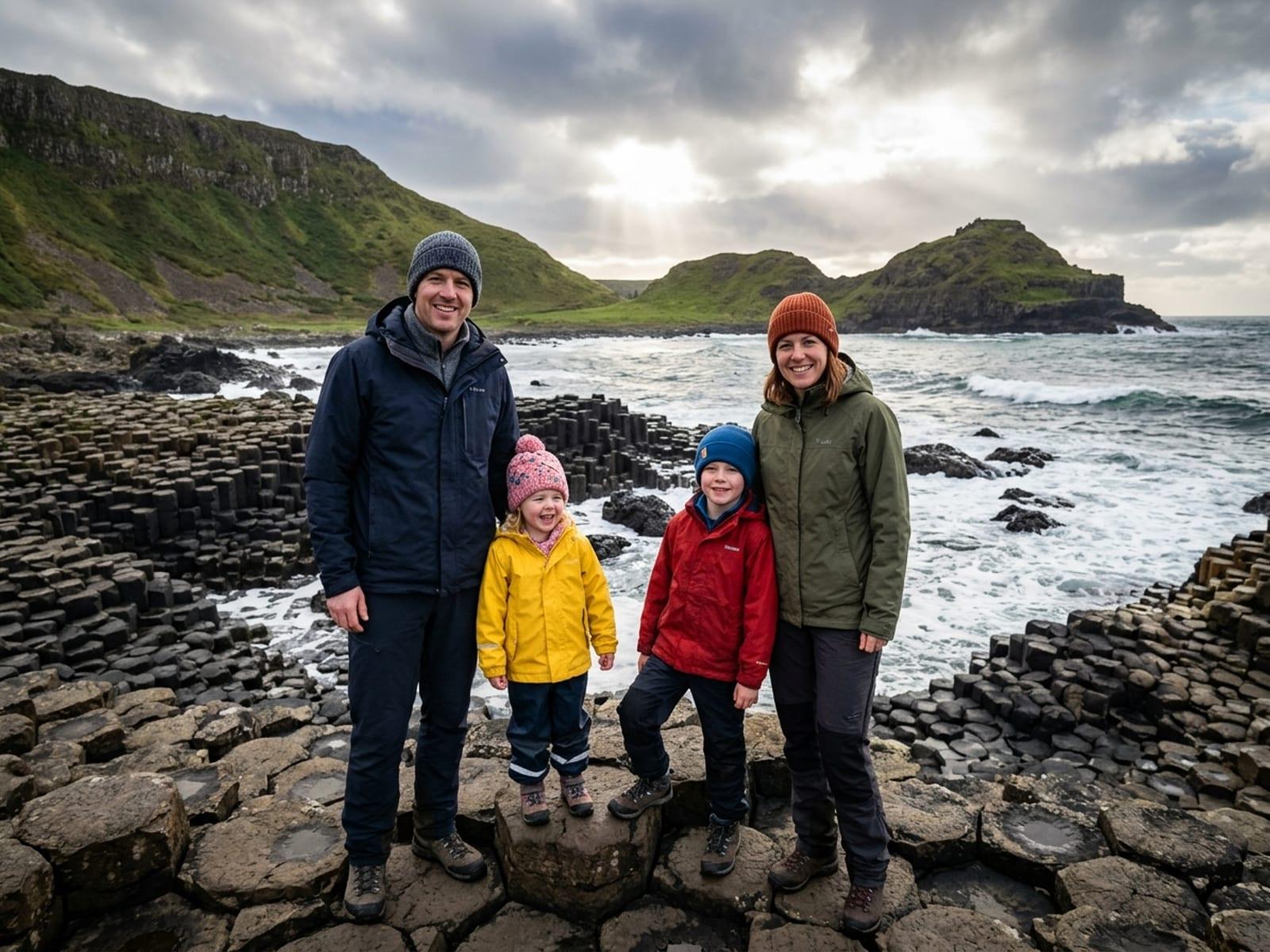
The Giant's Causeway is a stretch of coast near Bushmills in Northern Ireland where about 40,000 basalt columns, most of them six-sided, step down into the sea; it became a UNESCO World Heritage Site in 1986. You can walk down to the stones for free all year, and the shortest route, the Blue Trail, takes about 20 minutes from the visitor centre. Wet columns are very slippery, so hold small children's hands and wear grippy shoes and a waterproof jacket.
Some 40,000 columns of cooled, cracked lava
The Giant's Causeway is made up of around 40,000 interlocking basalt columns. Between 50 and 60 million years ago, volcanic activity forced molten basalt up from below, through layers of chalk, and as it spread out, cooled and hardened, it contracted and cracked into columns. Most are hexagonal, but they range from four to eight sides.
Around the headland, some rock formations are named for their shapes: the Organ, where columns stand in rows like organ pipes; the Giant's Boot, which looks like an enormous boot; the Chimney Stacks; and the Camel's Hump. Try finding which is which with the kids as you walk. The Giant's Boot is at the end of the shortest route, the Blue Trail.
The area was also designated a national nature reserve in 1987, and much of the site is now managed by the National Trust, the same charity that looks after the farms Beatrix Potter left in the Lake District. Nearly a million people visited in 2019.
The tale of the giant Finn McCool
The stones come with a legend. The Irish giant Finn McCool built a causeway across the sea so he could fight Benandonner, a giant who lived across the water in Scotland. Across the sea on the Scottish island of Staffa there's Fingal's Cave, a cave made of similar basalt columns, which is thought to have influenced the story.
There are many versions. Besides the one where Finn defeats his rival, a well-known telling has Finn's wife, Sadhbh, disguise him as a baby and put him in a cradle. Seeing the size of the "baby," Benandonner panics at how huge the father must be and flees back to Scotland, tearing up the causeway behind him so Finn can't follow. Storytellers share tales like this on the visitor centre's guided tours, so even children too young for the geology will remember the shapes of the stones.
The visitor centre and the path to the stones
Walking to the stones on the shore is free. The Visitor Experience at the visitor centre is paid, and includes a guided tour with a storyteller, an audio guide in 11 languages, and hands-on exhibits. According to the local tourism board, it's open from 9:00 to 17:00 (last entry 16:00) from 1 September to 25 October, with hours that vary by season. Check prices and current times on the National Trust's official website. The current visitor centre was rebuilt by 2012 after the previous building burned down in 2000. It's step-free, with ramps, a large accessible toilet with an adult-sized changing bench, and mobility aids to borrow. On a day of heavy rain, one option is to look around the exhibitions first and wait for the weather to improve.
From the visitor centre to the columns on the shore is about a 20-minute walk on the shortest route, the Blue Trail; to the Giant's Boot at the end it's 0.8 miles (about 1.3 km). Some stretches are steep, so save some of your children's energy for the climb back. A shuttle bus run by Translink leaves from behind the centre every 15 minutes for the stones and back, costing £1 each way (cash or card). The bus is meant for people who would struggle to walk there and back, so if your family is fit, walk and leave the seats for those who need them.
With a stroller, the loop section of the Green Trail is laid out as a step-free path. Parts of it are gravel, though, and you may need help pushing.
The other routes are the Yellow Trail, which follows the coastline along the clifftops, and the Red Trail, which includes the stone staircase known as the Shepherd's Steps. Looking down on the columns from above, you can clearly see the causeway running into the sea. Trying to go down to the shore and then view it from the top as well makes a long day for small children, so pick one or the other to suit their age.
On the rocks, don't let go of their hands
The tops of the columns look flat but are full of uneven steps, and they become very slippery when wet with rain or sea spray. Always hold small children's hands and don't go too close to the low columns near the water. This coast faces the Atlantic, and big waves can come in without warning. The best preparation is non-slip shoes with soles that aren't worn smooth.
The weather changes quickly, and even on a sunny day the sea wind will chill you. Bring waterproof jackets, plus hats and gloves for the children. Dogs on leads are welcome both indoors and out.
Before you go, you could make a picture of the family lined up on the hexagonal stones with pokesta's AI photos ($1 per photo, first one free).
Going further: a rope bridge over the sea
If you have time, you can also stop at the Carrick-a-Rede Rope Bridge near Ballintoy, a drive to the east. The bridge, 20 metres long, links the mainland to a small island, 30 metres above the rocks below. Salmon fishermen are thought to have been bridging the gap to the island for more than 350 years. It's managed by the National Trust and can be crossed all year, weather permitting, for a fee. Don't push children who are afraid of heights to cross; decide whether to go over once you're there and can see how they feel.
When to go and how to get there
You can visit the Giant's Causeway all year. Long summer days also bring crowds, so go down to the shore early in the morning or in the evening for a calmer walk. The path to the shore is open at all hours, but the rocks are dangerous after dark, so get back while it's still light.
The main gateway airport is Belfast International (BFS). From Belfast or Derry/Londonderry, take the train to Coleraine and change to a local bus. Bus routes and timetables change with the seasons, so check with the operator, Translink. Families who like walking can follow a route of about 11 km from the seaside town of Portrush that passes Dunluce Castle and the heritage Giant's Causeway and Bushmills Railway. If you carry on across the sea to Scotland in summer, towns and villages there hold Highland Games, where kilted competitors toss the caber. Northern Ireland is part of the UK, so UK entry rules apply. Entry requirements vary by nationality, so check your own government's official information before you travel.
References