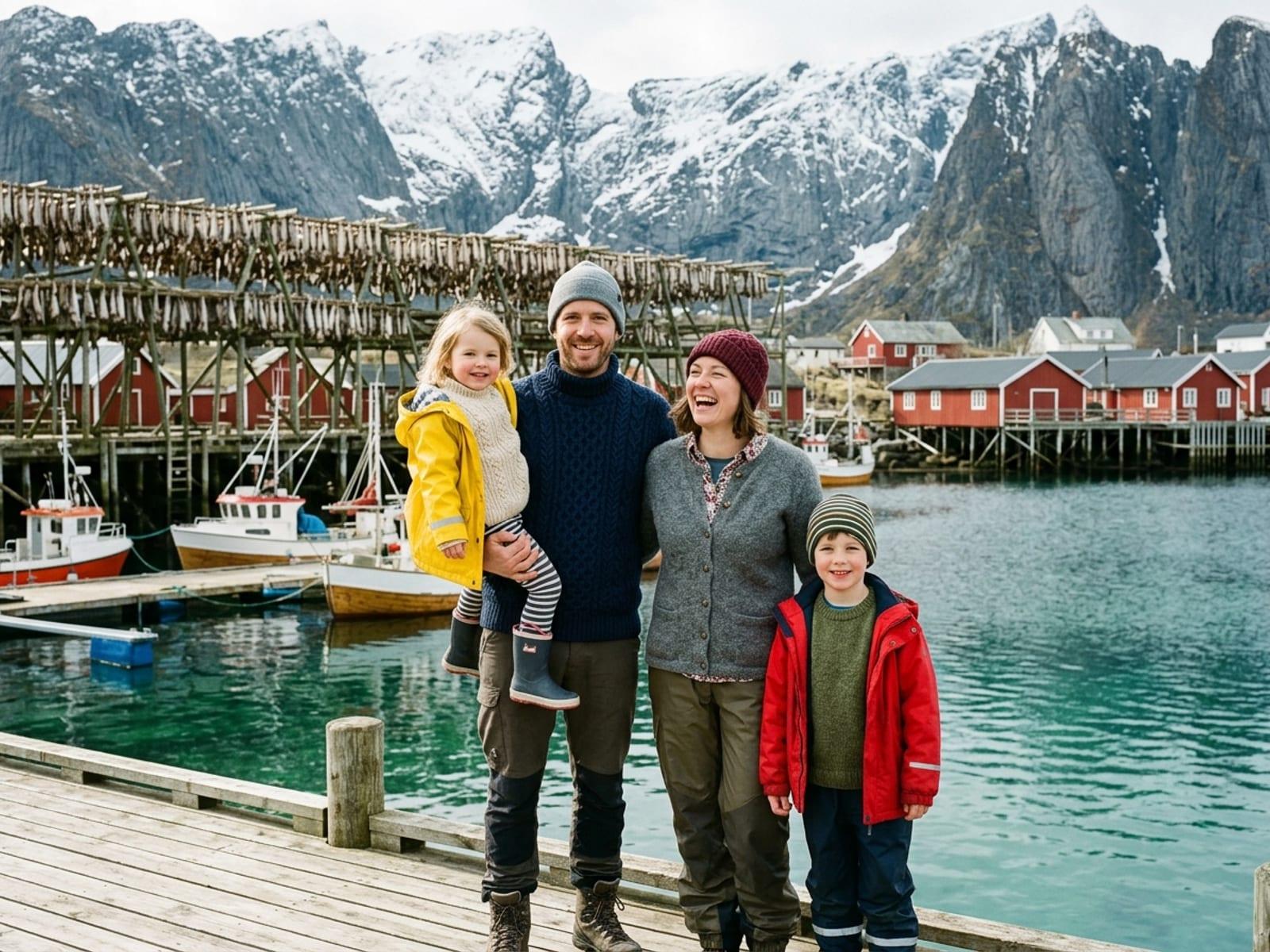
In the Lofoten Islands, out in the Arctic sea, rows of headless cod hang from wooden racks along the shore from late winter into spring. This is tørrfisk, or stockfish: cod dried for months by nothing but wind and cold air. Lofoten stockfish is also registered in the EU as a protected geographical indication (PGI), under the name "Tørrfisk fra Lofoten." If you want to see the racks full of fish, go around March to May; if you'd rather take your time in the fishing-village museums with the family, summer is better.
It starts with skrei, the cod that comes in winter
Stockfish is made from Atlantic cod known as skrei. Skrei grow up in the Barents Sea to the north and swim south to the waters around Lofoten to spawn. Only mature cod aged five or older make this journey. According to Visit Lofoten, millions of skrei arrive from around Christmas, and the cod fishery here is considered the largest in the North Atlantic.
Stockfish has driven Norwegian trade for more than a thousand years. In the Middle Ages, Hanseatic merchants traded it in Bergen, where the old wooden wharf of Bryggen still stands beside the Fisketorget fish market. We know from the Icelandic Egil's Saga that Vikings took dried cod on their voyages. The link with Italy runs deep, too. In 1432, the ship of the Venetian sailor Pietro Querini was wrecked, and he ended up on Røst, an island at the southwestern tip of Lofoten. He is said to have spent the winter there and taken stockfish home with him. Much of the stockfish produced today is still exported to Italy, where it goes into Vicenza's signature dish, baccalà alla vicentina.
Three months in the wind
The method could hardly be simpler. Headless cod are tied together in pairs and hung over wooden racks. According to Visit Lofoten, each fish is hung with its back facing the rain from the southwest and its belly toward the north wind. After that, the outdoor air does the rest. Lofoten winters are not warm enough for the fish to rot and not cold enough for them to freeze solid, and that climate is said to be ideal for drying. Visit Lofoten says the drying takes about three months, during which the fish lose roughly 75% of their water.
The stockfish museum explains that cod caught in January in western Lofoten are plump, while the cod landed in large numbers in March in eastern Lofoten have already spawned and are leaner. The fish dry on the racks through the winter, move into warehouses in May and June once they're fully dry, and are sorted over the summer. Fish for Italy are graded into 16 classes. The Veneto and Liguria regions in the north prefer the slimmer eastern Lofoten cod, while Campania in the south prefers the rounder western Lofoten fish.
Klippfisk, a name that sounds similar, is cod that has been salted and then dried, and it goes mainly to Portugal, Brazil and Spain. Lofoten stockfish uses no salt at all; it's dried by wind alone.
The heads that are cut off are threaded on lines and dried separately. Dried cod heads are popular in West Africa, especially Nigeria, where they've long been used to flavor soups and stocks.
Follow the life of a stockfish in Å
For a family visit, head to Å, the fishing village at the western end of the Lofoten Islands where the E10 road ends. Its one-letter name is the same as the last letter of the Norwegian alphabet, which children tend to find easy to remember.
In the middle of the village is the Norwegian Fishing Village Museum, considered one of the best-preserved fishing villages in northern Norway. Boathouses, a cod liver oil factory, fishermen's cabins, a smithy, a post office and a bakery all still stand, and in summer there are demonstrations of blacksmithing and cod liver oil making. The bakery, with its stone oven from 1878, is open from June 1 to September 30. The museum is open all year, but hours change with the season, so check before you go. Admission starts at NOK 150, and the café is open daily in summer. The parking lot is just past the tunnel, about a three-minute walk from the village center, which is an easy distance even for small children.
Near the entrance to the village, in an old fish landing station by the water, is the Lofoten Stockfish Museum. With old tools on display, it walks you through how fish landed from the boats became 25 kg and 50 kg export bundles. This is also where you'll hear how children once earned pocket money by cutting out cod tongues. Guided tours run regularly in summer, so timing your visit to one makes the exhibits much easier to follow.
Tasting it with children
Stockfish is sold in shops as a snack you can gnaw on straight from the bag. It's very hard, though, so tear it into small pieces for young children and give them a little at a time. For cooking, it has to soak in water for about a week first, so the easiest way for visitors to try it is to order it at a restaurant. Some grocery stores sell stockfish already soaked and ready to cook, so if your accommodation has a kitchen, you could cook it together as a family. Visit Lofoten points to restaurants around the islands, in Svolvær, Leknes and elsewhere, that serve stockfish dishes. There are also versions dried to different degrees, such as half-dried boknafisk and the strongly flavored hjellosing. Some islands also hold food events centered on stockfish, or offer village walks where you learn its story.
Over a plate of stockfish, tell the children about the Venetian sailor who washed up on Røst. Suddenly the food in front of them is something that has been crossing the sea for more than 500 years.
The fish on the racks are a product being carefully dried for sale. Remind children not to touch or tug at them, and take your photos from outside the racks. It smells of fish near the racks, so family members with sensitive noses should stay upwind.
To see how a family photo in front of the drying racks and red fishermen's cabins might look, you can try pokesta's AI photos ($1 per photo, and your first one is free).
When to go and how to get there
To see the racks hung with fish, visit from about March to May. In summer the racks are often empty, but the museum bakery and guided tours are in full swing. The nearest major airport is Bodø Airport (BOO). From Bodø, take the ferry to Moskenes in Lofoten, then follow the E10 to its end at Å. You can also fly into Leknes or Svolvær on the islands and continue by bus. Ferry timetables and whether you need to book vary with the season, so check the operator's latest information. If you're in the Arctic in February, you could combine the trip with Sámi Week in Tromsø and its reindeer races. Elsewhere in northern Norway, at the country's eastern tip in Kirkenes, you can join a king crab fishing safari.
References