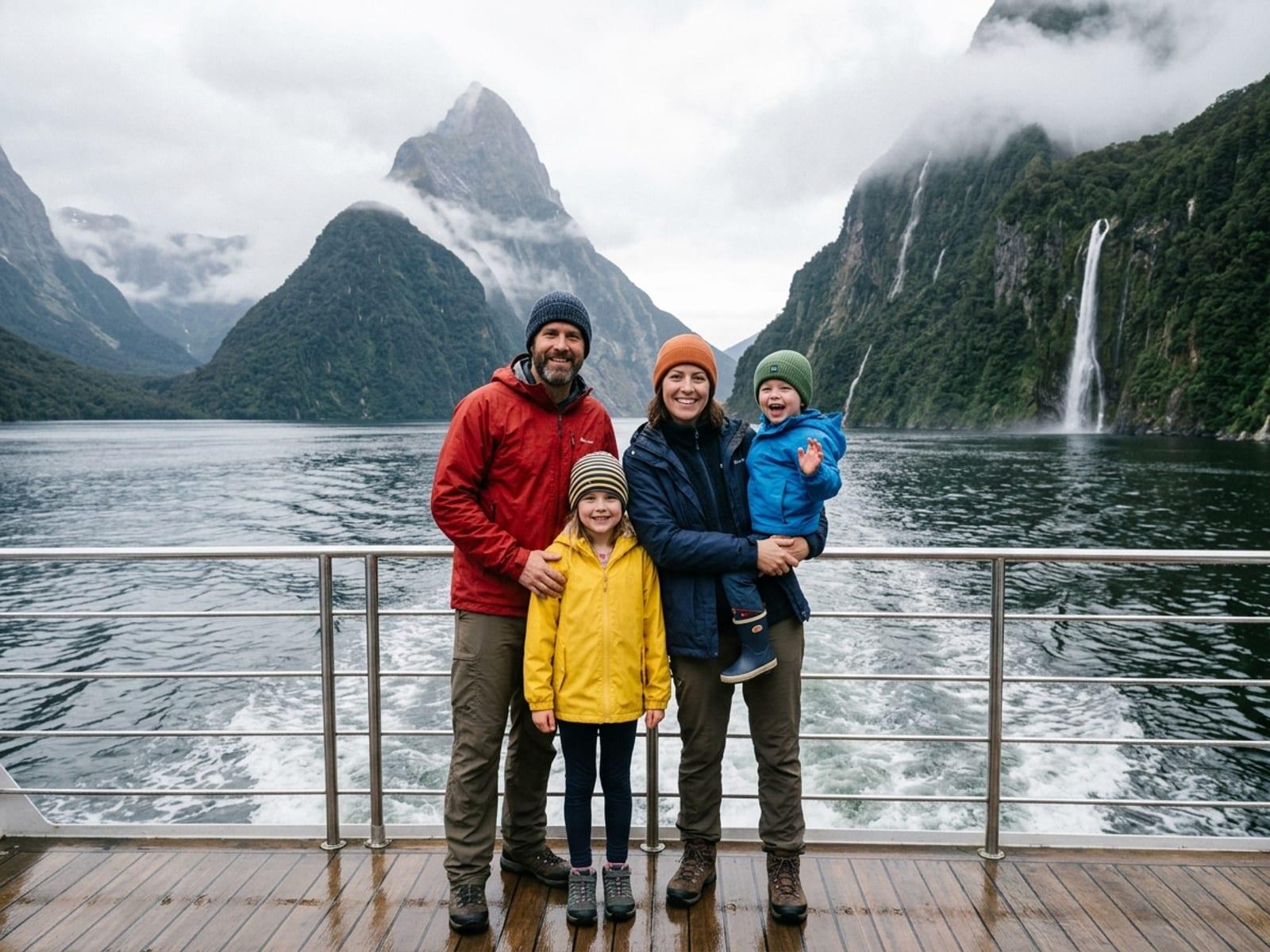
Milford Sound, Piopiotahi in Māori, is a glacier-carved fiord in the southwest of the South Island, inside the Te Wāhipounamu World Heritage Area. Cruises of one to two hours run all year, threading between sheer rock walls and waterfalls toward the sea, and the boat trip itself is easy for children. The road is the hard part: the round trip from Te Anau takes about eight hours with no shops or fuel on the way, so families do best staying the night in Te Anau, leaving the next morning, and deciding early whether to drive, take a bus or fly.
A "sound" that is really a glacier-carved fiord
Despite the word "sound" in its name, Milford Sound is a fiord carved by glaciers. It runs about 15 km inland from the Tasman Sea, is up to about 1.9 km wide and up to about 291 m deep. Under the 1998 settlement with Ngāi Tahu, it became officially dual-named alongside the Māori name Piopiotahi.
The area is part of Fiordland National Park and lies within Te Wāhipounamu – South West New Zealand, inscribed as a World Heritage Site in 1990. Te Wāhipounamu means "the place of greenstone (pounamu)" in Māori, and you can hold that stone in your hand at the pounamu studios of Hokitika on the West Coast. It takes in four national parks, Aoraki / Mount Cook, Fiordland, Mount Aspiring and Westland Tai Poutini, and covers about 2.6 million hectares. About 170 takahē, large flightless birds, live wild in Fiordland's mountain valleys, and the area is also home to birds found nowhere else, such as kiwi species and the Fiordland penguin.
Peaks, waterfalls and sea life from the deck
The symbol of the fiord is Mitre Peak, rising about 1,692 m straight out of the water. Of the waterfalls pouring down the cliffs, only two run all year round, Lady Bowen Falls and Stirling Falls, and Stirling Falls is about 151 m high. Near the falls, spray can blow across the deck, so put the kids in jackets that can get wet.
Milford Sound gets more than 6,000 mm of rain a year on average, making it one of the wettest inhabited places in the country, and 250 mm has fallen in 24 hours. Crisp views on a clear day and countless temporary waterfalls on a wet one are each worth seeing. A rainy forecast is no reason to cancel.
With luck, you'll also meet some sea life: fur seals resting on the rocks, the world's southernmost wild bottlenose dolphins, whales, and Fiordland penguins, which breed in the area. Listen for announcements and your guide's commentary, and hunt for them with the kids through binoculars. At Harrison Cove there's an underwater observatory where you can see black coral at about 10 m deep, and some tours combine it with a cruise.
Eight hours there and back from Te Anau
The only road to Milford Sound is State Highway 94, known as the Milford Road. It's 121 km from Te Anau and 291 km from Queenstown, and on the way you pass through the 1.2 km Homer Tunnel.
According to the Department of Conservation (DOC), a round trip from Te Anau with stops for the views, short walks and a cruise takes eight hours, and from Queenstown it's 12 to 14 hours. In the busy summer season, the tunnel runs one lane at a time on traffic lights, and you may wait up to about 20 minutes. Doing the whole round trip in a day with small children is tough, so for a family trip, stay overnight in Te Anau and set off the next morning.
Once you leave Te Anau there are no shops and no petrol stations until Milford, so fill the tank and bring food and drinks. There are public toilets in only three places: Te Anau, Knobs Flat along the way, and Milford. Mobile phones barely work once you leave Te Anau. The only phones are card phones at Knobs Flat and Milford and an emergency satellite phone at the Homer Tunnel. Plan the kids' toilet breaks around those three stops.
In winter the road can be covered in snow and ice, and some days it closes because of avalanche risk. In winter, stopping is not allowed between the Hollyford Road turnoff and The Chasm because it's an avalanche zone, and with less traffic around, setting off after 9 a.m. is recommended. Chains may be required, and you can hire them in Te Anau. If you're not confident driving in winter conditions, DOC suggests taking a bus. Before you set off, check road conditions with the transport agency's road information.
What to prepare with kids
At car parks and lookouts along the way you may meet kea, the mountain parrot. They come right up to people, but they're a threatened species and must not be fed. Tell your children before getting out of the car not to offer them food. DOC also recommends bringing insect repellent, and long sleeves and long trousers for the kids are a good idea.
Most boats have indoor seating and an open deck. On cold or rainy days, watch from inside and go out on deck only for the highlights, so the kids don't wear themselves out. The wind is cold even deep in the fiord, so bring hats and waterproof jackets even in summer.
To see how a family photo with the World Heritage cliffs behind you might look, you can try pokesta's AI photos ($1 per photo, and your first one is free).
Drive, bus or fly?
Cruises run all year, and somewhere between 550,000 and 1 million people visit each year. Summer, roughly November to March, brings fewer road worries and long days, but it's also the busiest time. The gateway airport is Queenstown Airport (ZQN). Besides the road, there are scenic light-aircraft and helicopter flights into Milford Sound's small airfield.
Comparing ways to get there as a family: driving yourself means you can stop wherever you like, but the adult at the wheel sees very little of the scenery. On a bus, the whole family can enjoy the views, and there's no worrying about winter roads. A scenic flight cuts the travel time dramatically, but bear in mind that flights are easily canceled by weather. Choose based on your children's ages and stamina.
North of Fiordland, the same World Heritage Area continues up to Aoraki / Mount Cook. Combine it with Bluff oysters from the far south and the salmon farm at Twizel in the Mackenzie Country and you can plan a trip up the South Island from south to north. Entry requirements for New Zealand depend on your nationality, so check the official information from your own government and Immigration New Zealand.
A good day at Milford isn't decided in the hour or two on the boat. It starts the night before, with an early bedtime in Te Anau.
References