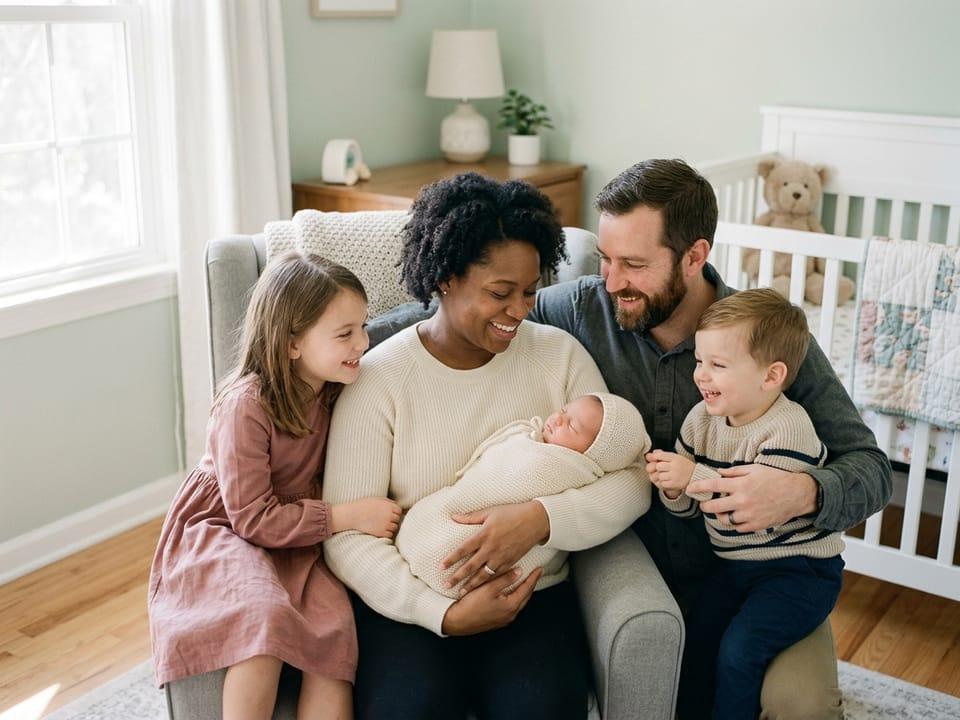
Newborn photography safety at home comes down to photographing the baby the way a newborn lies anyway: on their back on a firm, flat surface, or held securely in an adult's arms, with someone watching them the whole time. The studio images that fill social media, chin propped on hands, curled in a bowl, hanging in a cloth sling, are built with assistants, supports and often two photos merged into one. Copying them at home is where the risk is.
The froggy pose is two photos merged into one
In the froggy pose, a baby appears to rest their chin on their folded hands with the knees tucked underneath. A newborn can't hold that. Their neck can't carry the weight of the head, so in that position the head is balanced on two tiny wrists, and if anything shifts it drops. Professionals make the image as a composite. One newborn photographer, writing in Click Magazine, says the pose "should always be done as a composite for safety": an assistant supports the baby's head for one frame and holds the wrists for another, and the two are merged in editing so neither hand shows.
Read any newborn picture the same way. If a baby seems to be holding a position a newborn physically can't, sitting upright in a sack, perched on a shelf, peering over the edge of a crate, assume there's a hand, a support or a second photo you can't see. Suspended shots, with a baby in a fabric hammock hung from a branch or a pole, put a newborn's whole weight on cloth and knots above the ground, and there's no home version of that worth trying. Glass bowls are out too. If a basket or crate is part of the picture, it sits on the floor, steadied so it can't tip, with an adult's hand within reach the entire time.
Support the head and keep the airway clear
Newborns have very little head control, so every lift and every handover goes with one hand under the head and neck. When you settle a baby for a picture, look at the chin. A chin pressed down into the chest can narrow the airway, so the head should sit in line with the body, and the nose and mouth should be clear of fabric, a parent's chest or a toy.
Parent-and-baby shots are safest taken low and seated, on a bed or the floor rather than standing, with the baby's face where the adult can see it. The person holding the baby should be wide awake, not the parent who just did the 3 a.m. feed and is fading on the sofa; the NHS warns against falling asleep with a baby on a sofa or in an armchair. Older siblings hold the baby sitting down, with an adult's hands right beside theirs, and Newborn Family Photos at Home covers how to arrange those shots.
Then there's height. A baby put down "just for a second" on the edge of a bed, a table or a sofa arm can wriggle further than you'd expect, so lay them on the floor or in the middle of a bed and keep a hand or your body beside them.
Warm enough for photos is not the same as safe for sleep
Studios that pose newborns keep the room warm, because the baby often has little on. The Click Magazine photographer keeps hers at around 80°F (about 27°C), with a heater that shuts off by itself if it's knocked over. That's a working temperature for a short posing session with a trained photographer in the room, not something to recreate in a nursery.
At home it's simpler to keep the baby dressed or wrapped and skip bare-skin shots, or keep them brief. Check warmth the way health services describe: the NHS says to feel the chest or the back of the neck, because hands and feet are normally cooler, and to take off a layer if the skin is hot or sweaty. For sleep, it suggests a room of about 16 to 20°C (roughly 61 to 68°F). Plunket in New Zealand puts it as warm but not too hot, comfortable for a lightly clothed adult, and recommends an electric heater with a thermostat rather than a fan or gas heater. The American Academy of Pediatrics advises no hat indoors once you're home from the hospital, and dressing a baby in about one layer more than an adult would wear.
Seasons don't line up, either: a July baby in Auckland arrives in midwinter and a July baby in Toronto in midsummer. Whatever the month, keep any heater well back from the baby, never aimed at them, and turn it down when the photos are over.
Props: nothing small, nothing tied on, nothing that tips
The American Academy of Pediatrics' choking advice applies directly to photo props. It says to avoid toys with small or detachable parts, or anything that can be squeezed entirely into a child's mouth, and to keep coins, small balls, button batteries and balloons away from young children. Newborn props break those rules more often than you'd think: beads and silk flowers glued to headbands, buttons on knitted rompers, pom-poms, tiny plush animals. Take off anything that can come off, and stay within reach whenever a prop is near the baby's face.
Leave out anything tied around the neck, whether ribbon, string or necklace, and loosen any headband that leaves a mark. Plunket's list of things that don't belong in a baby's bed includes "toys, teething necklaces, or anything they could suffocate or choke on", and the same thinking works for the photo set. A wrap should hold the body without ever covering the face. If you're choosing what to buy, Newborn Photo Props and Outfits on a Budget goes through it.
When the photos end, the sleep space goes back to plain
The styled crib is the easy trap. A cot or bassinet dressed for the camera with a quilt, a pillow, bumpers and soft toys is exactly what safe sleep guidance says to remove, so strip it back before the baby sleeps there. The AAP's advice is to place babies on their back for every sleep, on a firm, flat surface, with soft objects and loose bedding kept out of the sleep area. If the baby drops off in a car seat, swing or carrier during the shoot, move them onto a flat sleep surface on their back as soon as you can; the AAP says any surface inclined more than 10 degrees isn't safe for sleep.
The NHS adds the feet-to-foot position, with the baby's feet at the bottom of the cot or Moses basket. In New Zealand, Plunket's guidance includes the wahakura, a bassinet woven from flax, and the plastic Pēpi-Pod as ways to give a baby their own safe space close to the parents. Your own country's health service publishes its safe sleep advice too, and it's worth reading before the first night home. A posing beanbag, a basket, a nursing pillow or a parent's lap on the sofa isn't a sleep place, however soundly the baby slept there during the photos.
Two adults: one holds the phone, one watches the baby
The simplest safety rule needs no equipment: two adults, with one doing nothing but watching the baby. The person with the phone can concentrate on light and focus (settings are in DIY Newborn Photos With Your Phone), and the spotter can end the session the moment the baby is cold, hungry or unsettled. If the picture you have in mind needs a pose a newborn can't hold on their own, that's the shot to pay a professional for, and Affordable Newborn Photography at Home explains how to budget for it.
References