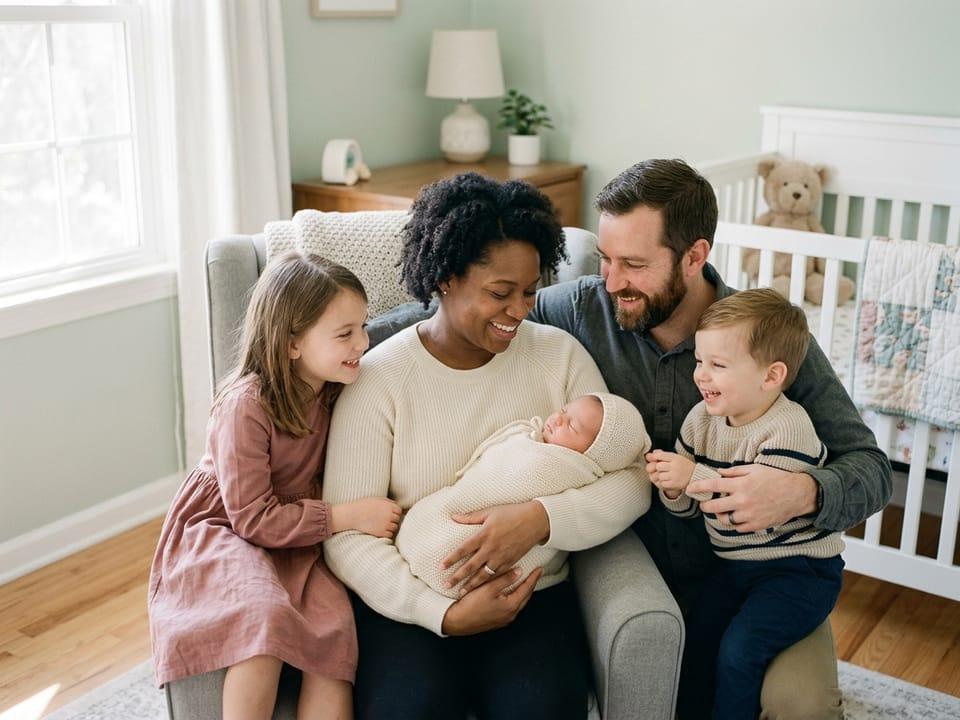
Good newborn family photos at home come from three arrangements: a parent holding the baby, the baby lying down with the family gathered around, and an older sibling holding the baby with an adult's hand close by. All three work on a floor, a bed or a sofa with window light and a phone on a tripod. The difference between a lovely picture and a risky one is mostly about height, support and who is watching the baby, so that is where to start.
Settle the line-up before anyone picks up the baby
Decide in advance which combinations you want, because a newborn's patience runs out long before a family's ideas do. Put the shots that matter most first: both parents with the baby, then each sibling, then grandparents if they're visiting. Everyone who will hold the baby washes their hands, and Nemours KidsHealth's guide for first-time parents adds that anyone handling a newborn should be up to date on their vaccines and should help only if they feel well. A visitor with a cold can still stand in the group shot without holding the baby.
Dress for the pose, not just the color scheme. Soft, plain tops in similar tones keep attention on the baby's face. Leave off scratchy knits, chunky buttons and necklaces that sit exactly where a small cheek will rest. A parent in a tank top or with a bare chest, holding the baby skin to skin, photographs warmly and keeps the baby close.
If you want every member of a big family in every frame, or you have two or three small children and want an extra pair of experienced hands, a photographer who does in-home newborn sessions takes most of the juggling off you. Prices, in dollars, pounds or euros depending on where you live, vary by region, time of year and package, so ask each one the same questions: how long they stay, how many family groupings they'll do, how many edited images you get, and whether there's a travel charge.
Parents: hold the baby low, close and sitting down
The most dependable newborn photo with parents is also the plainest. A parent sits, the baby cradled in their arms or upright against their chest, both faces turned toward the window. Support the baby's head and neck the whole time; KidsHealth's guide says so plainly, and it applies to every change of pose, not only the first lift. From there, small changes make very different pictures. One parent looks down at the baby while the other rests a hand on the baby's back. Both parents bring their foreheads close to the baby's, eyes closed. A close-up of a tiny hand on a wedding ring, or on a forearm three times its width.
Sit on the floor, the bed or the sofa rather than standing, so that if the baby startles they're only inches from something soft. The sofa needs one warning. These are exhausting weeks, and holding a sleeping baby in a warm room is exactly how tired parents nod off. The American Academy of Pediatrics says the risk of sleep-related infant death is up to 67 times higher when a baby sleeps with someone on a couch, armchair or cushion. Keep sofa sessions short, make sure the other adult is awake and in the room, and once the baby falls asleep, move them back to their own flat sleep space.
Lying the baby down: on the floor, never at the edge of the bed
For the shot with everyone around the baby, spread a blanket on the floor in window light, lay the baby on their back in the middle, and have the family lie or kneel in a circle, heads pointing in. The overhead view is the classic one, but the phone shouldn't hang directly above the baby's face. Shoot from a step stool at the baby's feet, angled down, with a wrist strap on the phone.
A bed looks softer, and it's further to fall. The New York State Department of Health's advice on preventing falls is never to leave an infant alone on a high surface such as a changing table or bed, and to keep a hand on them while they're there. If you do use the bed, put the baby in the middle with an adult lying on each side, and keep one adult's hand on the baby the entire time.
Leave out the setups you may have seen in professional portfolios, such as a baby propped upright on a parent's palms or balanced on a sibling's lap with nobody touching them. Images like these are often composites, built from two frames in which a helper held the baby and then edited out. Newborn photo safety at home explains which poses those are and why.
Older siblings: seated, supported, and allowed to say no
The toddler holding the newborn is the photo many parents picture first, and the easiest to get wrong. Sit the older child on the floor with their back against the sofa, or on the bed against the headboard, with a cushion under the arm that will take the baby's head. An adult lays the baby across the child's lap and stays kneeling right beside them with a hand under the baby's head, either just out of shot or in it. A parent's hand in the corner of the frame looks natural. Don't plan to edit it out, and never take the hand away to get a cleaner picture. Two-year-olds get bored, sneeze and stand up without warning, so treat it as a thirty-second job and have the camera ready before the baby is handed over. An older child may manage a cradle hold sitting down, but the adult still kneels beside them.
Plenty of sibling photos need no holding at all. The big sister lying on the floor blanket nose to nose with the baby. A big hand next to a small one. The older child kissing the top of the baby's head while a parent holds the baby. If the sibling doesn't want to join in, let it go. A cross big brother looks cross in the photo, the first weeks are a lot to take in, and you can try again in a few days.
Getting the person with the camera into the picture
Usually one person takes the photos and quietly vanishes from them. A phone on a tripod fixes that. Set it between the chest and eye height of whoever is in the middle of the group, and use a Bluetooth remote, or the self-timer, which on some phones takes a short burst. Whole-family photos with a tripod and self-timer goes through the height, distance and setup. With a newborn the remote matters more than usual, because the person holding the baby should never be the one dashing back from the tripod. Seat everyone, hand the baby over, then press the button.
Visitors change the plan as well. A newborn passed from lap to lap in a warm living room full of relatives can get too hot, and in a New Zealand December that room may be warm before anyone arrives. The AAP's rule of thumb is one more layer than you'd wear yourself, and no more, and photo outfits count. Do the group shot early in the visit, while the baby is fed and settled and the adults are still fresh. And if someone important can't be there, like a grandparent overseas, pokesta can use AI to create a newborn family photo with everyone together from each person's own phone pictures ($1 per photo, the first one free).
Stop while the baby is still content
Three good line-ups beat ten tired ones. When the baby starts rooting, fussing or going red in the face, the session is over, even if the grandparents haven't had their turn. Feed, settle, and try again tomorrow; newborns change fast, but not that fast. For the everyday moments in between, such as feeds and bath time, see lifestyle newborn photos at home.
References