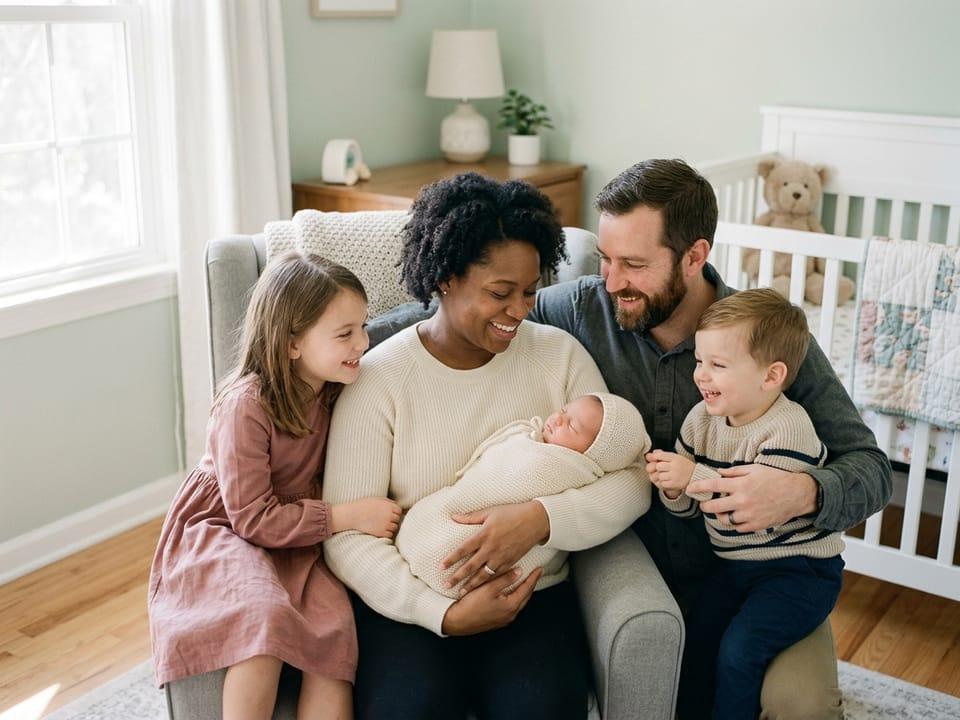
Cheap newborn photo props start with the two things actually worth buying: a stretchy knit wrap and a plain swaddle blanket you'll use every day anyway. Nearly everything else can be borrowed or found at home. A few popular props, namely tiny glued-on trims, tight headbands and the baby-in-a-bowl look, are worth skipping whatever the budget, because they add risk rather than anything the photo needs.
Buy one stretchy wrap and one plain swaddle
A stretchy wrap is a long length of soft knit fabric that holds a sleeping baby snugly and gives the smooth, cocooned look you see in newborn portraits. One or two in quiet colors (cream, grey, a muted green or rose) cover most shots and sit well against almost any blanket. A plain cotton or muslin swaddle earns its place twice: it's a photo layer this week and a burp cloth or tummy-time mat for months after. Of everything sold as a newborn prop, these are the two you'll keep using.
When you shop, pull the fabric. It should have real stretch in both directions, be long enough to wrap from shoulders to feet with some left over, and have soft edges with no fringe, loose threads or appliqués. Prices vary a lot between shops and countries, so compare softness and stretch rather than brand names.
Wrapping for a photo is still swaddling, so the same rules apply. The American Academy of Pediatrics' parenting site, HealthyChildren.org, calls for hip-healthy swaddling that lets the legs bend up and out, room for at least two or three fingers between the chest and the wrap, and no weighted swaddles or blankets at all. Swaddling can make a baby overheat; watch for sweating, damp hair or flushed cheeks. And once a baby shows any sign of trying to roll, it's time to stop swaddling.
Borrow, or raid the linen cupboard, for the rest
Most of what you see in newborn portraits has a free version. A parent's chunky knit sweater (a jumper, in the UK and Ireland) laid flat gives instant texture. A hat knitted by a grandparent beats a bought one, because it comes with a story. Wedding rings look lovely beside a baby's hand when they stay on the parent's finger instead of being balanced on the baby. A name spelled out in wooden letters, or written on a card, can sit beside the blanket rather than on it.
Friends with older babies tend to have outgrown newborn outfits, wraps and swaddles, and local parent groups often pass them on. Secondhand is fine as long as everything goes through the wash before it touches the baby. That's also what Professional Photographers of America tells newborn photographers to do with their own props, blankets and clothing.
Choose outfits after the birth, by weight and fabric
Newborn sizing is less consistent than it looks. Some labels go by age and some by weight, and the same label can fit differently from one brand to the next. Names differ too: a one-piece that North American shops call a sleeper is a sleepsuit or babygrow in the UK and Ireland. Since the baby's size is unknown until they arrive, the cheapest strategy is to buy any photo outfit afterwards, or buy two sizes and keep the receipt.
Fabric next to the skin should be soft cotton or cotton knit. Keep lace, sequins and stiff trims away from the face and hands. Choose outfits that open down the front or fasten with snaps (poppers) so nothing has to be pulled over a sleeping newborn's head. Skip drawstrings and ribbon ties around the neck. The NHS gives the same reasoning for dummies: don't tie or clip one to a baby's clothes, because the tie or ribbon could strangle them, and don't leave any cord lying around.
Think about season as well. A baby born in June in New Zealand arrives in winter, when a knit romper and a warm room make more sense than a bare-skin shot. In a summer in North America, Britain or Ireland, a single cotton layer may be all you want. For the room itself, see our guide to a newborn photo setup at home.
Skip anything small, tight, or that holds the baby up
Small trims are the first thing to drop. Pearl buttons, beads, little fabric flowers glued onto headbands and loose sequins can come off in a hand and end up in a mouth. The NHS lists buttons among the small objects to keep out of a baby's reach, and a prop is no exception.
Headbands are the next. An elastic that leaves a red line on the skin is too tight, and even a loose one can slide down over the eyes or nose. Put it on for the photo, then take it off straight away. Hats are for a quick shot too: the AAP's safe sleep guidance says not to put a hat on a baby indoors once you're home from the hospital, so a knitted hat comes off before the nap.
Then there are containers, the baskets, bowls, crates and buckets of studio portraits. A finished studio image doesn't show how it was made. A newborn photographer interviewed by the US news station WCPO described composites in which an assistant holds the baby for each frame, and said she checks props for hazards such as splinters and lead paint; a neonatologist in the same report warned that a baby on a basket or table has to be secure so they can't roll off. At home, put a teddy in the basket instead of the baby, or set the basket beside the baby on the floor.
Fluffy rugs and pillows are fine as a photo layer and nothing more. The AAP lists soft objects and loose bedding as a suffocation risk during sleep, so they leave with the camera. Our newborn photo safety guide covers poses and positions in more detail.
A photographer's prop cupboard can cost less than your own
If you love the fully styled look, with matching wraps, a dozen hats and a bonnet in every color, it can make more sense to book a newborn photographer whose session already includes washed, correctly sized props than to buy a set you'll use for one afternoon. What you pay depends on region, season and package, and is quoted in local currency, whether that's dollars, pounds or euros. Compare what's included (outfit changes, number of edited images, prints), and ask how props are cleaned and who supports the baby during posed shots. Our guide to affordable newborn photography at home breaks those costs down. Some families want a dressed-up group picture more than a pile of props; pokesta can make one with AI, in event outfits and settings, from each family member's own phone photos ($1 per photo, the first one free).
Wait for the baby before you shop
Before the birth, buy one wrap and one plain swaddle. Afterwards, once you know the baby's size and the weather, add an outfit if you still want one. Everything else can be borrowed, made at home or left out, and the photos will still show what you'll want to remember: how small they were.
References