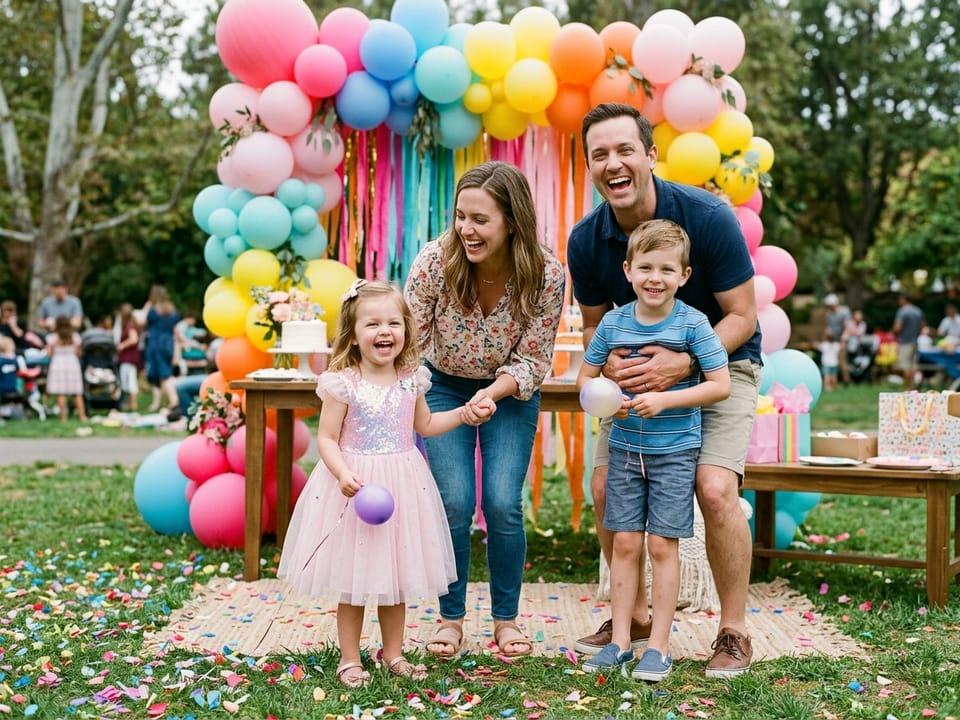
An outdoor first birthday photoshoot goes best in the low light before sunset or in open shade, on a big blanket over ground you've checked, in a park whose rules you've read. Sun, insects and damp grass matter more for a one-year-old than for anyone else in the picture, because they're the one sitting on the ground with their hands going into their mouth. The season decides the rest, and in New Zealand it runs the opposite way from North America, Britain and Ireland.
Golden hour flatters the child and spares their skin
Golden hour is the stretch shortly after sunrise and before sunset when the sun sits low in the sky. Light from the side instead of overhead takes away the hard shadows under the eyes and the squint. There's a health argument too. The American Academy of Pediatrics advises limiting sun exposure between 10 a.m. and 4 p.m., when UV rays are strongest, and on a summer evening the soft light arrives well after that.
The catch with golden hour baby photos is that it collides with dinner and bed. On a June evening in Britain, Ireland or much of Canada, the best light can arrive after your child's bedtime. The morning version works just as well, with dew on the grass. Closer to the equator, as in the Philippines, the sun drops more steeply and the warm light is over faster, so be set up before it starts.
If midday is the only time you have, look for open shade: the shadow of a building or a large tree with open sky in front of it. The light there is even, and the AAP's sun advice for babies points to the same places: shade under a tree, an umbrella or the stroller canopy. Avoid dappled light through leaves, which scatters bright blotches across a face. For a child who won't stay put in the shade, a hat with a brim all the way round does the same job (the AAP suggests a three-inch brim) and looks far better in photos than a squint.
A big blanket, and a careful look at the ground under it
Outdoors, a one-year-old is a floor-level subject, so the ground is part of every picture and part of the risk. Bring a blanket bigger than seems necessary, ideally a picnic rug with a waterproof backing in case the grass is damp. Plain colours keep the eye on the child. The edge of the blanket also gives a crawler a boundary, and the moment they reach for the grass beyond it often makes the best frame of the day.
Before you put it down, walk the patch. Pick up anything small enough to end up in a mouth: stones, bottle caps, acorns, cigarette ends, the remains of someone else's picnic. Look for animal droppings, and for flowering clover, which brings bees to exactly where your child will put their hands. A mown, open spot beats long grass at the edge of trees, and that matters for ticks as well. If cake is coming out, sweet frosting draws wasps, so keep it covered until the last moment and pack it away straight after.
Sunscreen, repellent and a tick check
Your child is past six months, so sunscreen can go alongside shade and a hat. The AAP recommends a broad-spectrum sunscreen with an SPF of at least 15, reapplied every two hours and after sweating or drying off with a towel. Put it on while you're setting up, so no white streak shows on a nose in the first frames.
Insect repellent needs more care at this age. The AAP's advice is to keep it off children's hands, since those hands go into mouths and eyes; to spray it onto your own hands and rub it on rather than spraying a child's face; to skip products that combine sunscreen and repellent; and not to use oil of lemon eucalyptus or PMD on children under three. With DEET, it suggests the lowest concentration that covers the time you'll be outside, then washing it off with soap and water once you're home. If there's a cake for small hands to dig into, that first rule matters twice. These are American recommendations; products and their label age limits vary by country, so follow the label and your own health service.
According to the CDC, ticks live in grassy, brushy or wooded areas. Which ticks and tick-borne diseases you'll meet depends on where you live, but the check is the same. After a shoot near long grass or trees, check under your child's arms, in and around the ears, inside the belly button, behind the knees, in and around the hair, between the legs and around the waist. The CDC adds that showering within two hours of coming indoors has been shown to reduce the risk of Lyme disease, and bath time back home is a natural moment to go over those spots again.
The season picks the location
Autumn colour arrives around October in Canada, the northern United States, Britain and Ireland, while in New Zealand autumn runs from March to May and a December or January birthday is a high-summer garden shoot. In the Philippines the bigger questions are the rainy season and the midday heat, so check the forecast on the day and have a covered spot or an indoor plan in reserve.
A winter birthday doesn't rule out outdoor photos. Five well-wrapped minutes in frost or snow can give you one lovely frame before you head in to warm up, and the rest of the session can happen at home with our first birthday photo ideas at home. For handling the child once you're out there, see how to photograph a one-year-old.
Check the park's rules before you bring props
A few phone pictures of your own child during a picnic are part of an ordinary day in the park. An organised shoot is a different matter, especially once a hired photographer, a balloon arch, a cake table or a backdrop comes along, and the rules belong to whoever runs the park. Two official examples show the range. On its commercial permits pages, The Royal Parks in London lists individual and family portraits alongside engagement and wedding shoots as photography that needs a permit; permits are issued for one hour, for up to 10 people in selected areas, need at least 10 days' notice and proof of public liability insurance, and a fee is payable once the application is approved. In New Jersey, the Morris County Park Commission says photography is encouraged in its parks, yet requires a permit for special-occasion sessions, family portraits included, at two arboretums and an outdoor education centre, and at its other parks when props or equipment are needed or a photographer has been hired. Applications there take five to seven working days.
Your city or council parks department will have its own version, and botanic gardens and private estates may set separate rules. Read the page for the specific park, and if you're hiring a photographer, ask who arranges the permit and whether its fee is in the quote. Leave playgrounds out of the plan, too: other people's children are not a backdrop.
Pay for help when the group gets big
One phone and one helper are enough for the child alone; add grandparents, cousins and a dog on uneven ground in changing light, and it gets harder. That's where a photographer who knows the local parks earns the fee: they know which corner is in shade at five o'clock, which spots need a permit, and how to arrange twelve people on a slope. What that costs depends on where you live, the season and the package; our first birthday budget guide shows how to compare what's included. If someone in the family can't make it to the park, pokesta can create a family photo in birthday clothes and an outdoor setting from each person's own phone photos using AI, at $1 per photo with the first one free.
Pack for twice as long as you plan to stay, and leave while your child is still enjoying the grass.
References