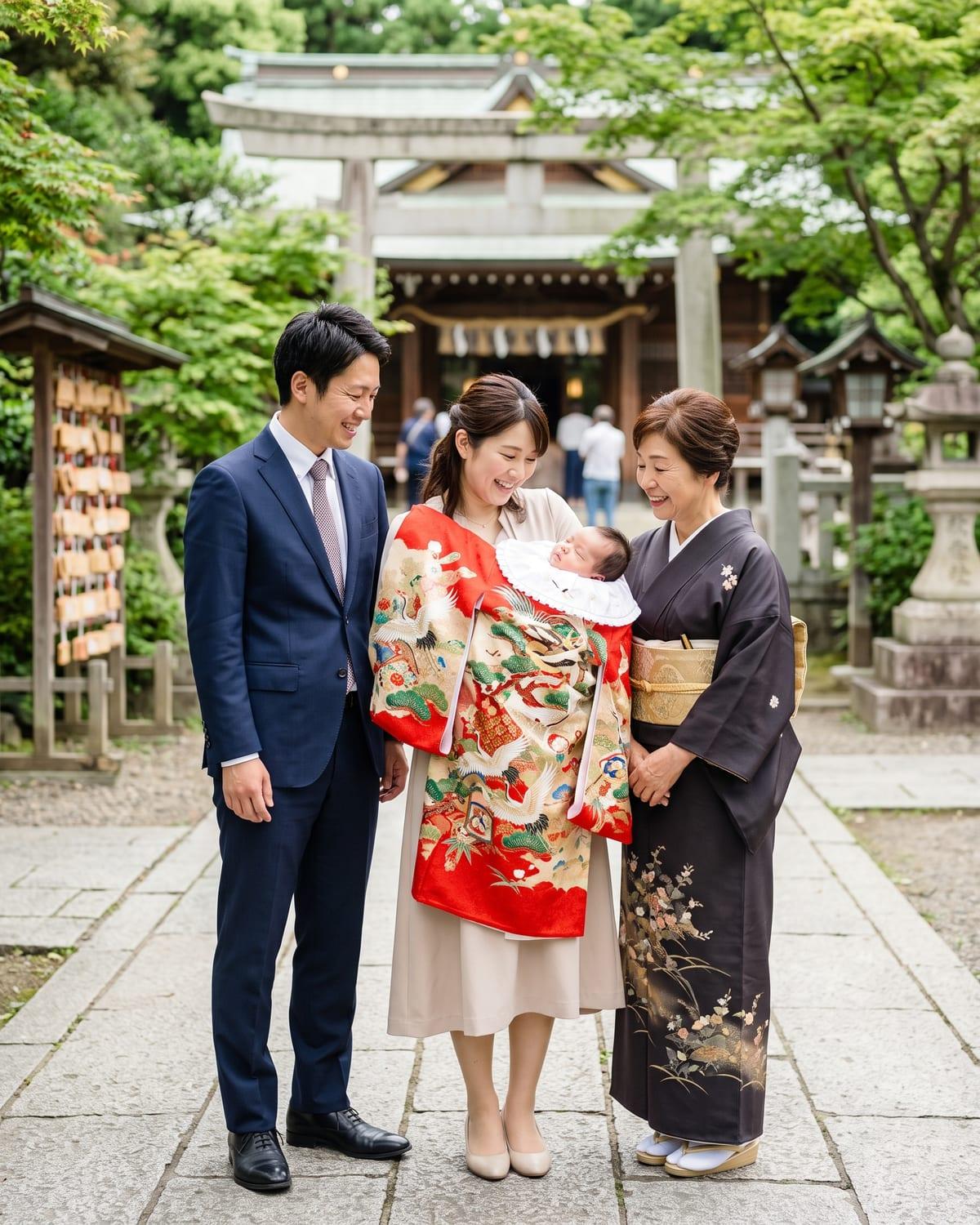
The first thing to settle for twins' Omiyamairi (a newborn's first visit to a Shinto shrine, usually about a month after birth) isn't the outfit or the shrine. It's how many adults will be there to hold the babies. One adult carrying two babies through the visit, the blessing and the photos isn't realistic. Once you know the headcount, the number of iwaigi to prepare and who takes the pictures mostly fall into place.
Start from two holders and one backup
During the blessing, each baby is in someone's arms. With twins, that means at least two people holding. Add a third adult who can take over when one baby starts crying or needs a diaper change, and the whole day feels much less tight.
Whether mom counts as one of the holders depends on how she's feeling. The postpartum period is generally said to last about six to eight weeks, and Omiyamairi falls right in the middle of it. If dad and a grandmother do the holding while mom handles feeds and keeps track of the bags, she can sit down and rest partway through without the plan falling apart. Traditions around who holds the baby, and how to raise the subject with both sides of the family, are covered in Who holds the baby at Omiyamairi?.
If the grandparents can't come and there are only two adults, bring two baby carriers and have each adult take one baby. A double stroller makes getting around easier, but the blessing takes place inside the shrine hall, so the stroller stays at the entrance. Gravel paths and steps are common, too, so check the route from the parking lot to the hall on a map beforehand.
Two iwaigi, or one passed between the babies
An iwaigi is the celebratory kimono draped over the baby, hanging by cords from the shoulders of whoever holds them. With twins there are roughly three ways to handle it: get two, drape one over each baby in turn only for photos, or skip the iwaigi and dress both babies in matching baby dresses.
Two iwaigi give you photos of both babies dressed up at the same time. With a boy and a girl, it's also fun to put two different patterns side by side. Buying doubles the cost, so some families rent both, or buy one and rent the other.
Sharing one iwaigi means retying the cords every time it moves to the other baby. Decide the photo order in advance, something like "older twin in the iwaigi, then younger twin in the iwaigi, then both side by side in baby dresses," and you won't be re-draping it over and over on the shrine grounds.
A purchased iwaigi can sometimes be remade into a kimono for a three-year-old's Shichi-Go-San (a festival for children aged three, five and seven). If you're buying two, whether you plan to use them that long can help you decide.
If you're still unsure, think about how the two babies will look next to each other in photos. One baby in an iwaigi and the other in only a baby dress tends to look uneven when you look back at the pictures later. How to drape the iwaigi and tie the cords is explained in How to drape an iwaigi.
Ask the shrine about the offering before you prepare it
To receive a blessing, you fill in a form at the shrine office with your address, names and wishes, and pay the hatsuhoryo (the offering for the blessing). With twins, shrines differ on whether this counts as one blessing or two separate ones.
Santai Shrine in Gunma Prefecture, for example, advises that for twins, or when siblings celebrating Shichi-Go-San join the Omiyamairi, the names should be written jointly on the noshi envelope (the decorated envelope used for the offering). That's one shrine's guidance, though, and others may do it differently. When you call to book or ask questions, say "they're twins" first, then ask about the amount, whether to use one envelope or two, and how to fill in the form. Ask at the same time whether the items given after the blessing are one set per baby, so you can bring a bag big enough.
Getting both babies in the same frame
For photos on the grounds, have the two holders stand side by side and line up the babies' faces at the same height. If there's a big height difference between the adults, one baby ends up lower in the frame, so the taller person lowers their arms a little or the shorter one stands on a step.
Splitting the shots into three kinds, "each baby alone," "both together" and "the whole family," cuts down on missed photos. Single shots have the advantage that you can take them even when the two babies are in different moods.
Take the side-by-side shot first. After the blessing, both babies may be worn out from being held, and when one starts crying the other often joins in. Assume the window when both are calm will be short. Get the paired shot, then the family photo, then single shots, starting with whichever baby is awake.
A common problem later is not being able to tell which baby is which. Set a rule like "the older twin is always on the left," or give them different colored iwaigi or hats, and sorting the photos becomes much easier.
Back home, laying both babies on their backs on the same futon or blanket and shooting from above makes a picture only twins can give you. When shooting straight down, loop your phone's strap around your wrist so you can't drop it on them.
Ideally, the photographer is someone other than the holders. If you're hiring a photographer to come along, first check whether the shrine allows outside photographers. Some, like Kawagoe Hachimangu, allow a photographer to accompany the family during the blessing only when they're using the shrine's own photo studio.
Pick a day when both babies are well
The Association of Shinto Shrines (Jinja Honcho) describes the 31st day after birth for boys and the 33rd for girls as typical, while saying families should pick a good day around then with the child's health and the weather in mind. With twins you're watching two babies' health, so if one has a cold, there's no need to hold to a particular date.
Build the day's schedule around feeds. Newborns are generally said to feed every two to three hours, but twins don't always get hungry at the same moment. Feeding both right before you leave, then taking turns in the nursing room once you've checked in for the blessing, makes the waiting time easier to use. Whether there's a nursing room or a place to change diapers, and whether it's big enough for both babies at once, is worth asking the shrine about or checking on a visit beforehand.
For boy-girl twins, the traditional timing guidelines are two days apart. Visiting twice is a lot to ask of the family, though, so doing it on one day is the practical choice. If you have concerns, talk to the shrine where you're booking the blessing.
Decide the headcount first, and fit the rest around it
Two holders are enough for the blessing; three make calm photos possible. The number of iwaigi and how the offering is handled can follow from that number and from what the shrine tells you. If you'd like a photo that includes family members who couldn't come, you can create an Omiyamairi photo. Other families' pictures are in the Omiyamairi posts.
References