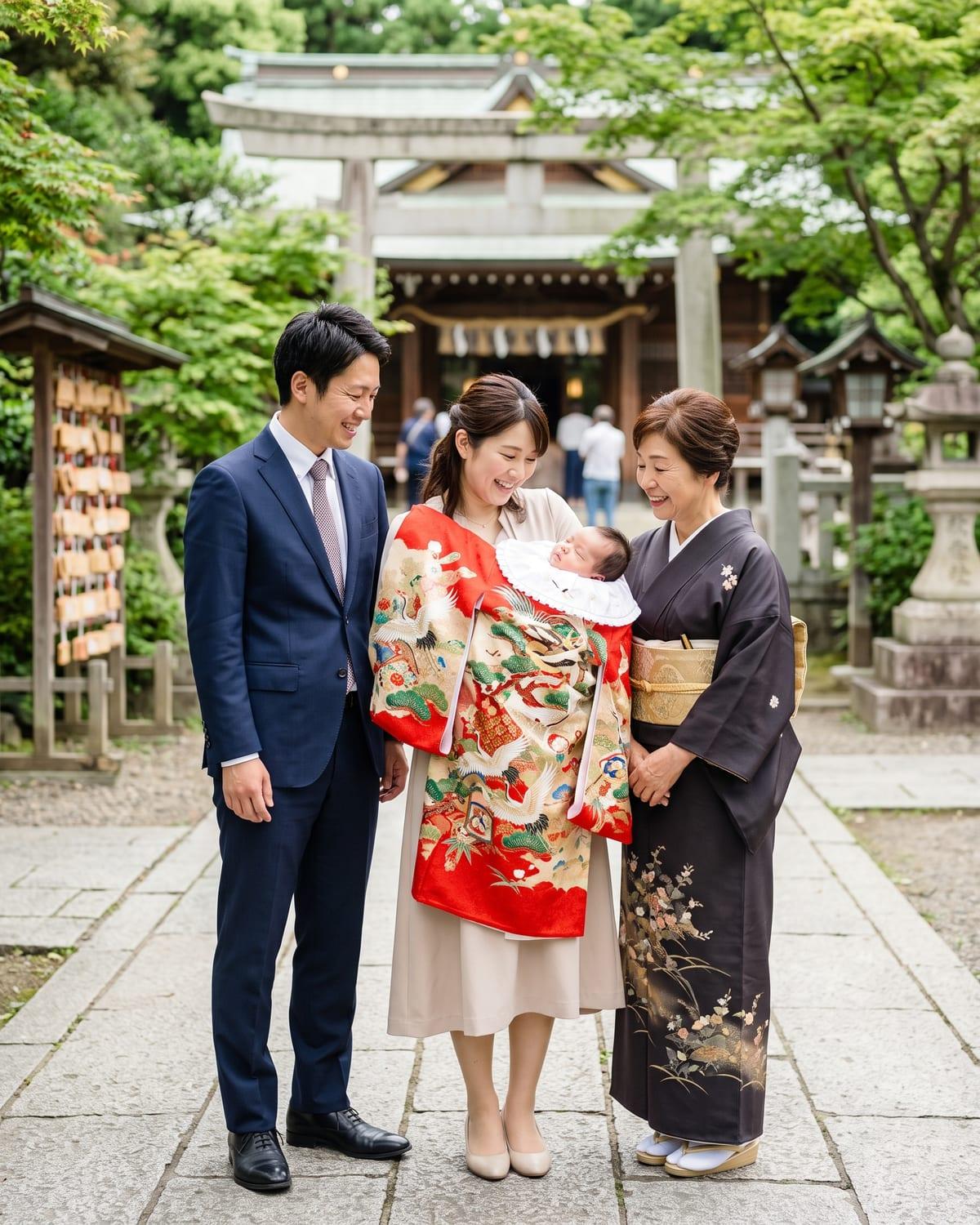
As far as we could find, there is no reliable evidence that a camera flash has ever blinded a baby. The story that spread in 2015 came out of China with no location or hospital named, and on the American Academy of Ophthalmology's website an ophthalmologist answers that there is no proven damage. No study proves flash is completely safe, either. An adult case of eye injury from a close-range flash has been reported, and camera makers warn against firing a flash near the eyes. So keep it away from your baby's face. If you're still uneasy before Omiyamairi, a newborn's first visit to a Shinto shrine at about one month, ask about the lighting when you book, and if the answer doesn't settle you, pick a natural-light studio, an on-location photographer, or a shoot at home.
We found nothing to back the "blinded by a flash" story
The story of a baby blinded by a flash took off in July 2015. China's People's Daily Online reported that a three-month-old had lost sight in one eye because of a phone's flash, and Britain's Daily Mail picked it up. When the Spanish fact-checking site Maldita.es traced it back, the reports gave no specifics: no location, no parents' names, no identified experts, no hospital. The US fact-checker Snopes also found no evidence for it.
The American Academy of Ophthalmology has an "Ask an Ophthalmologist" section that features exactly this question: do numerous camera flashes have a negative impact on a baby's eyes? Dr. Richard E. Bensinger answers that there is no proven damage to a baby's eyes from this source (the answer dates from 2012). José Manuel Benítez del Castillo, vice president of the Spanish Society of Ophthalmology, told Maldita.es that occasional photos, with the flash not fired straight at the eyes or from too close, cause no problem for babies, children or adults.
What about Japan? In October 2026, we searched the public information of groups such as the Japan Ophthalmologists Association and the Japanese Association of Pediatric Ophthalmology, and found no statement that addresses head-on whether photo flash harms babies' eyes. Not finding one is neither proof of safety nor proof of risk.
The harm on record comes from very short distances
In November 2026, we searched the medical databases PubMed and Europe PMC and found no study that directly tests whether camera flash damages babies' eyes. The closest clues are an animal experiment and an adult case.
In a 2006 rat study published in Documenta Ophthalmologica, researchers fired a commercial photographic flash 10, 100 or 1,000 times from 0.1, 1 or 3 meters. Changes in the cornea and retina appeared only under the harshest condition, 1,000 flashes at 0.1 meters, and corneal staining and the retina's electrical response returned to normal within a week. Rat results can't simply be applied to human babies, but they do suggest that distance and repetition matter.
A human case was reported in 2011 in GMS Ophthalmology Cases. A 43-year-old professional photographer took the light of his own professional flash in the eye at short range while changing his camera settings, injuring the macula, the center of the retina. Three days later, vision in his left eye was 20/70; about two months on, it had recovered enough that he had no problems at work. This wasn't blindness, and the authors call it the first reported case, but they conclude that a flash at close range can injure the eye and urge photographers to protect their subjects and themselves.
Camera makers say much the same. Fujifilm's camera notes warn against firing a flash close to people's eyes because it may cause visual impairment, and tell users to keep well back when photographing infants. If you're taking the photos yourselves, keep two habits: don't fire a flash right in front of your baby's face, and don't fire it over and over.
If your baby is being treated for an eye condition, or a doctor has told you anything about light, it's a different matter. Ask that doctor before the shoot.
A flash photo can even help spot eye problems
A page from the Japanese Association of Pediatric Ophthalmology on how children's eyes develop treats flash as a clue rather than a hazard. If one eye glows a different color from the other in a flash photo, it may be a sign of strabismus (misaligned eyes); if the same eye always glows, it could be congenital cataract or retinoblastoma, so see an eye doctor right away.
The AAO answer touches on the same point. If a child is older than about four to six months, when eye alignment is usually established, and the red-eye reflex consistently appears in only one eye, the child should see a pediatric ophthalmologist promptly. One photo isn't enough to judge, but when you look through the studio's photos, it does no harm to check that both eyes glow the same way.
Studio light comes in two kinds, so ask how it's used
Studio lighting falls into two broad types: strobes, which fire a strong burst only at the moment the shutter opens, and continuous light such as LEDs, which stays on. Studio strobes are often fired through umbrellas or softboxes from a little distance away to spread the light, which is not the same as a small phone flash going off right in front of a face. Continuous light doesn't surprise a baby with a sudden burst, but because it's always on, some babies squint at it.
Natural light is the third option. Life Studio, a Japanese studio chain, describes shooting babies and families in a warm studio filled with natural light. Even so, a studio that advertises natural light may add other lighting depending on the weather or time of day. Whatever the studio, the surest way to know how they shoot is to ask when booking.
For many babies, the real issue is probably less about their eyes than about being startled by a sudden flash or noise, then crying or squeezing their eyes shut. That affects the photos too, so feel free to raise it.
Whether you call or send an online inquiry, asking these questions takes most of the worry out of the day.
- Do you shoot with strobes, continuous light or window light?
- If strobes, how far from the baby are they, and how is the light directed?
- If the baby startles at the flash, can you change the brightness or approach?
- How do you pose a baby who can't yet hold their head up?
- Where can we feed and change the baby, and how long does the shoot take?
Studio Alice's FAQ, for example, says it has a reclining chair so a baby without head control can sit on their own, that a nursing space is available, and that you should allow about two hours for the shoot. Write down the answers so the whole family has the same information.
Studio, hired photographer or DIY: compare how much say you have over the light
A studio's strength is a tidy backdrop and controlled lighting whatever the weather. If you want the iwaigi (the celebratory kimono draped over the baby) arranged properly, or a group shot with the grandparents in even light, a studio is clearly worth it. As a price example, Life Studio's baby plan includes 85 digital photos and a slideshow for 33,000 yen on weekdays and 38,500 yen on weekends and holidays (tax included); the shoot takes 1 to 1.5 hours, and from arrival to finishing the photo review on a monitor takes about 2 to 2.5 hours. What else to check when choosing an Omiyamairi studio is covered in choosing an Omiyamairi photo studio.
An on-location photographer usually works with daylight on the shrine grounds. fotowa lets you choose photographers by style, such as soft, natural-light images. The base fee is 24,200 yen on weekdays and 29,700 yen on weekends and holidays (tax included), for about 60 minutes including setup and packing up, with 75 or more photos as files, and the date can be changed free up to the day before. The trade-off is exposure to heat, cold and weather.
If you shoot yourselves, the light is entirely your call. How to turn off your phone's flash and shoot in bright shade or by a window is explained in phone tips for Omiyamairi photos. It costs almost nothing, and you can stop whenever the baby has had enough.
These prices were checked on each official site in October 2026. They vary by season, location and plan, so confirm on the official site before booking.
If it worries you, ask first and then choose
Worrying about flash is natural for a parent. With no definitive answer either way, asking about the lighting and choosing a studio whose approach you're comfortable with is enough. If you decide to skip the studio, there's another way to get a photo. With pokesta, you can create an AI family portrait of your baby in an iwaigi with the family, from photos already on each person's phone, at $1 per photo, without leaving home. It's an image made from your photos, not a record of the shrine day. Your first photo is free, so try it with a window-lit photo of your baby.
Create an Omiyamairi family photo
References
- American Academy of Ophthalmology, "Do numerous camera flashes have a negative impact on a baby's eyes?" https://www.aao.org/eye-health/ask-ophthalmologist-q/camera-flash-baby
- Maldita.es, "No, no hay evidencias de que el 'flash' de las cámaras de fotos pueda dañar los ojos de los bebés" (in Spanish) https://maldita.es/malditaciencia/20200203/no-no-hay-evidencias-de-que-el-flash-de-las-camaras-de-fotos-pueda-danar-los-ojos-de-los-bebes/
- Inoue M, et al., "Phototoxic effects of commercial photographic flash lamp on rat eyes," Documenta Ophthalmologica, 2006 https://pubmed.ncbi.nlm.nih.gov/17016736/
- Veugelen T, et al., "Flash photography-induced maculopathy," GMS Ophthalmology Cases, 2011 https://pmc.ncbi.nlm.nih.gov/articles/PMC5015607/
- Japanese Association of Pediatric Ophthalmology, "Children's eye development and abnormal findings by age" (in Japanese) http://www.japo-web.jp/info.php?page=9
- Fujifilm, "Be sure to read these notes before use" (GFX100RF, in Japanese) https://app.fujifilm-dsc.com/ja/manual/gfx100rf/technical_notes/notes/camera_notes.html
- Studio Alice, "FAQ: About the shoot" (in Japanese) https://www.studio-alice.co.jp/faq/shoot.html
- Life Studio, "Baby photos (Omiyamairi, 100 days, half birthday, first birthday)" (in Japanese) https://www.lifestudio.jp/plan/baby
- fotowa, "On-location Omiyamairi photographers" (in Japanese) https://fotowa.com/first-shrine-visit