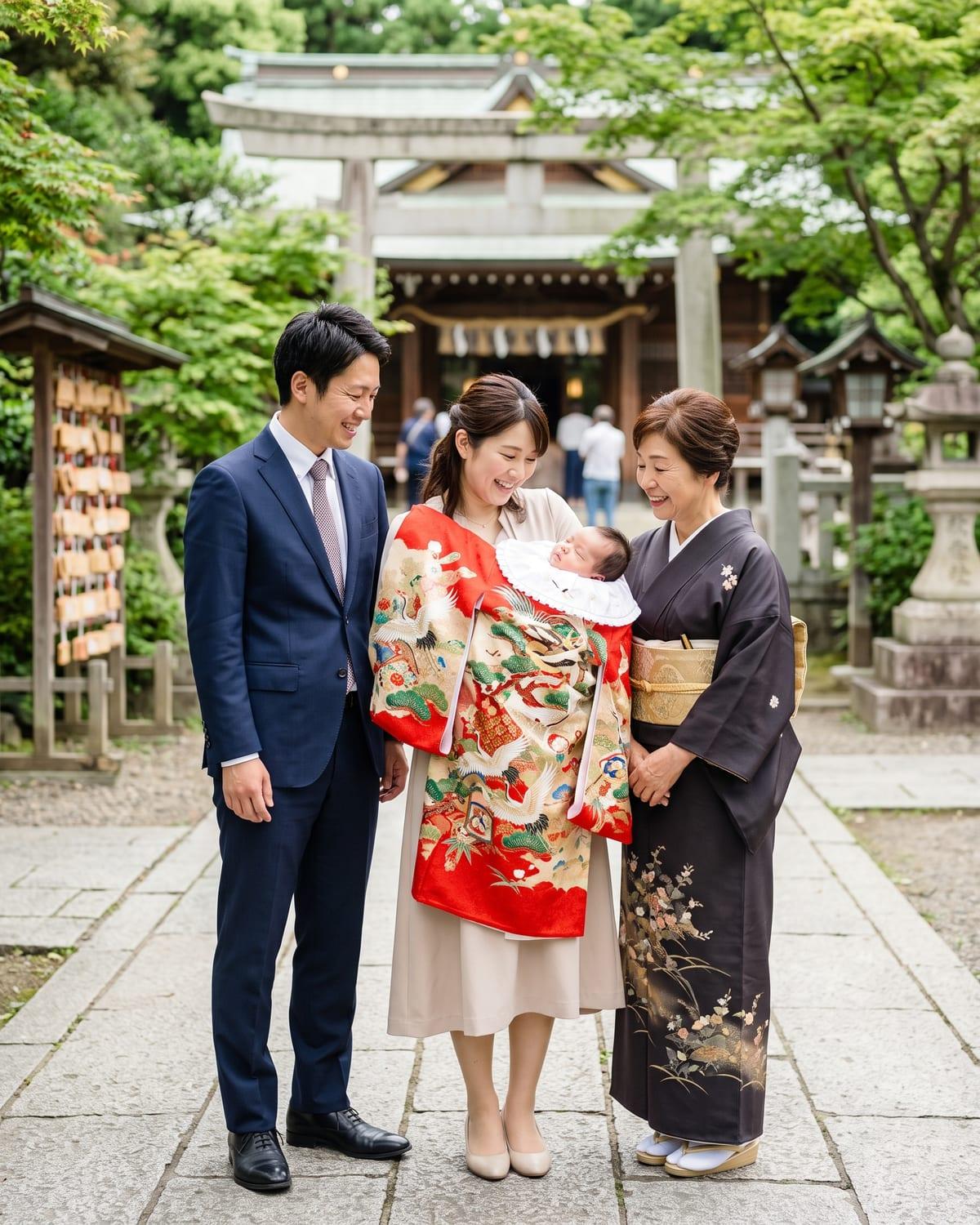
Omiyamairi (also called hatsu-miyamairi) is a newborn's first visit to a Shinto shrine, usually about a month after birth, to give thanks and ask for the child's protection. You may have heard that the baby is supposed to be held by the paternal grandmother. In the past, though, it wasn't always her; in some places a midwife or the wife of the couple's go-between carried the baby. Today it isn't a rule you have to follow at all, and the mother or the maternal grandmother can hold the baby just as well. The hard part is that picking one person may leave someone else disappointed, and the way around that is usually to have one person hold the baby for the blessing and another for the photos.
It wasn't always the mother-in-law
Omiyamairi is the occasion when a child first visits the local guardian deity (ujigami) and becomes one of the shrine's parishioners. The Nihon Daihyakka Zensho encyclopedia says the person who carried the baby, dressed in festive clothes, was "the go-between's wife, the midwife, the mother-in-law or the like." Japanese Wikipedia likewise notes that in older times a wet nurse or a female relative held the baby, with a celebratory robe draped over the top.
The mother stayed away because of the ritual impurity associated with childbirth. It was thought to weigh most heavily on the mother, then on the baby, then the husband and the rest of the family. According to the Heibonsha World Encyclopedia, a new mother's impurity was believed to last 75 days, so a visit around day 30 was sometimes only a "torii visit" that went no further than the shrine gate, and some places held the formal visit on day 75 or day 100. In western Japan, a visit on the 100th day, called momoka-mairi, was common.
The person holding the baby had jobs to do, too. In some places they would deliberately pinch the baby in front of the shrine to make it cry, so that the deity would take notice and protect the child; on the way home, they visited relatives, who tied ohineri, small twists of paper with money inside, to the cords of the baby's robe. The custom of the mother's family providing the robe is covered in Who provides the Omiyamairi iwaigi?
Today the idea of birth impurity has largely faded, and many guides from shrines and photo studios say it doesn't matter who holds the baby. In some families the mother does; in others, grandparents from both sides take turns. Some regions and families still place real importance on the paternal grandmother holding the baby, so start by finding out how both families feel about it.
Check three things first: the mother's health, who's coming, and the iwaigi
Omiyamairi usually takes place about a month after birth, when the mother's body hasn't fully recovered. Even if she plans to hold the baby, holding them for a long stretch may be hard depending on how she feels on the day. If the mother is holding the baby, decide on one person who will take over the moment it gets tiring. If she isn't, she can stay unencumbered and take care of feeds and diaper changes. Either way, assigning roles around her health keeps things from becoming too much.
Next, who can come. Grandparents from both sides won't necessarily be able to attend, and some families go with just the parents and the baby because the grandparents live far away or have health concerns. Pin down who's coming first, and the question of who holds the baby gets settled faster.
If you're using an iwaigi, the celebratory kimono, it hangs by cords from the shoulders of the person holding the baby. In other words, whoever holds the baby wears the iwaigi, and each switch means untying the cords and draping it again. If you'll be switching often, it's simpler to put the iwaigi on only for the blessing and the commemorative photos. The steps are in How to drape an iwaigi and tie the cords, and matching everyone's level of formality is covered in What to wear for Omiyamairi.
Even a one-month-old baby gets surprisingly heavy on the arms and shoulders after a while in an iwaigi. Many shrines have stone steps and gravel paths, and if the grandparents are older, footing matters too, especially if the grandmother is in a kimono and zori sandals. Use a baby carrier while walking around the grounds and have the grandparents hold the baby only in front of the main hall and for photos, and stamina becomes much less of a worry.
The blessing with one grandmother, the photos with the other
When grandparents from both sides attend, the approach least likely to cause friction is having different people hold the baby at different moments. For example, the paternal grandmother during the blessing, the maternal grandmother for photos on the grounds, and the mother for walking around and feeds. That way everyone gets a turn.
How the blessing is run varies by shrine, so time the handovers to its routine. At Meiji Jingu in Tokyo, for example, individual prayer requests need no reservation and are accepted on the day; the ceremonies are held roughly every 30 minutes from about 9:30 a.m. to 4:30 p.m., together with other worshippers. You register at least 10 minutes before the session you want and wait in the room you're shown to. While you wait, the baby can rest with the mother or in a carrier; drape the iwaigi just before you're called and hand the baby to the grandmother, and she only needs to hold the baby in the robe for the ceremony itself. The same page asks anyone with a fever or feeling unwell not to enter the hall for the ceremony.
For the commemorative photos, take a few shots with different people holding the baby in addition to the group photo, and you'll have pictures to give each family. If you're using a photo studio, telling them in advance that you'd like "some shots with grandma holding the baby and some with mom" may get it built into the schedule. How the holder should stand, and how to arrange groups of different sizes, are in Omiyamairi family photo poses.
Tell both families at the same time, as a concrete plan
The holder question tends to go wrong when plans are discussed with only one side and the other side finds out on the day. Many grandparents look forward to holding the baby, and feeling that it was decided without them is enough to cause hurt feelings.
The two of you should agree on a plan first, then tell both families at the same time. Instead of opening with whether the tradition is right or wrong, present it as a concrete plan, something like: "We'll see how I'm feeling, but the plan is for your mom to hold the baby during the blessing, and my mom for some of the photos." It's much more likely to be accepted that way. If the paternal grandmother values the tradition, asking her to take the blessing will probably help her feel good about the arrangement.
Another approach is for each parent to talk to their own parents: the father contacts his family, the mother contacts hers. It's easier to explain the situation, and say what you really think, to your own parents.
Falls on stone steps, and heat under the iwaigi
Whoever holds the baby, the things to watch for are falls and overheating. On stone steps, walk on the side with the handrail and have an adult in front of and behind the holder. An iwaigi can easily end up covering the area around the baby's face, so another adult should check every so often that the face is clear and the baby isn't getting too hot. If the holder is wearing zori, have them switch to comfortable shoes, at least while walking. And there's no need to make the baby cry the old-fashioned way: if the baby starts crying, don't insist on keeping the same holder; hand the baby to whoever can settle them best.
Start from the mother's health, and give absent family a place in the photos
Let how the mother is feeling be the starting point, give each grandparent a moment of their own, and present the arrangement to both families at the same time, as a concrete plan.
If one set of grandparents couldn't make it on the day, there won't be a photo of them holding the baby. Ways to include them on the day and send them the photos are in When grandparents can't come to Omiyamairi. You could also take a photo later at a studio, or use a service like pokesta, which generates an Omiyamairi commemorative photo with AI from photos of each family member (one free try after signing up, then $1 per photo). It isn't a substitute for the photos from the day; it's a way to put family who couldn't be there into one picture.
References
- Kotobank, "Miyamairi" (Nihon Daihyakka Zensho, Heibonsha World Encyclopedia and others; in Japanese) https://kotobank.jp/word/%E5%AE%AE%E5%8F%82%E3%82%8A-139610
- Wikipedia, "Omiyamairi" (in Japanese) https://ja.wikipedia.org/wiki/%E3%81%8A%E5%AE%AE%E5%8F%82%E3%82%8A
- Meiji Jingu, "Individual prayer requests" (in Japanese) https://www.meijijingu.or.jp/sanpai/3.php
- Kimono Rentalier, "Who attends Omiyamairi, and who holds the baby? Customs, etiquette, and inviting grandparents and siblings" (in Japanese) https://kimono-rentalier.jp/column/shrine-visit-for-birth/omiyamairi-sankasya/
- Muramatsuzan Kokuzodo, "Who holds the baby at Omiyamairi? Attendees and basic etiquette" (in Japanese) https://www.taraku.or.jp/blog/birth/shrine-visit-person-hugging/
- Precieux Studio, "Watch out for family friction at Omiyamairi: talk through who attends and who holds the baby" (in Japanese) https://www.precieux-studio.com/column/omiyamairi-trouble/
- HugKum (Shogakukan), "Omiyamairi for a baby girl: when to go, who holds the baby, grandparents' roles and dress etiquette" (in Japanese) https://hugkum.sho.jp/97159