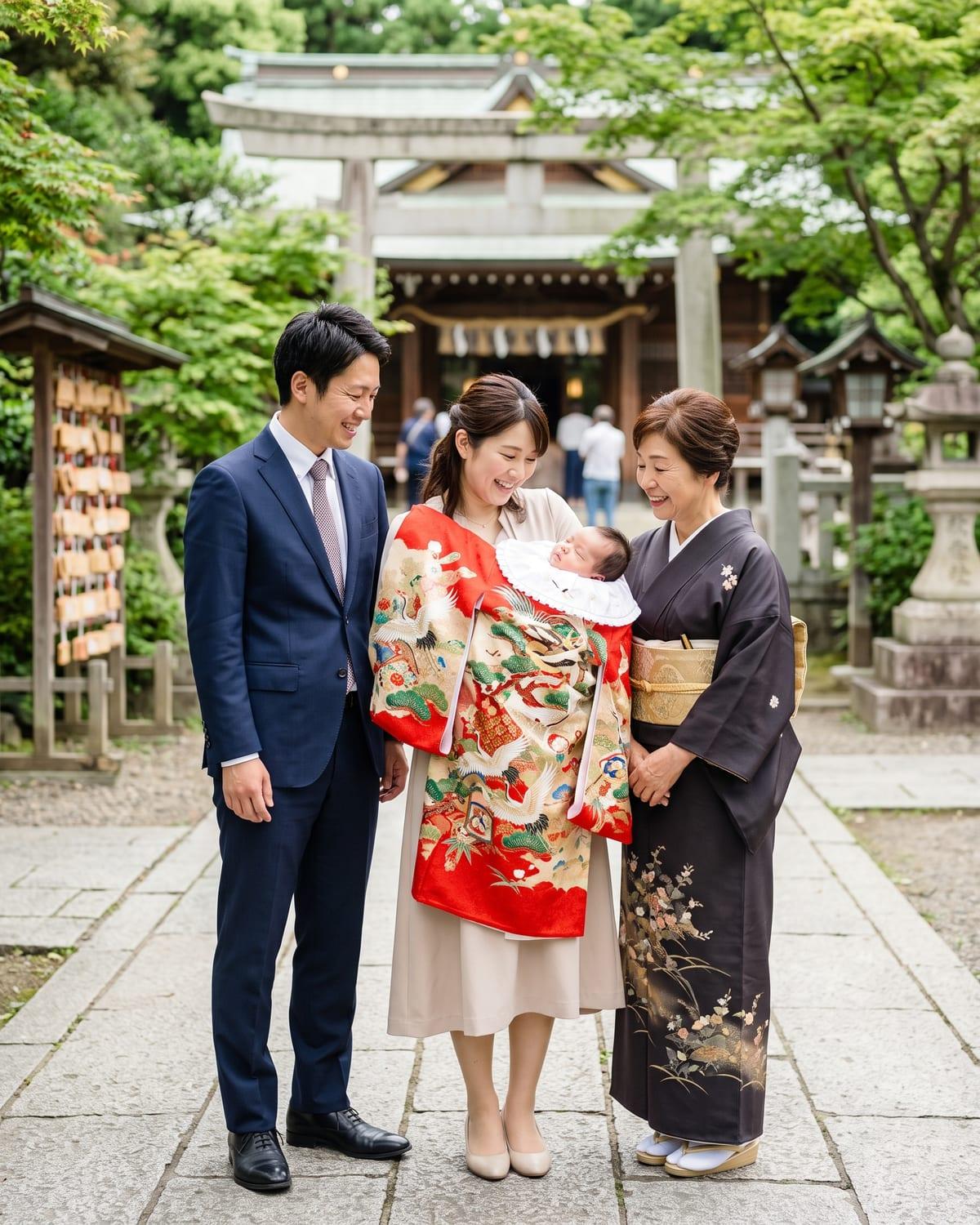
There's no rule against doing Omiyamairi, a newborn's first visit to a Shinto shrine, before the one-month checkup. But the customary days for it, day 31 for boys and day 33 for girls, fall right inside the checkup window set out in a manual from Japan's Children and Families Agency: after day 27 of life and before six weeks. Vaccinations start at two months, so a visit on the customary day comes before the first shots. The smoother order is to let the checkup confirm how baby and mother are doing, then fix the shrine date, then book the studio or photographer in a way that lets you change the date. That way, if the doctor raises something, you won't be scrambling to move bookings.
Days 31 and 33 overlap with the checkup
At Omiyamairi, the family reports the birth to the local deity and prays for the baby's health. The Association of Shinto Shrines explains that it is generally held on day 31 for boys and day 33 for girls, that this can vary by region, and that families pick the best day around those dates with the child's health and the weather in mind.
The Children and Families Agency's "One-Month Infant Health Checkup Manual" says the checkup is, as a standard, for babies past day 27 of life who have not yet reached six weeks. That works out to roughly day 28 through day 41. Days 31 and 33 sit near the front of that range, so if your checkup is in the fifth week, a shrine visit on the customary day comes first.
A column from Studio Alice, a children's photo studio chain, makes the same point: there's no rule that you absolutely must avoid Omiyamairi before the checkup, but many families go after it, once the baby's and mother's health have been checked.
The checkup looks for things that can't be seen at birth
The reason to wait lies in what the checkup does. The manual explains that this window was chosen because symptoms of conditions that are hard to diagnose right after birth, such as heart and metabolic disorders, hip development problems and hearing loss, tend to appear around this time. The visit also checks that the baby has been getting vitamin K2 syrup and covers the vaccinations that begin at two months. The manual notes that many parents worry about small things in the first month, like a stuffy-sounding nose, a slight temperature, spitting up or crying that won't stop, and that a face-to-face talk with a doctor matters.
Mothers have checkups too. The same manual asks the examining doctor to review the results of the mother's postpartum checkups at two weeks and one month. A month after giving birth, both body and mood can still be unsettled. Fixing the date after hearing "everything looks fine" makes the day itself much calmer.
When a newborn can go out depends on how they were born and on the season. The manual's general guide to fresh air starts with opening a window at around two weeks and gradually taking the baby outside, but that's general advice. Whether a shrine or studio outing is fine for your baby is for the maternity clinic or doctor to say.
If grandparents' schedules mean you really must go before the checkup, keep that day light. Do only the prayer ceremony and move the studio and the meal to another day, ask the shrine which hours have shorter waits, and check where you can feed the baby. If the baby seems unlike themselves, the doctor comes before the shrine.
Vaccines start at two months, so the shrine usually comes first
Whether the shrine can come before vaccinations is easier to sort out once you look at when they begin. Japan's Ministry of Health, Labour and Welfare lists four vaccines recommended from two months: rotavirus, the five-in-one combination vaccine, pneumococcal and hepatitis B. Days 31 and 33 fall before two months, so a visit on the customary day comes ahead of the first dose. We found no official guidance saying Omiyamairi must wait until after vaccinations.
The tricky case is a shrine visit that slips toward two months. The first rotavirus dose is given by 14 weeks and 6 days, and a first dose at 15 weeks or later isn't recommended. Don't push vaccines back for the shrine. Set the vaccination schedule first, then place the visit and photos around it. Babies can run a fever or be fussy after shots, so it helps to avoid the day of the shot and the day after. Our guide to scheduling photos around vaccinations goes through this in more detail. How long to leave between a shot and the visit is a question for the clinic giving the vaccine.
Book photos once the checkup date is set
The order is: confirm the checkup date, attend it, set the shrine date, then book the photos. Depending on the results, you might be asked to come back another day, or the mother's recovery might take longer than expected. If so, both the shrine visit and the photos move. Studio Alice's column suggests getting Omiyamairi preparations moving by around the time of the checkup. You can shortlist outfits and supplies early, and leave only the final date until after the checkup.
If you want to secure a photo slot early in a busy season, read the change rules first. The on-location photo service fotowa says you can change the date for free up to the day before the shoot. Studio Alice says there's no cancellation fee if a child falls ill on the day of the booking. If you're renting the iwaigi (the celebratory kimono draped over the baby), check the return deadline too. Studio Alice lends one free to families who book an Omiyamairi shoot, due back by noon the day after the shoot.
Moving Omiyamairi to two or three months causes no real problem. How to think about a later visit is covered in when Omiyamairi is delayed, and splitting photos from the shrine day in same day, before or after.
Studio, hired photographer or DIY: choose by how easily the date moves
A photo studio shoots indoors with controlled lighting and backdrops, so weather doesn't matter. Studio Alice charges a session fee of 5,500 yen (tax included) per family for Omiyamairi, however many poses you take, including costumes, dressing and hair styling; the total then depends on the prints and files you choose. If you want the iwaigi arranged properly by professionals, or a well-lit group portrait with the grandparents, a studio is worth it. Shooting on a different day from the shrine visit also lets you book after the checkup results.
An on-location photographer captures the shrine visit as it happens. fotowa's base fee is 24,200 yen on weekdays and 29,700 yen on weekends and holidays (tax included), for about 60 minutes including setup and packing up, with 75 or more photos as files. Studio Alice also offers on-location Omiyamairi shoots in some areas, at 38,280 yen (tax included) on weekdays, covering the session, 50 digital photos and rental of the iwaigi and accessories. Shooting outdoors means the date can move for weather as well as health.
Doing it yourselves costs almost nothing, and changing the date means telling no one. You can decide after the checkup, or on the morning itself. The trade-off is that the person taking photos isn't in them, and draping the iwaigi is up to you.
These prices were checked on each official site in October 2026. They vary by season, location and plan, so confirm on the official site before booking.
When in doubt, plan outward from the checkup date
Set the checkup date first, and the shrine and photos after it. Planned that way, there's little left to agonize over. Sometimes moving the visit past the checkup means grandparents who live far away can't come. In that case, pokesta can create an AI family portrait of everyone gathered around the baby in an iwaigi, using photos of each family member, at $1 per photo, without leaving home. It's an image made from your photos, not a record of the shrine day. Your first photo is free, so once the checkup is done and you have a moment, try it with a photo of your baby already on your phone.
Create an Omiyamairi family photo
References