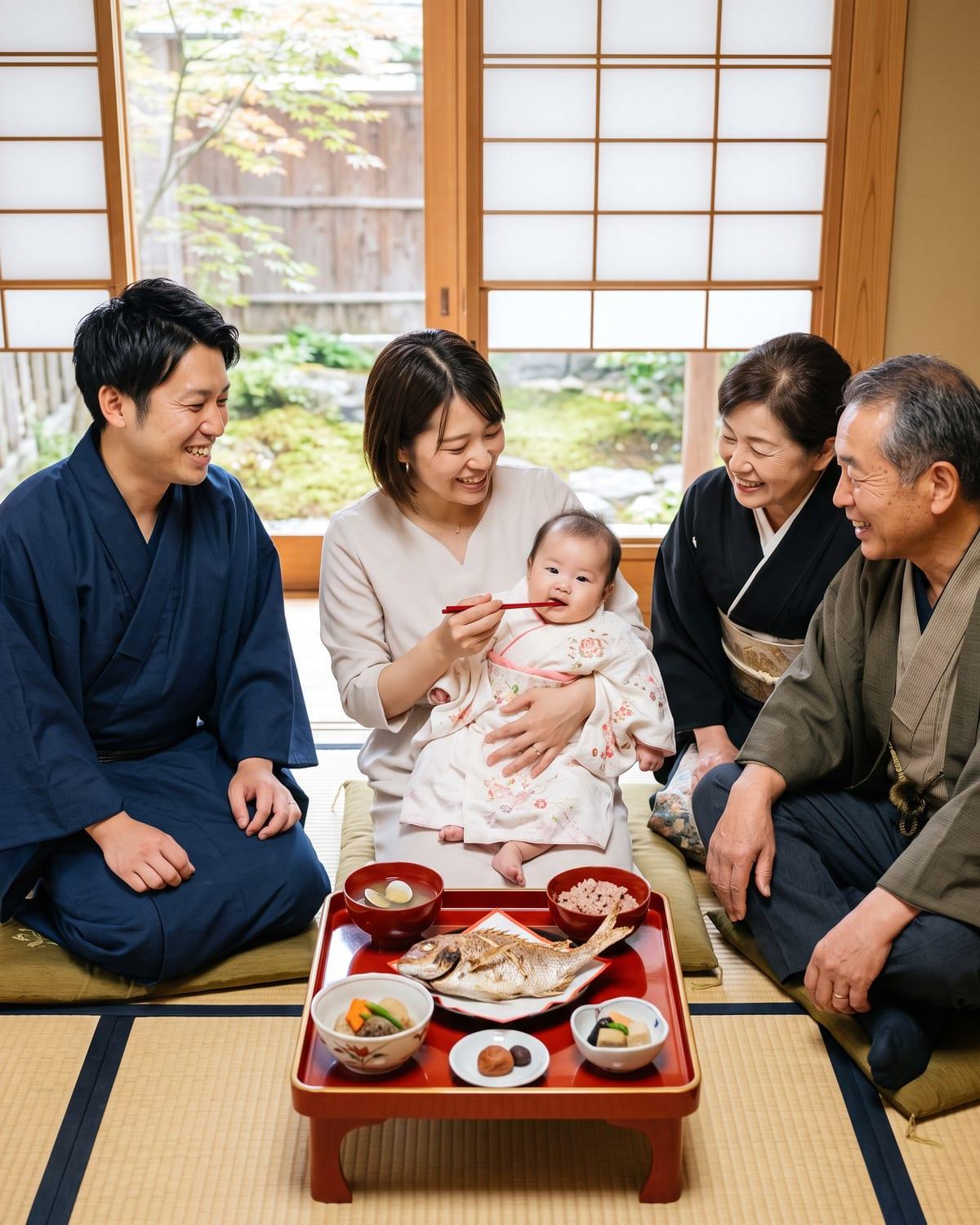
Okuizome is a Japanese ceremony held around a baby's 100th day: the family pretends to feed the baby a celebration meal, wishing that the child will never go hungry. Count the day of birth as day one; most families hold it somewhere between day 100 and day 120, at home or in a restaurant's private room, with the parents and both sets of grandparents. The tray holds one soup and three dishes: sekihan (rice with red beans), clear clam soup, a whole sea bream, a simmered dish and pickles, plus an umeboshi and a small hagatame ("teeth-strengthening") stone. On the day, take the photos while the baby is content, touch the chopsticks to the baby's lips in the order rice, soup, rice, fish, rice (three rounds), finish with the hagatame ritual, and then the adults eat.
Day 100 counts the day of birth as day one
Okuizome is held around the 100th day after birth, and many families fit it in somewhere between day 100 and day 120. The day of birth counts as day one, so day 100 is the birth date plus 99 days: a baby born on April 1 reaches day 100 on July 9, and one born on July 1 on October 8. Some regions set it at day 110 or day 120, and parts of the Kinki region (around Osaka and Kyoto) deliberately wait until about day 120 as a wish for a long life, a custom called kui-nobashi.
Your baby's health and a day the family can gather matter more than the exact date. Moving it to a nearby weekend is common, and the mother may not have fully recovered yet. Avoid days when the baby is likely to be out of sorts, such as right after vaccinations. If it slips later, one guide suggests holding it any time before solid food starts at around six months.
Other cultures mark this stage too. In the Chinese-speaking world, bǎizuì is a banquet for a baby's 100th day, already recorded in the Song-dynasty Dongjing Meng Hua Lu; today's customs are in Chinese 100-day traditions. In Taiwan, shōuxián (siu-nuā in Taiwanese) comes at four months: the mother's family gives ring-shaped crackers, strung on red thread and hung on the baby's chest so the drooling stops and the child is easy to raise (how shouxian is done). Okuizome is neither a banquet nor a drool ritual; its heart is bringing a one-soup, three-dish tray to the baby's lips, and the hagatame.
Who to invite and where to hold it
Large gatherings of relatives and friends were once the norm. Today it is more often just the parents, the baby and both sets of grandparents, though other relatives are welcome too. The person who does the pretend feeding, the yashinai-oya ("nurturing parent"), is by custom the oldest person present, so decide who will come and who will take that role together. Give grandparents an arrival time that doesn't clash with a feed, so you can begin as soon as they arrive.
Home is the most common place: you can feed the baby and let them nap freely, with no time limit, and the food can be home-cooked, delivered, catered or a frozen set by mail. Restaurants with private rooms, including traditional ryotei, also host Okuizome, handling the food and clean-up, and some guide you through the ceremony. Senbazuru at Hotel New Otani Tokyo, for example, provides a staff member to help with the ritual, a hagatame stone and a printed guide with the baby's name (weekends and holidays only, booked two days ahead, as of October 2026). Prices and private-room time limits vary; what to check before booking is in holding Okuizome at a restaurant.
By the day before: the meal, the tableware and the stone
The tray holds the one-soup, three-dish set (ichiju sansai) listed above, with the hamaguri clams in the soup and the sea bream grilled whole, plus the umeboshi (pickled plum) and the stone. The meaning of each dish and the cooking timeline are in the Okuizome menu, so the focus here is the tableware and the stone. You don't have to cook it all: buy the sea bream ready-grilled, plate a store-bought simmered dish, or have a full set delivered.
Formally, the meal is served in lacquered bowls on a footed tray: vermilion inside and out for a boy, black outside and vermilion inside for a girl. By tradition the set is newly made for the baby, customarily as a gift from the mother's family, so ask before buying; the grandparents may already be planning to. Many families now use baby tableware instead, and there is no fixed rule.
The chopsticks are iwai-bashi, plain willow celebration chopsticks tapered at both ends. One end is said to be for the baby and the other for the gods, so use only one end at the baby's lips and don't turn them around partway through.
The hagatame stone traditionally comes from the shrine where you did Omiyamairi (a newborn's first shrine visit) or from your local guardian shrine, and some shrines hand one out at the Omiyamairi. If you are allowed to pick one up from the shrine grounds, choose a rounded stone about 2 to 3 cm across and boil it before use. Afterward, wash it and return it to the shrine it came from. Shrines differ on when to bring it back, so ask when you receive it.
As for the layout, Moony (Unicharm) puts the rice at front left, the soup at front right, the simmered dish at back left and the grilled dish at back right, with the stone in the middle. HugKum adds that the whole sea bream goes head to the left and tail to the right, as seen from the baby. The day before, wash the dishes and lay them out this way once to check that everything fits on the tray. Sekihan and the simmered dish can be made ahead, which leaves only picking up (or grilling) the sea bream and warming the soup for the day itself.
On the day: photos, then the ceremony, then the meal
Set the start time around feeds and naps, working backward so the ceremony begins just after a feed. Once everyone has arrived, take the whole-family photo and a shot of the laid-out tray first; babies often cry or fall asleep after the ceremony.
The yashinai-oya holds the baby on their lap and brings the chopsticks to the baby's mouth. Traditionally this was an elder of the same sex as the baby, but it isn't a strict rule, and either parent can do it.
The feeding order varies by region and family. The sequence most often described is rice → soup → rice → grilled sea bream → rice, repeated three times; some guides add the soup once more at the end. Other families bring every dish to the lips one by one, including the simmered dish and pickles. If you're unsure, follow the grandparents' local custom, or simply touch every dish to the lips once.
Touch the chopsticks only lightly to the baby's lips. Babies around 100 days old can't eat solids, so put just a trace of food on the tips, or simply mime it, to keep rice or fish out of their mouth.
The hagatame usually comes after the feeding, though doing it first is also fine. Tap the chopstick tips on the stone, then touch them gently to the baby's gums and wish for strong teeth. The stone itself never goes into the baby's mouth, and since it is a choking hazard, keep it out of reach throughout.
The ceremony itself takes less than 10 minutes. Babies still often cry partway through, so pause, settle them with a cuddle or a feed, and carry on. Then it's the adults' turn to eat. The sea bream is shared among the adults, and any leftovers can be flaked into sea bream rice or soup.
Shoot from across the tray, slightly low
Get at least one shot with the tray and the baby's face together; it tells the story of the day when you look back. Photograph the baby on the yashinai-oya's lap from the far side of the tray at a slightly low angle, so the food is in the foreground and the baby's face behind it. Because you're shooting from the opposite side, the sea bream's head, placed on the baby's left, will point to the right of your frame. Leave it that way rather than turning it for looks; the photo then doubles as a record of the tray set out properly.
The hagatame moment is over in a flash, so record it on video. Putting one person in charge of the camera lets the yashinai-oya and the parents focus on the ceremony. If grandparents live far away, connect them by video call so they can watch, or generate a 100-day commemorative photo with AI on pokesta from photos of each family member (one free try after signing up, then $1 per photo).
Decide three things first: the date, the yashinai-oya and the start time
There isn't much that has to be settled in advance. Which day, who will do the feeding, and what time you'll begin: once those three are fixed, the ceremony works even without every dish or the formal tableware. Rather than wearing yourselves out on preparations, lean on delivery and ready-made food, and spend the day watching your baby's face.
References
- Moony (Unicharm), "How to do Okuizome (the 100-day celebration): preparation and how the day goes" (in Japanese) https://jp.moony.com/ja/tips/baby/childcare/events/bm0005.html
- HugKum (Shogakukan), "When is Okuizome held? Preparation, place, guests and how to celebrate" (in Japanese) https://hugkum.sho.jp/127344
- Hotel New Otani Tokyo, Senbazuru, "Okuizome plan" (in Japanese) https://www.newotani.co.jp/tokyo/restaurant/senbazuru/okuizome/
- Moedict, "百晬" bǎizuì (Ministry of Education Revised Mandarin Chinese Dictionary, in Chinese) https://www.moedict.tw/%E7%99%BE%E6%99%AC
- Moedict, "收瀾" siu-nuā (Ministry of Education Dictionary of Frequently-Used Taiwanese Taigi, in Chinese) https://www.moedict.tw/'%E6%94%B6%E7%80%BE