
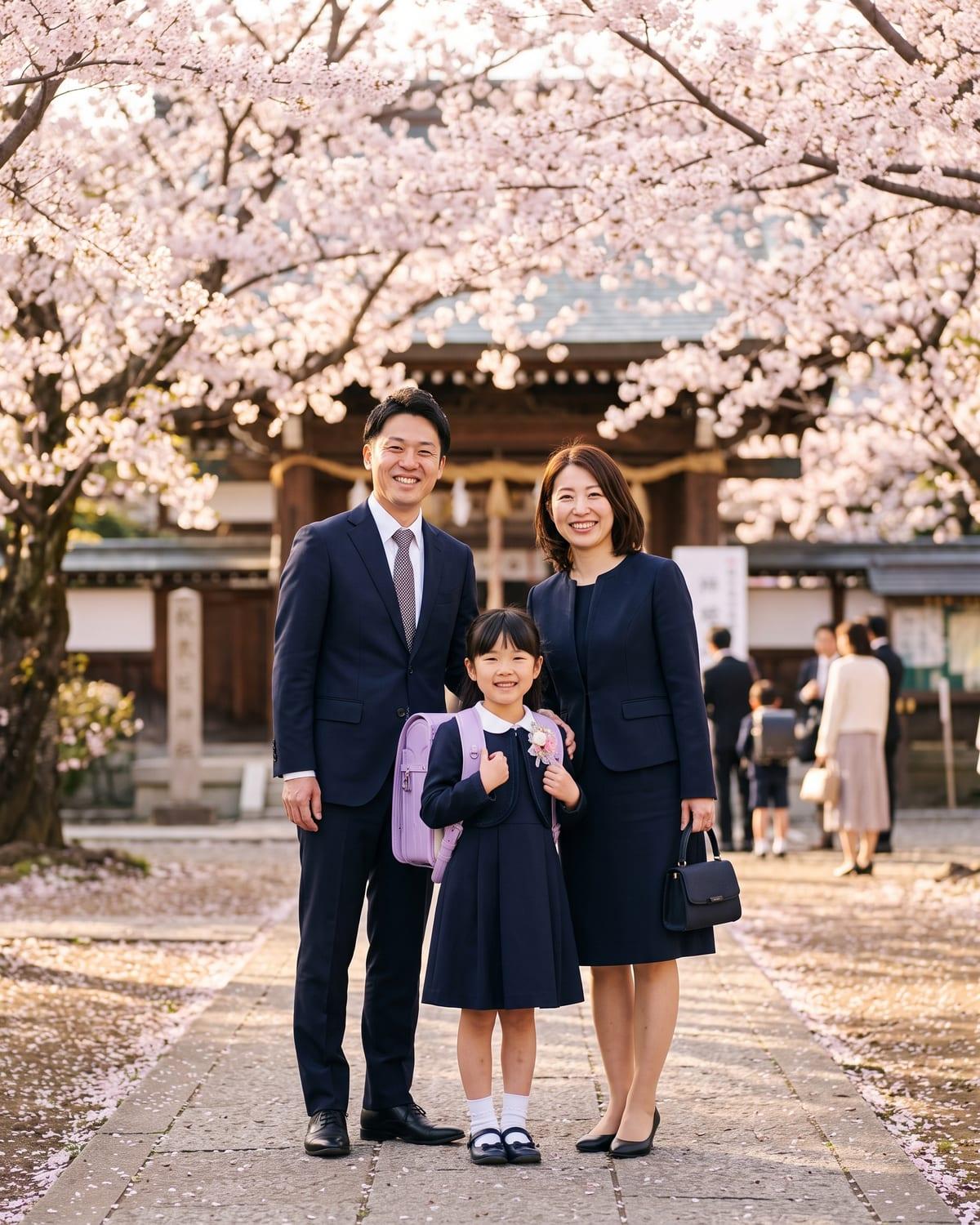
There's no rule that both parents must attend a Nyuenshiki (the entrance ceremony Japanese kindergartens and daycares hold for new children, usually in April). Whether you both can go depends on how many people the school allows and on both your jobs. For employees in Japan, it helps to know that since April 2025, leave for caring for a child can also be used for preschool entrance and graduation ceremonies. If you both attend, decide in advance who takes photos and who watches your child. That alone makes the day much less hectic.
First, check how many people the school allows
Start with the number of attendees given in the school's notice. Some schools set a limit per family because of the size of the hall, and some don't allow siblings to come. If it says "one parent or guardian," the question is settled before you start.
Check the date too. Kindergarten ceremonies are usually in early April, often between about the 5th and the 10th, and used to be on weekdays. With more dual-income families, more schools now hold them on weekends. Many daycares hold theirs on April 1. Whether it's a weekday or a weekend decides whether you need to arrange time off.
The ceremony itself starts around 9 a.m. at kindergartens and lasts an hour at most; at daycares it runs about 30 minutes to an hour. A group photo and a classroom talk from the teacher often follow, so expect everything to wrap up before noon.
Time off: annual leave, or the expanded child-care leave
To attend a weekday ceremony, you need time off. Usually that means annual paid leave, but the amendment to Japan's Child Care and Family Care Leave Act that took effect on April 1, 2025 added another option.
What was called leave for nursing a sick child was renamed and broadened. Permitted reasons now include entrance and graduation ceremonies at preschool (and entrance ceremonies at school), as well as class closures due to infectious disease. Eligible children now extend from those not yet in elementary school to the end of third grade. The allowance is five days per year for one child and ten for two or more, and it can be taken by the day or by the hour. This leave must be granted separately from annual paid leave, so you can attend the ceremony without using up your vacation days.
There are a few things to watch. One is pay: whether these days are paid or unpaid depends on your employer, so check your work rules. Another is eligibility: day laborers are excluded, and where there's a labor-management agreement, people scheduled to work two days a week or fewer may be excluded too. According to the ministry's Q&A, the events covered are entrance ceremonies (preschool or school) and graduation ceremonies; open classes and sports days don't qualify under the law, though an employer may choose to include them.
Hourly leave suits an entrance ceremony well. If it starts at 9 and finishes within an hour, you could take the morning off and go to work in the afternoon. How to apply and when hourly leave can be taken are set by your employer's rules, so talk to them as soon as you know the date.
There's also a point about counting days. The five or ten days are per "year," and how that year is divided is set by your employer's rules. Check whether an April entrance ceremony and a March graduation come out of the same year's allowance, and it's easier to plan. Hourly leave has its own rule too: the Ministry of Health, Labour and Welfare's Q&A says it is taken either continuously from the start of the working day or continuously up to its end, so think of it as a morning or afternoon off.
Also, don't spend all the days on ceremonies. The leave is really meant for caring for a sick or injured child, and for vaccinations and health checks. When a child first starts group care, they may well come down with fevers and miss days. Rather than both parents taking a day, one could use annual leave, sharing out the days based on what each of you has left.