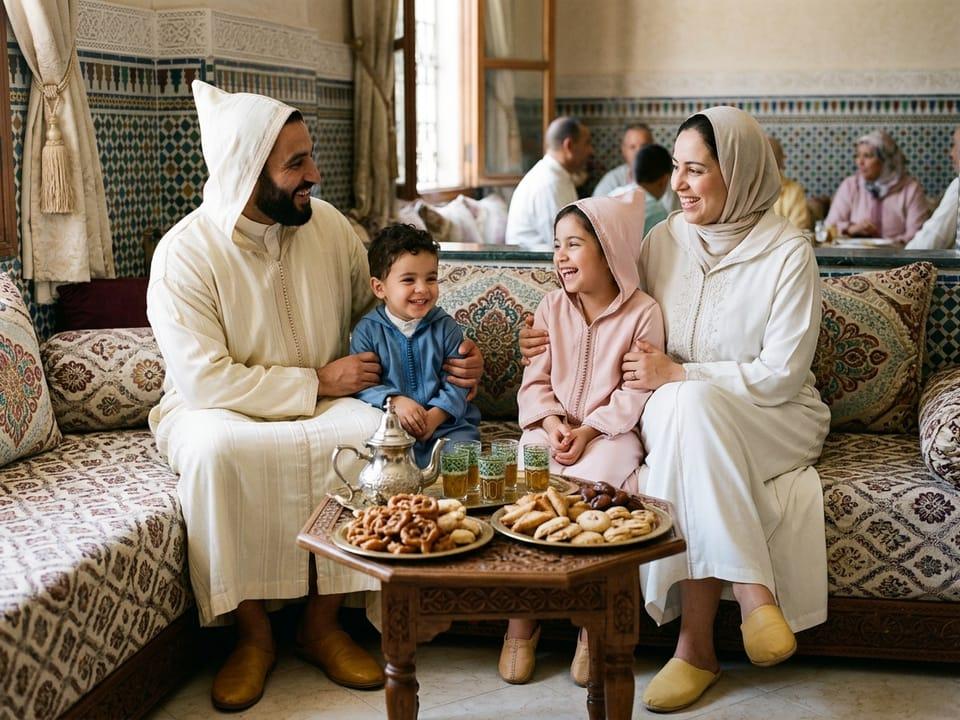
In Morocco, the Eid al-Fitr photo most likely to catch the whole family is the one you take yourself, with a phone on a tripod and the self-timer, in the short gap between coming home from Eid prayer and leaving for the first visit. A photographer or a studio is worth paying for in a few specific cases. Because the date is confirmed only the evening before, the safest professional booking is a home visit on the second day of Eid, with someone who agrees in advance to move if the moon moves the holiday.
Any booking has to survive a date set the night before
Morocco's Ministry of Habous and Islamic Affairs sends its judges and delegates across the country to look for the new crescent on the evening of the 29th of Ramadan. If they see it, Eid is the next day; if not, Ramadan runs to 30 days and Eid follows. In 2026, while Saudi Arabia and several Gulf states expected Eid on Friday 20 March, astronomers judged a Moroccan sighting on the Thursday evening nearly impossible, which put Eid on Saturday the 21st. For 2027 the expected date is around 9 or 10 March, and it becomes final only with that evening's announcement.
A photographer booked weeks ahead for "Eid morning" may therefore find the morning has moved by a day, and they have their own family to celebrate with. Eid al-Fitr is a public holiday with two days off for government offices and the private sector, and on the first morning shops close and even taxis get scarce. Don't assume a studio opens on Eid itself. Ask it directly, and keep the answer in writing.
A self-timer at home is the only option sure to catch everyone
The Eid prayer starts about twenty minutes after sunrise, in mosques and in the musalla, the open-air prayer ground. Breakfast follows, then the round of visits: younger people call on their elders first, and married couples divide the day between two families. The one moment when the whole household is home, dressed and still spotless comes right after prayer, and nobody from outside can be counted on to reach your door at that hour.
Set up the night before so the morning takes two minutes. Put the tripod at the far end of the salon facing the banquettes, at roughly the chest height of a seated adult, and use the phone's main lens rather than the ultra-wide, which stretches whoever sits at the ends. Seat the grandparents in the middle, small children on laps or on cushions in front, and standing adults at the two ends, since the banquette runs along the wall and there is no room behind it. Use the ten-second timer, in burst mode if your phone has one, or a cheap Bluetooth remote, and take three or four rounds. Let window light fall from the side; with the window behind the family, faces go dark.
Studio, photographer or self-timer: how they compare
|
Studio |
Photographer at home |
Self-timer at home |
| What you pay for |
Session, prints or files |
Their time, editing, travel |
Only a tripod |
| If Eid moves a day |
Depends on opening days |
Only if agreed beforehand |
No problem |
| Whole family present |
Hard, everyone must travel |
Yes, if timed around visits |
Yes |
| Tired or unwell child |
Travel and waiting add strain |
Child stays home |
Stop and retry anytime |
| Look |
Backdrop, controlled light |
Natural light, candid shots |
Natural, depends on your setup |
| Best for |
Formal portrait after the holiday |
Big multi-generation gatherings |
Most households |
We couldn't find published family-session rates from Moroccan photographers that we could verify as of October 2026, and fees vary by photographer, city and season. Compare quotes on the same terms: how long they stay, how many edited images you get and when, whether travel is extra, and what happens if Eid shifts.
A professional earns the fee in three situations. One is a big gathering, fifteen or twenty relatives at the grandparents' house, which a phone in a salon can't fit or light well. Another is when you want both parents in every picture, not only in the timer rounds. The third is unposed photos of the day, the tea being poured as guests arrive, that nobody in the family has free hands to take. A studio suits a formal portrait against a backdrop, but book it for the days after the holiday rather than Eid morning.
If you hire someone, book an hour on the second day
By the second day the date is no longer in doubt, the rush of prayer and first visits is over, and everyone is still off work. Ask for a one-hour visit timed for when most relatives will be in one house, and say how many people to expect so they bring suitable lenses and lights. Agree on the number of edited photos and a delivery date, and settle the fallback: if Eid lands a day later than expected, does the slot shift with it at no charge? Before anything goes online, check with everyone in the pictures, since some women in the family may prefer their faces not be shared.
For outfits and colors that photograph well, see What to Wear for Eid in Morocco. For the first morning's schedule, see When to Take the Eid Family Photo in Morocco.
Take the real photo yourself, and fill the gaps another way
The rule of thumb: take the full-family photo yourself on the first morning, and pay a professional only for the gathering a tripod can't handle. Even a perfect timer shot leaves out whoever is working abroad or couldn't travel. pokesta can put together an Eid family portrait in djellabas and kaftans from phone photos you already have, at $1 per photo with the first one free. It is a generated image, not a record of that morning, so keep it next to the real photo rather than in its place. Try it with a recent photo of your child before you book or pay anyone.
References