
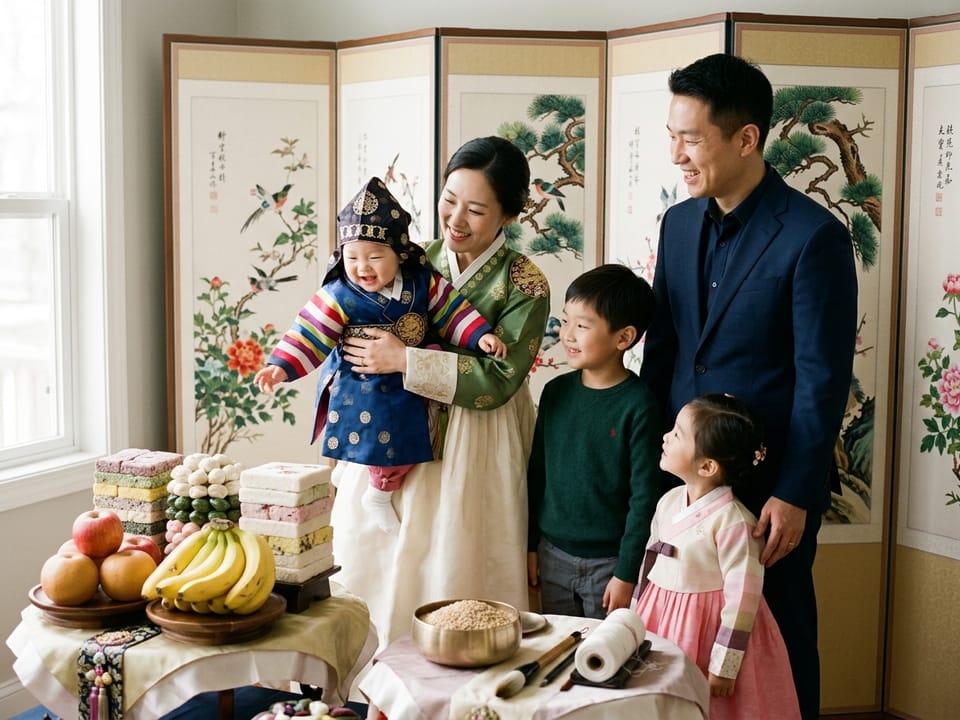
If your baby has a fever or a contagious illness in the days before the doljanchi, the Korean first-birthday party, plan on moving it. Whether the baby is well enough is your pediatrician's call; the party is the part you can change. Call the venue that day and ask for a new date rather than a cancellation, because under the Fair Trade Commission's dispute standard for banquet facilities, a customer who cancels within seven days of the event can owe the deposit plus 10 percent of the total. The doljabi and the photos can happen later, with just the family.
A sick one-year-old shouldn't host a party
A doljanchi puts the baby in a dress-up outfit, in a room full of relatives and other small children, for two hours or more. That's hard on a baby getting over a fever and unfair on other families if the illness spreads. Hand, foot and mouth disease is the textbook case. In August 2026 the Korea Disease Control and Prevention Agency said it mainly affects children five and under, begins with fever, sore throat and poor appetite, and brings small red spots in the mouth and a rash on the hands and feet; most children recover in 7 to 10 days. It asked parents to keep children with the disease out of daycare and kindergarten until the blisters have completely healed, and to stay away from kids' cafes, culture centers and swimming pools. A banquet room full of toddlers is the same kind of place. The agency also advises seeing a doctor if symptoms get worse.
So the rough rule is this: a fever, a diagnosed infection, or a doctor's advice to keep the baby home means moving the party. For a mild cold in a baby who's eating and playing, scaling down may be enough: a shorter event, a shorter photo slot, no long receiving line. Ask the doctor, not the guest list, and leave a week or two after recovery before the new date.
Ask the venue for a new date before you say "cancel"
The Consumer Dispute Resolution Standards for banquet facilities (연회시설 운영업), published by the Korea Consumer Agency, set out what happens when a customer cancels for their own reasons. A month or more before the date, the deposit comes back. From then until seven days before, the deposit is kept as the penalty. Within seven days, the penalty is the deposit plus 10 percent of the total amount. The standard's penalty-free date changes cover situations like a Class 1 infectious disease with closure orders, not one child's fever; hand, foot and mouth disease is a Class 4 disease. And the standard is a reference that applies only where the parties haven't agreed other terms, so your contract comes first.
That's why the wording matters. A date change keeps your booking alive, while a cancellation triggers the penalty. Call, explain, offer two or three alternative dates including weekdays, and get the venue's answer in a message. In its February 2026 warning on doljanchi services, the agency said most of the 146 relief applications it received in 2023–2025 came from families who couldn't get their deposit back after cancelling.
A family-only lunch in a restaurant's private room falls under a different part of the standard. If the restaurant told you in advance that it applies reservation-based rules to rooms, cancelling 24 hours or more ahead returns the reservation deposit in full, and later cancellations return half or a quarter. Without that notice, the general restaurant rule applies, with a full refund up to an hour before.