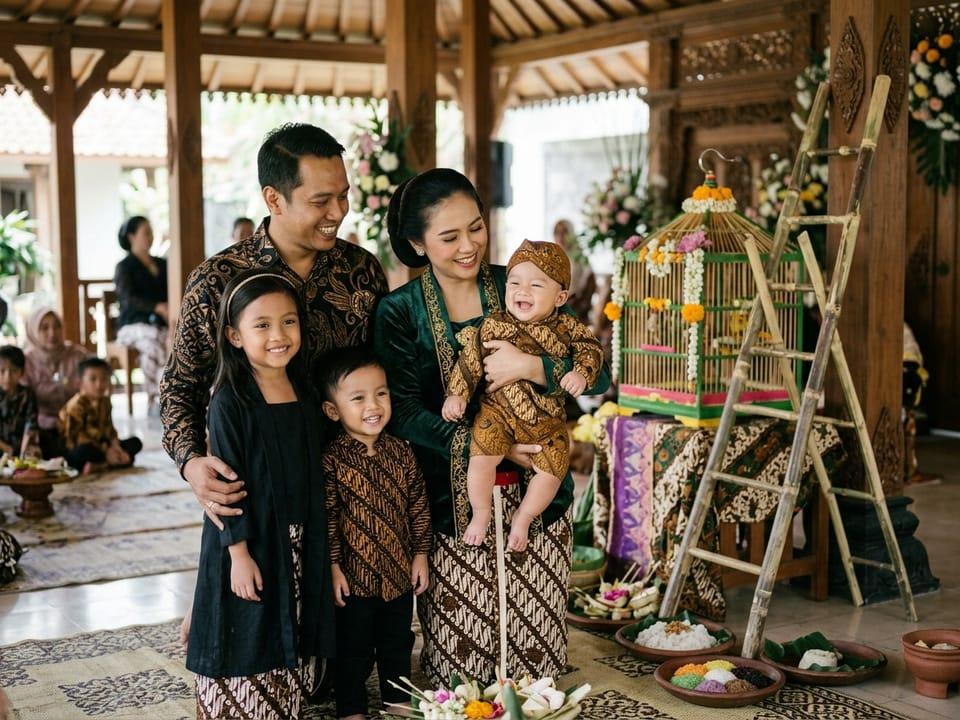
Tedak siten is traditionally held at seven lapan, 245 days after birth, and because 245 divides evenly by both seven and five, that day falls on the same weton as the baby's birthday. The same weton comes round every 35 days, so if the baby is ill or the weather turns, the next matching date is five weeks later. Whether a later date, or a different good day, is acceptable is a decision for your family and its elders, so agree on a backup before you need one.
Why 245 days lands on the baby's weton
A weton is the pairing of a day of the seven-day week with a day of the five-day Javanese market week, or pasaran: Legi, Pahing, Pon, Wage and Kliwon. Because 7 × 5 = 35, each pairing returns every 35 days, a cycle called selapan. Orami puts tedak siten at seven lapan, 7 × 35 = 245 days, the age when the baby can begin to stand and set their feet on the ground. Count 245 days from the birth date and you arrive at the same weton the baby was born on.
Families use weton to look for good days and avoid unlucky ones, for events from building a house to weddings. How strictly that applies to tedak siten varies. Some families hold to the exact day; others are comfortable with another good day nearby. That is not something a guide can settle for you; the elders who will lead or attend the ceremony are the right people to ask.
If the baby is sick, the next same-weton date is 35 days later
A baby with a fever is not going to enjoy walking on sticky rice in a crowded yard, and the flower-water bath and a morning outdoors may not be wise either. Ask your doctor first, and give the answer to the elders rather than asking them to weigh the medical question.
There are three ways forward. You can move to the next date with the same weton, 35 days later, at eight lapan. You can ask the elders to choose another good day. Or, if the family is comfortable with it, you can keep the original date for a short, quiet version with only the closest relatives, and hold the bigger gathering later. Whichever you choose, tell your vendor and photographer as soon as you know, because their rescheduling terms may depend on notice.
The rainy season can overlap the date: check the months now
Across much of Indonesia the rainy season runs roughly from October to March, and in Jakarta January is the wettest month, with about 300 mm of rain on average. On 22 September 2026, BMKG forecast that the 2026/2027 rainy season would begin in November 2026 in 24.66% of Indonesia's land area and in December 2026 in another 17.31%, with the peak in December 2026, January 2027 or February 2027 depending on the region. It also expected the start to be later than the 1991–2020 average across 61.08% of the land area. These are forecasts, so check BMKG's local update closer to the day.
The arithmetic is worth doing early. A baby born between April and June 2026 reaches 245 days between early December 2026 and early March 2027, right in that forecast peak.
If it rains, bring the earth to the terrace
The name tells you what matters: tedak means to step and siten comes from siti, the earth. Orami describes the ceremony as usually held in the morning in the front yard, but the ritual can move. Families can set up on a covered terrace or in a pendopo, put up a tarp over part of the yard, or, if the elders agree, set out a wide, shallow tray of soil or sand so the baby's first steps still touch the ground. Keep the flower-water bath indoors or under cover, lay a mat where the floor gets slippery, and have a dry change of clothes ready.
Wet weather also changes the light. Under a roof, place the baby near the open side facing out, so the face is lit from the garden rather than from overhead lamps.
Studio, photographer or phone when the date might move
|
Photographer at home |
Relatives' phones |
Studio session |
| Cost approach |
Fee and deposit; check what happens if you move |
Nothing extra |
Separate session fee |
| Sick or tired baby |
Can wait for the moment |
Easy to miss shots |
Can pause and come back |
| Rescheduling |
Get the terms in writing before paying |
Moves with you |
Indoors, unaffected by rain |
| Result |
Every step and a group photo |
Personal, uneven |
Calm portrait, no ritual |
| Best for |
Fixed date, large family |
Uncertain date, small ceremony |
A portrait on a different day |
A photographer is still worth booking for a large family on a date that is settled, as long as the deposit and rescheduling terms are clear. If the date may move, relatives with a shot list cost nothing to reschedule. More on dividing the photography is in the photographer-or-phone guide, and on keeping a recovering baby calm in when the baby cries in the kurungan.
While you wait for the new date, try a portrait for free
If the ceremony has to wait, the family photo does not. pokesta can create a tedak siten family portrait with AI from the phone photos you already have, $1 per photo and the first one free. It is a created image, not a record of the ritual, which you will still have when the day comes. Try a free portrait with a recent photo of your baby while you and the elders settle the date.
References