
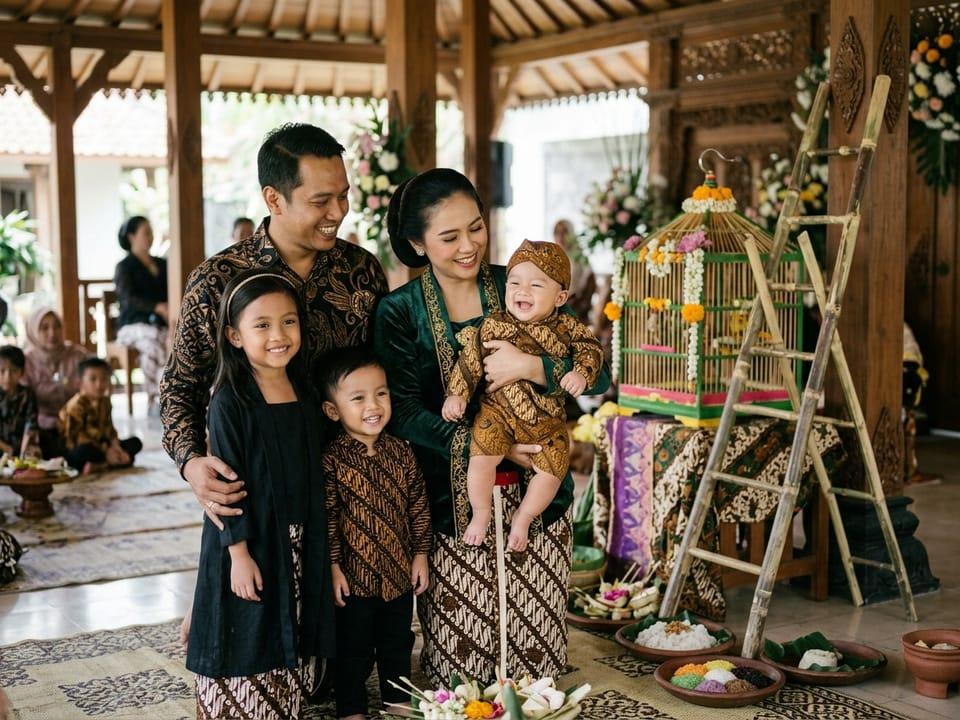
A baby who cries during tedak siten is not a sign that anything went wrong. The ceremony is held at seven lapan, or 245 days after birth, which falls right inside the six-to-twelve-month window when stranger anxiety usually peaks. Keep a parent's hands and face within the baby's reach at every step, give each ritual a named photographer, and treat a tearful face in the kurungan as part of the record. Don't repeat a ritual to get a calmer picture.
An eight-month-old has good reasons to cry
Tedak siten takes its name from tedak, to step, and siti, the earth: it marks the first time a Javanese baby's feet touch the ground. Orami describes it as usually held in the morning in the front yard of the house. Stranger anxiety typically appears around four months and peaks between six and twelve months, so a yard full of relatives, an MC with a microphone, sticky rice under bare feet and a bamboo cage add up to a lot for one small person.
You can take some of the pressure off before the first step. Feed the baby shortly before the start, and have the parent the baby is calmest with do the holding. Ask guests to greet from a little distance first, and ask the MC to keep the microphone and speaker away from the baby. An anthropology thesis from Universitas Gadjah Mada noted that tedak siten has grown more elaborate, with event organizers now part of it; if a vendor's rundown looks long and loud, you can ask for a simpler one.
Ritual by ritual, keep a parent within reach
The order below follows Orami's description. Details differ between regions and families, so check the sequence with the elder or MC leading your ceremony.
The baby first walks across sticky rice, jadah or jenang, in seven colors, which Orami links to a child learning to get past life's obstacles. A parent holds the baby from behind under the arms and lets each foot touch the rice; there is no need to linger on every color. Shoot this one low, at foot level, with the parent's hands in the frame.
Next comes the sugarcane ladder, likened to Arjuna, with tebu read as antebing kalbu, steadiness of heart. A parent guides the baby up and down, so stand to the side to catch both faces. In Orami's order the playful step in a pile of sand, ceker-ceker, comes next, a good moment to let a fussy baby reset.
The kurungan is the hardest step for a baby who is wary of being apart from a parent, even briefly. The baby goes into a decorated bamboo cage and picks one of the items inside, such as a book, jewelry, rice or cotton, which is taken as an early hint of their future. Keep the opening on the parent's side and have that parent kneel there so the baby can see their face the whole time. The items carry meaning, so ask the elders before adding a favorite toy to lure the baby forward.
During udik-udik, the father and grandfather scatter coins and flowers and guests scramble for them. Hold the baby well back from the crowd. The baby is then washed with sritaman flower water of rose, jasmine, magnolia and kenanga. Orami's list of items includes bayu gege, water left outside overnight and in the morning sun until about 8 a.m. Whatever water your family uses, test it on your wrist and keep a towel open. The new clothes come last.