
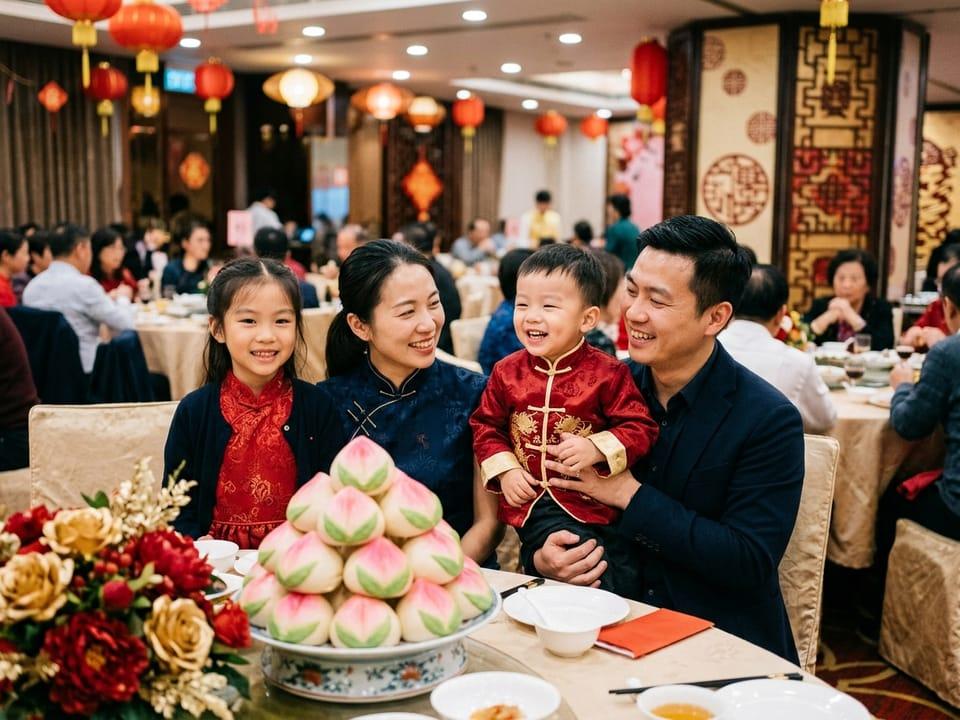
The moments you can't miss at a shouyan (寿宴, a Chinese longevity birthday banquet) are the birthday greetings, the peach-shaped longevity buns and the cake, and the honoree with each branch of the family. All of them fall around the start of the meal, so about two hours of a photographer's time is usually enough; you don't need a half-day or full-day booking. Rates vary widely by city, date and team, so rather than quoting market prices, this piece shows how to compare quotes item by item: hours, crew, editing and delivery. Check figures against each provider's current quote.
Fix the date first, because the birthday year differs by place
Before contacting anyone, settle the date and the time the meal starts. Which birthday gets a banquet isn't the same everywhere. The city gazetteer of Jingdezhen in Jiangxi records that people there over 60 celebrate every ten years, calling 60 the "lower longevity," 80 the "middle" and 100 the "upper." The same gazetteer, describing adult birthdays, also mentions celebrating at nine rather than ten ("做九不做十") and moving the birthday a month earlier in a leap year. Whether you count by the traditional reckoning or by actual age, and whether you celebrate a year early, is for the family elders to decide; book once they have.
The gazetteer also describes setting out an incense table and red candles, the younger generations bowing, longevity noodles and longevity cakes, gifts of longevity buns, noodles and embroidered banners, and the main meal usually at midday. On a schedule like that, a photographer who arrives at 10:30 and leaves around 1 p.m. covers what matters most.
What to cover in those two hours
The hour before the meal and the hour after usually run in roughly this order:
- The honoree arriving and sitting down, with a first photo with their spouse and children
- Baishou (拜寿), the birthday greetings: each branch (fang, 房) comes up in turn for one photo with the honoree
- The four-generation group photo, before anyone picks up chopsticks
- Close-ups of the buns, noodles and cake, then cutting the cake and blowing out candles
- Speeches and toasts from the children, and a few words from the honoree
After that, toasts at the tables can be covered on family phones. Keeping the honoree seated while the family comes to them is the least tiring approach; seating and dim-light technique are in photographing an elderly parent at a shouyan.
Whether two hours is enough depends half on the photographer and half on you. A few days ahead, send a run sheet: when the meal starts, the order of the greetings, who is in each branch, and whether the honoree can stand and for how long they can sit. On the day, assign a relative who knows everyone to stay with the photographer and point out "that's the third son's family" or "that great-aunt came from out of town." The people a stranger is most likely to miss are the ones who rarely come and most need photographing.