Longevity Birthday Family Photos: Take Them at the Banquet, Book a Studio Day, or Shoot at Home?

pokesta Editorial Team · Updated October 26, 2026

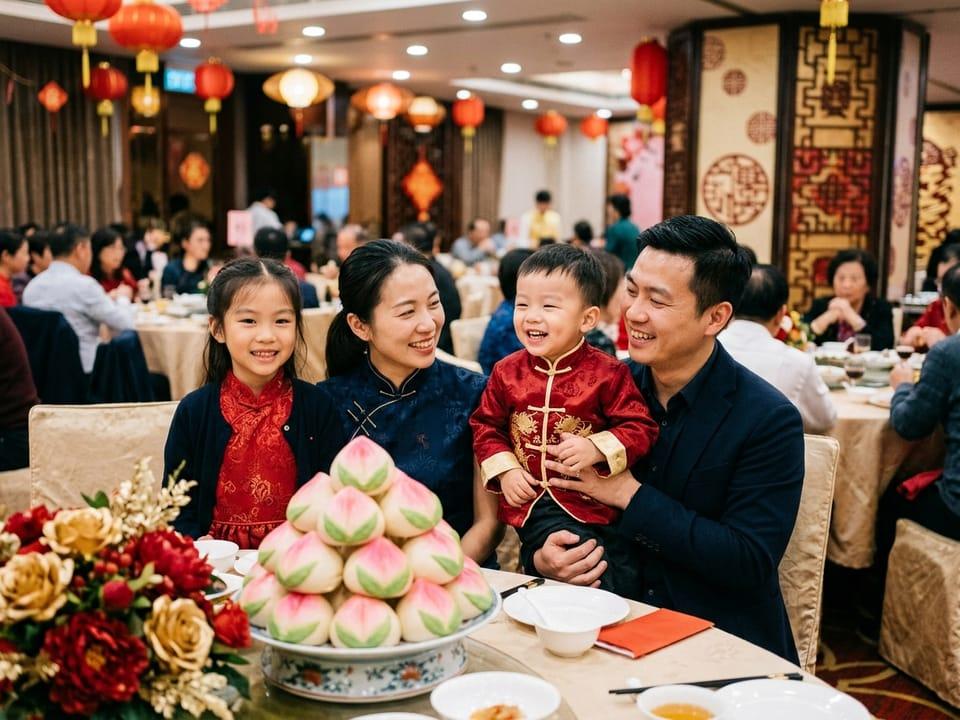
Longevity Birthday family photo (AI-generated image)

For a family portrait you can hang in the living room and enlarge without regret, the safest plan is a separate day before or after the shouyan (寿宴, the longevity birthday banquet), with fewer people, at a studio or at home. The banquet is the one day the whole family is together, but the hall is dim, time is short and the honoree gets tired, so treat that day as a record and take a single picture of everyone. Splitting it in two means the honoree is only tired a little each time, and each set of photos has its own job.

On the day, you have the people but not the light or the time

The banquet has something no other day has: relatives from far away, a great-grandchild just learning to walk, and the honoree at their happiest. Its weaknesses are just as plain. Private rooms and banquet halls are mostly lit from the ceiling, which shadows faces; round tables take up the space, so a clean wall is hard to find; and once the meal starts nobody wants to leave their seat, leaving only the stretch before it. The city gazetteer of Jingdezhen in Jiangxi records that the younger generations bow to the honoree and that the main meal is usually at midday. With guests arriving and greetings in the morning, the window for photos is shorter than it looks.

So don't expect a masterpiece on the day. In the ten minutes before the meal, take the full group and each branch of the family with the honoree, and let the rest be documentary. Put the group in front of the wall with the 寿 backdrop or the peach-shaped longevity buns, honoree seated in the middle, every light on, three bursts. It may never be the most polished picture, but decades later it's the one people point at and say "so-and-so was there too." Seating and dim-light technique are in photographing an elderly parent at a shouyan.

A studio has the best light, at the cost of an outing

A studio's lighting, backdrops and retouching are beyond any banquet hall, and someone handles hair and makeup. For a dignified portrait of the honoree alone, a studio is the right place. The price is the journey and the waiting. China's National Health Commission standard on fall prevention for older adults (WS/T 887—2026) lists steps and thresholds, poor lighting, and chairs that are too low or lack armrests among fall risk factors, and says older people should be taught to change position slowly. Before booking, ask which floor the studio is on, whether there's a lift, whether there are steps at the door, whether there's a chair with armrests, whether changing means going up or down stairs, and how long the whole visit will take.

On cost, ask whether a large group costs extra and get the number of files and retouched images in writing. A 2024 Workers' Daily report noted that consumer protection regulations in Jilin and several other provinces require businesses to hand over the remaining digital files on request without charging beyond what was agreed. Northern winters and southern summers make any outing harder, so pick the mildest part of the day.

Home is the easiest, and the light is yours to arrange

At home the honoree has their usual chair, can rest whenever they like, and if the pictures disappoint you can try again tomorrow. In daytime by a window, with light falling across faces from the side, people look far better than under banquet ceiling lights. The drawbacks are a cluttered background, too little room for a big group, and the need for a tripod and someone comfortable with the self-timer; a photographer can also come to you. Six or seven people usually fit in front of one living room wall; for more, move the coffee table or shoot in two groups. Checking the shots on the TV straight away is a luxury no studio gives you. A Spring Festival family photo at home uses the same method.

Three approaches side by side

On the banquet day (a photographer can come) A studio on another day Home on another day (or a visiting photographer)
How the cost works Photographer by hours, crew, editing Packages; ask about extra people and files Almost nothing if you shoot it
Strain on the honoree No travel, but a long day Travel, changing, waiting Lightest
Rescheduling Fixed once the banquet is booked Depends on the contract Anytime
Photos Dim and rushed; good for a record Best light, retouching and makeup Window light; tidy the background
Best for Everyone together, the greetings A formal portrait of the honoree The couple and their children

What a photographer on the day costs, and how long to book, is in what a shouyan photographer costs.

Record the day; take the picture for the wall on another

In practice: one or two weeks before the banquet, or a week after, choose a morning when the honoree feels well, invite only the couple and their children (grandchildren too, if you like), and shoot at a studio or at home in under an hour. Start with the honoree alone and with their spouse, while they're fresh and their clothes are still neat; that's often the frame you'll use most. Then add the children, and the grandchildren last, with the honoree staying in the same seat throughout. Choose clothes the honoree is comfortable in, a tangzhuang, a qipao or their smartest outfit; if the studio's clothes need trying on, count that in the hour. At home, clear the wall, set up the chair and tripod, and take test shots the day before.

When someone can't make it, fill the gap with AI

Even on a separate day, a child or grandchild in another city may not be able to come. With pokesta you can turn the phone photos your family already has into a longevity family portrait with AI, everyone in tangzhuang and qipao, at $1 per photo, and the first photo is free. It's a created image, not a real photo from that day, so hang it as a companion to the studio portrait rather than a replacement. Before booking the studio, try one free with a recent photo of the honoree and see whether you like it.

References