
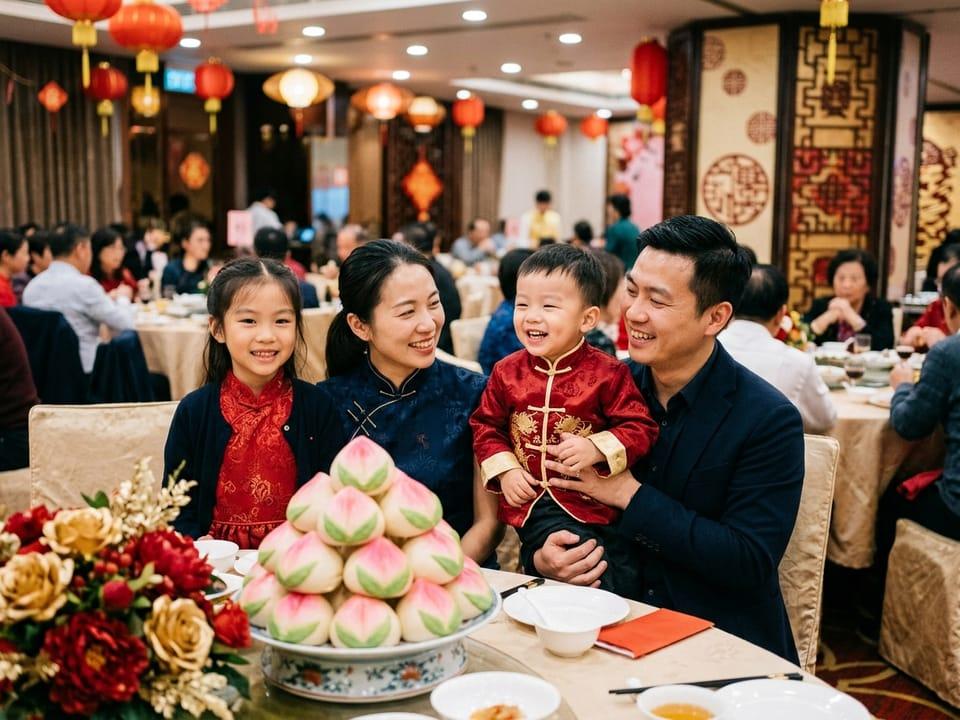
When the guest of honor at a shouyan (寿宴, a Chinese longevity birthday banquet) is frail, keep them seated and bring the family to them. Do the posed photos in the ten minutes or so before the toasts and the first course, and take only two kinds: each branch of the family (each fang, 房) with the honoree, and one picture of everyone. Shoot three bursts per group and closed eyes stop being a problem. Once the meal starts, the camera just records; nobody gets asked to pose again.
What tires them out is standing, rising and waiting
At a shouyan, the honoree (寿星, shouxing) is usually worn down less by the meal than by getting up again and again, standing while everyone gathers, and being led onto a stage. China's National Health Commission issued a technical standard on fall prevention for older adults in 2026 (WS/T 887—2026). It lists postural hypotension and low blood pressure after meals among fall-related conditions and says older people should be taught to change position slowly. It also names poor or uneven lighting, glare, deep shadows, steps and thresholds, and cables or clutter in walkways as fall risks in the home. A banquet hall often has all of them too: dim lights, steps up to a stage, and cables for the sound system and screen running under the carpet.
That suggests a few rules. From the moment the honoree sits down until the photos are done, they don't stand; the family moves. Nobody leads them onto the stage. Nobody asks them to stand for a group photo straight after eating. The standard also lists hearing loss as a risk factor, so "look over here" or a countdown may not register; a raised hand from the photographer works better. Seat them away from the air-conditioning vent, and in winter let them keep their coat on until the last moment.
Seat the honoree in the center and build out by generation
Baishou (拜寿) means the younger generations offering birthday greetings to the honoree. The city gazetteer of Jingdezhen in Jiangxi records that families there set out an incense table and red candles, the younger generations bow, and the main meal is usually at midday. Who bows first and who stands on the left varies by region and family; some go branch by branch, others by age. Ask the elder running the day before the banquet starts rather than borrowing rules from the internet. The structure of the photo, though, is the same everywhere:
- The honoree (and their spouse, side by side) sits in the center on a chair with a back and armrests and no wheels.
- Their children stand behind or sit at the sides, with faces roughly level with the honoree's.
- Grandchildren go at either end, great-grandchildren in front of the honoree's knees; the smallest sit on their own parents' laps, not on the elderly person's.
- An honoree who uses a wheelchair stays in it, brakes on, with family crouching or sitting on either side.
With a big family, two or three rows are enough: front row seated, back row standing, faces showing between the shoulders in front. Zoom in on the phone afterward to check no face is hidden. It's the same logic as a Spring Festival family photo at home.
Ten minutes is enough only if the day before is spent preparing. Write the branches and their order on a sheet and hand it to a relative who knows everyone; they call people up, and the photographer just shoots. Take the full-family picture first, then the branches, so the most important frame is done while the honoree is freshest. If smiles won't come on command, have the youngest great-grandchild hand over a peach-shaped longevity bun, or have a grandchild talk to them from beside the camera.