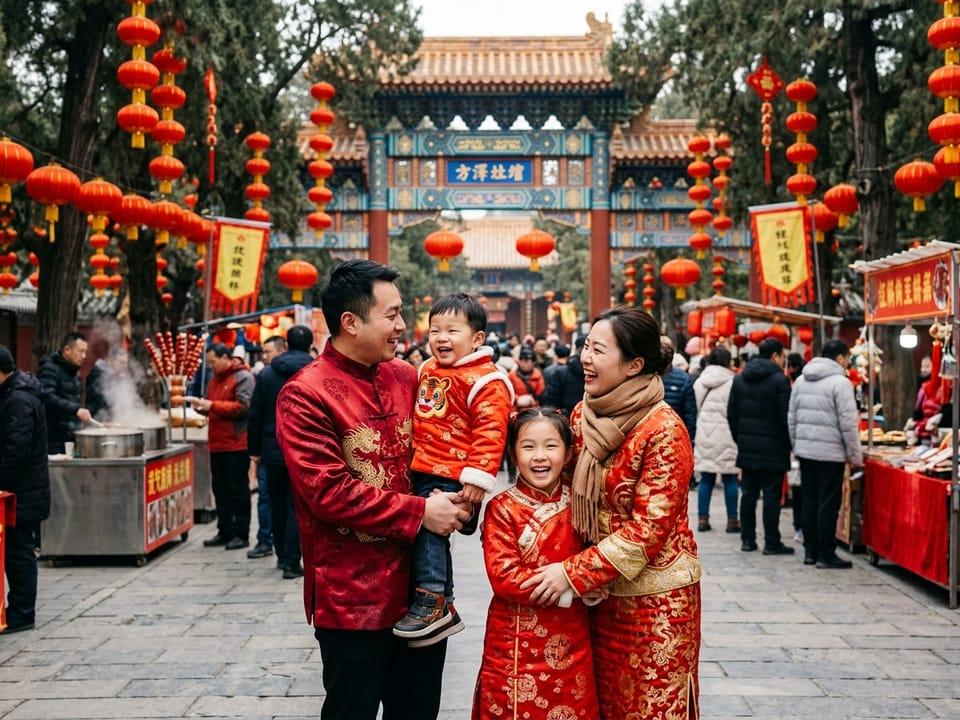
You can still take the family portrait (全家福) when someone can't get home for Spring Festival. Photograph everyone who is there first, then ask the missing relative for a matching picture of themselves, lit from the same side and taken from the same height, and have a studio or an editing app put them in. Whether the result looks real depends far more on that light and angle than on retouching skill. Tell the family it's a composite, and take a proper group photo in the year everyone is home.
A composite looks fake when the light and angle don't match
Most failed composites start with a selfie that was already on the absent person's phone. Three things give it away. The first is light direction. If the window is on the left in the family shot, every face is brighter on that side, and a face lit from the other side, or flattened by a ceiling lamp, never sits right. The second is camera height: the family photo was taken with the phone level at chest height, while a selfie is shot from above, so the head looks big and the body small. The third is distance. A front camera at arm's length draws a face differently from a phone two or three metres back.
So reverse the usual order: take the family photo first, then send it to the missing relative to copy. If you're using a studio, ask the photographer what they need and pass that on.
A checklist to send to the person who can't come
Send this along with the family photo.
- Light: shoot by a window in daytime, with the light on the same side of the face as in the family shot, ceiling lights off.
- Height and distance: have someone else take it, phone at chest height, two or three metres away, on the 1x lens. No front-camera selfies and no ultra-wide, which stretches people near the edges of the frame.
- Pose: if the family is seated, sit on a chair; if they're standing, stand. A waist-up or full-length shot is far more useful than a close-up.
- Clothes: follow the family's colour plan, even if it's only a red scarf.
- Background: a plain wall with nothing behind.
- Sending: take several, and tick "original image" (原图) on WeChat, or send the files directly.
At home, leave a small gap where that person usually stands. Arranging three generations and working with window light are covered in our guide to the New Year family photo at home.
Ask before you composite, and label it afterwards
A photo the person took and sent you for this is fine to use; an old picture lifted from their WeChat Moments without asking is not. Article 1019 of China's Civil Code says no organisation or individual may infringe another person's portrait rights by defacing their image or forging it with information technology, and that a person's likeness may not be made, used or published without their consent, unless the law provides otherwise. No one sues a cousin over a New Year photo, but asking "can I put you in the family picture and post it in the family group?" is simple courtesy.
Label it, too, because in a few years nobody will remember who was really away. A caption such as "Spring Festival 2027, Auntie on duty in another city, photo is a composite" keeps the family record straight.
Studio, home visit or DIY: what each does well
|
Studio shoot and composite |
Photographer at home |
Shoot and edit yourself |
| Composite quality |
Controlled light; a retoucher handles hair edges |
Depends on your room's light |
Works if the light matches; hair edges are hardest |
| Elders and small children |
Everyone travels |
Nobody travels |
Nobody travels |
| Rescheduling |
Pre-holiday slots are tight; the shop's rules apply |
Agree it with the photographer |
Any time |
| Best for |
One big print for the wall |
Large families with less mobile elders |
A yearly record |
A studio's steady lighting makes the extra picture easier to match, and a retoucher handles hair and clothing edges more cleanly than an app. For a print that will hang in the living room, or when the grandparents want something formal, that's money well spent. Whether compositing costs extra, how it's charged and what file is needed all vary by studio, so ask when you book. Book early, too: a Nanning photo studio with nearly 70 years of history told Xinhua that its family-portrait season starts soon after New Year's Day, and that the first to the eighth day of the lunar new year are its busiest.
With a home visit nobody leaves the house; in the same report, a regular customer booked one for the second day of the new year more than ten days ahead. Doing it yourself costs the least: a phone tripod and the self-timer are enough. If you composite in an editing app, loose hair and sheer scarves give it away first, so putting the added person at the end of a row makes the job much easier.
Put the video call in the picture
When someone truly can't come back, the Nanning studio makes a video call during the shoot so the absent relative can hear the shutter click. You can do the same at home: turn the phone or tablet brightness up, have a child hold it at chest height, and tilt the screen slightly down to dodge window reflections. Take the photo, then record a few seconds of video with everyone calling out "新年好" (Happy New Year). It may say more about that year than a composite ever could.
Reshoot when everyone's home, and make one from phone photos meanwhile
In the year everyone makes it home, take the real picture in the same doorway or on the same sofa. Lined up with the earlier years, it fills the gap.
Until then, if you'd like to see the whole family together, pokesta can take the phone photos each person already has and use AI to create a New Year family portrait in matching tangzhuang, at $1 per photo with the first photo free. It is a generated image, not a record of the day, but it can give a relative far away a share of the reunion. Try it free with a recent photo of your child before you book a studio.
References