Once Lunar New Year is over, people from all over northern Vietnam head for a cluster of temples in the hills southwest of Hanoi. The Huong Pagoda festival (Chua Huong, often called the Perfume Pagoda) runs for roughly three months, from the first to the third lunar month, and is the largest pilgrimage in the north. You travel by rowboat between limestone peaks, climb the mountain and pray at a temple set inside a cave. It takes a full day, so families with children do best by avoiding the busiest days and making good use of the cable car.
The gates open on the sixth day of Tet
Huong Pagoda is not a single building. The name covers the temples, shrines and caves scattered across the mountains and forests of Huong Son in Hanoi, about 70 km from the city center. Four pilgrimage routes link some 20 temples, shrines and caves, and at the heart of it all is the inner temple inside Huong Tich Cave. The first temple is thought to have been a small shrine built in the 15th century, during the reign of Le Thanh Tong, near the site of today's Thien Tru Pagoda. At the cave entrance, carved alongside the year 1770, are characters that read "the foremost cave under the southern sky."
The festival follows the lunar calendar. In 2026 it ran from the 2nd day of the first lunar month to the 25th day of the third, which was February 18 to May 11 on the solar calendar. The opening ceremony was held on February 22, the 6th day of the first lunar month. In 2027, Lunar New Year falls on February 6, so the festival period and the ceremony shift with it. Check the organizers' announcement for each year's official dates.
The 2026 festival introduced electronic ticketing, QR-code checks and AI cameras to monitor crowds. Vietnam's government is preparing to designate the area a national tourism area and plans to have a nomination dossier for UNESCO World Heritage status ready by 2030.
Crowds peak from the middle of the first lunar month to the middle of the third, and on the busiest days visitors are said to number in the tens of thousands. You can visit outside the festival period as well, so families who would rather walk in peace might consider going at another time.
The Yen stream, Thien Tru Pagoda and Huong Tich Cave
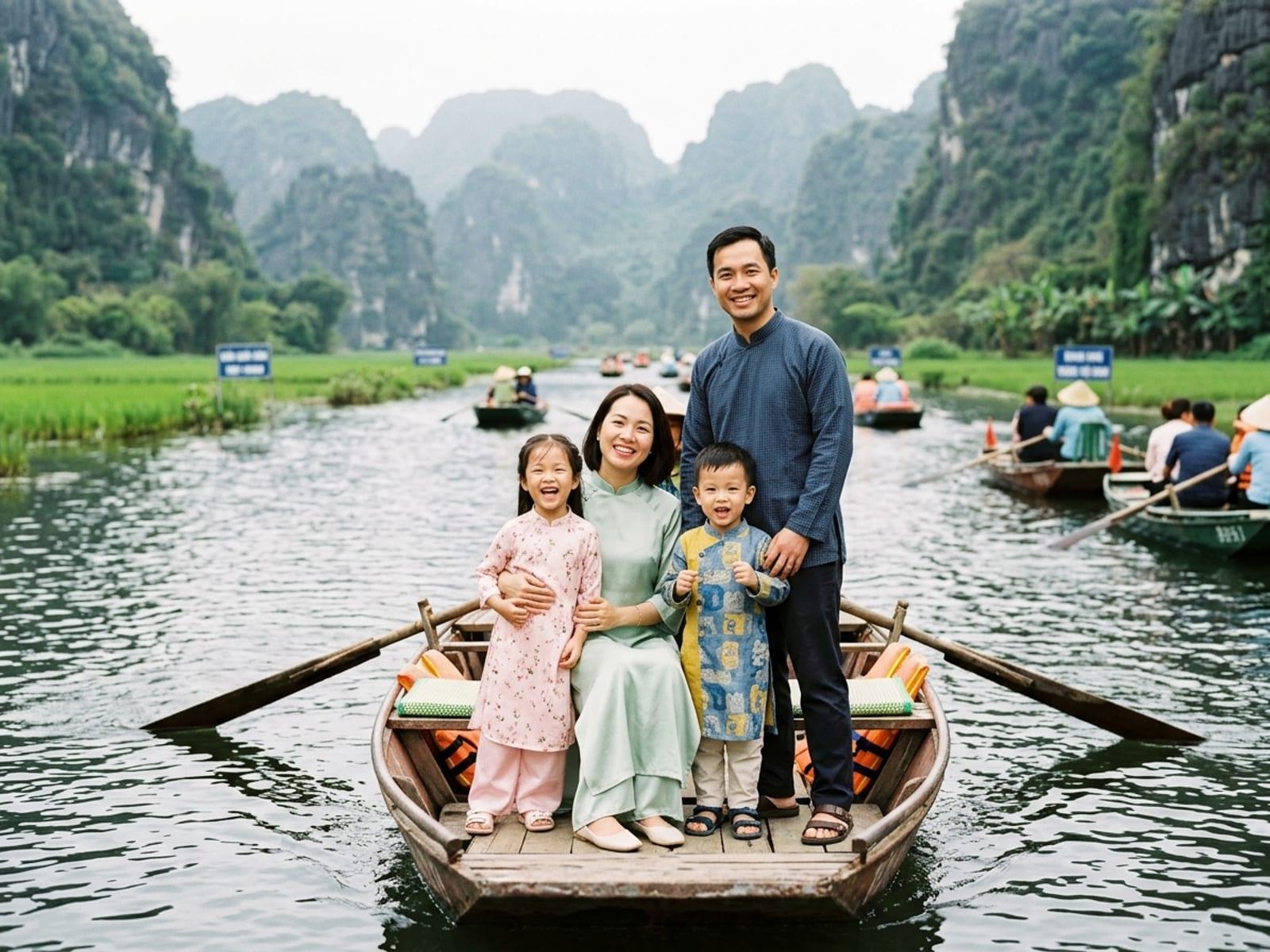
The pilgrimage starts at Duc wharf. You board a shallow boat and spend about an hour going up the Yen, a narrow stream. Sheer limestone mountains and rice fields line both banks, and on the water a string of other boats is heading the same way. During the 2026 festival, motorboats were limited to emergency use, so passengers were carried by hand-rowed boats only. Boat tickets are managed with QR codes.
After landing, you walk to Thien Tru Pagoda. From there to Huong Tich Cave is a mountain path with stone steps that takes more than an hour, not counting stops at temples along the way. There is also a paid cable car, which is recommended on hot days and is a big help with small children. The cave mouth is shaped like a dragon's open jaws, and at the bottom of a long stone stairway you find greenish stone statues of the Buddha and of Quan Am (Guanyin) among the stalactites. Pilgrims stop to pray at some of the stalactites, too.
Pilgrims greet each other with "A Di Da Phat," a blessing invoking Amitabha Buddha. As a visitor, a small nod as you pass is all that is needed.
For a quieter trip, try the Tuyet Son route
Besides the main Yen stream route, there is another one that starts at Phu Yen village and follows the Tuyet Son stream by boat for about 1.5 km to Bao Dai Pagoda. According to tradition, Bao Dai was built in 1694, during the reign of Le Hy Tong, by Princess Hoang Thi Ngoc Huong. The boat ride is shorter and you get a close view of limestone peaks and rice fields, which makes it worth considering for families worried about the long main route. From around the tenth lunar month, hikers and photographers come for the apricot blossoms along this path.
Cover shoulders and knees, and wear good walking shoes
Huong Pagoda is a tourist site, but for many people it is also where they make their wishes for the year. Skip sleeveless tops, short skirts and shorts, and choose clothes that cover the shoulders and knees. If you are thinking about photos, an ao dai in calm colors suits the setting well. You will sit in the boat for a long time, so pick one that isn't too long at the hem, in a color that won't show dirt.
For footwear, choose broken-in shoes with grippy soles. Early spring in the north often brings drizzle, and the stone steps get slippery when wet. The boat is breezy, so a light jacket is a good idea. Pack water, hats, rain gear, a towel for sweat and a change of clothes for the kids. Parts of the cave are dim and damp underfoot, so a backpack that keeps both hands free makes the steps easier. Before you go in, go over the basics with your children: take off hats inside the temples, and don't pose for photos with your back to a Buddha statue.
With kids, go on a weekday morning and take the cable car
The day is a chain of boats, mountain paths and cave stairways. Strollers are almost useless here, so bring a baby carrier for infants. Even children who walk well will find the full round trip on the steps harder than adults do. Plan ahead: cable car on the way up, then the steps on the way down if everyone still has the energy.
Before boarding, check that life jackets are on board, and seat children between adults. On busy days the line for boats at the wharf gets long. Weekends and the days right after the opening are especially crowded, so if you can, leave early on a weekday morning. In 2026, stalls were required to post their prices, so check the price before you buy food or drinks.
A photo taken from the boat, with the mountains and stream behind you, is the shot this festival is known for. Before you go, you can try out how your family might look in ao dai on a boat with pokesta's AI photos ($1 per photo, and the first one is free).
Getting there from Hanoi and choosing when to go
The main gateway is Noi Bai International Airport (HAN), about 35 km northeast of central Hanoi. Most people reach Huong Pagoda by car from the city, and there are plenty of day tours with hotel pickup. Roads to the parking areas get congested during the festival, so leave plenty of time.
For how Lunar New Year itself is celebrated, see our article on Tet in Hanoi. The days right after Tet overlap with people traveling home after the holiday, so it is easier to get around if you plan your trip one to two weeks after New Year. If you are looking for another place near Hanoi where kids can get their hands busy, the Bat Trang pottery village makes an easy half-day trip. For an overnight trip further out, our piece on trips from Hanoi covers Ha Long Bay, Ninh Binh and Sapa.
Entry requirements depend on your nationality, so check your own government's official information before you travel. Festival dates, boat services and cable car hours can change from year to year, so also look at local announcements before you go.
References