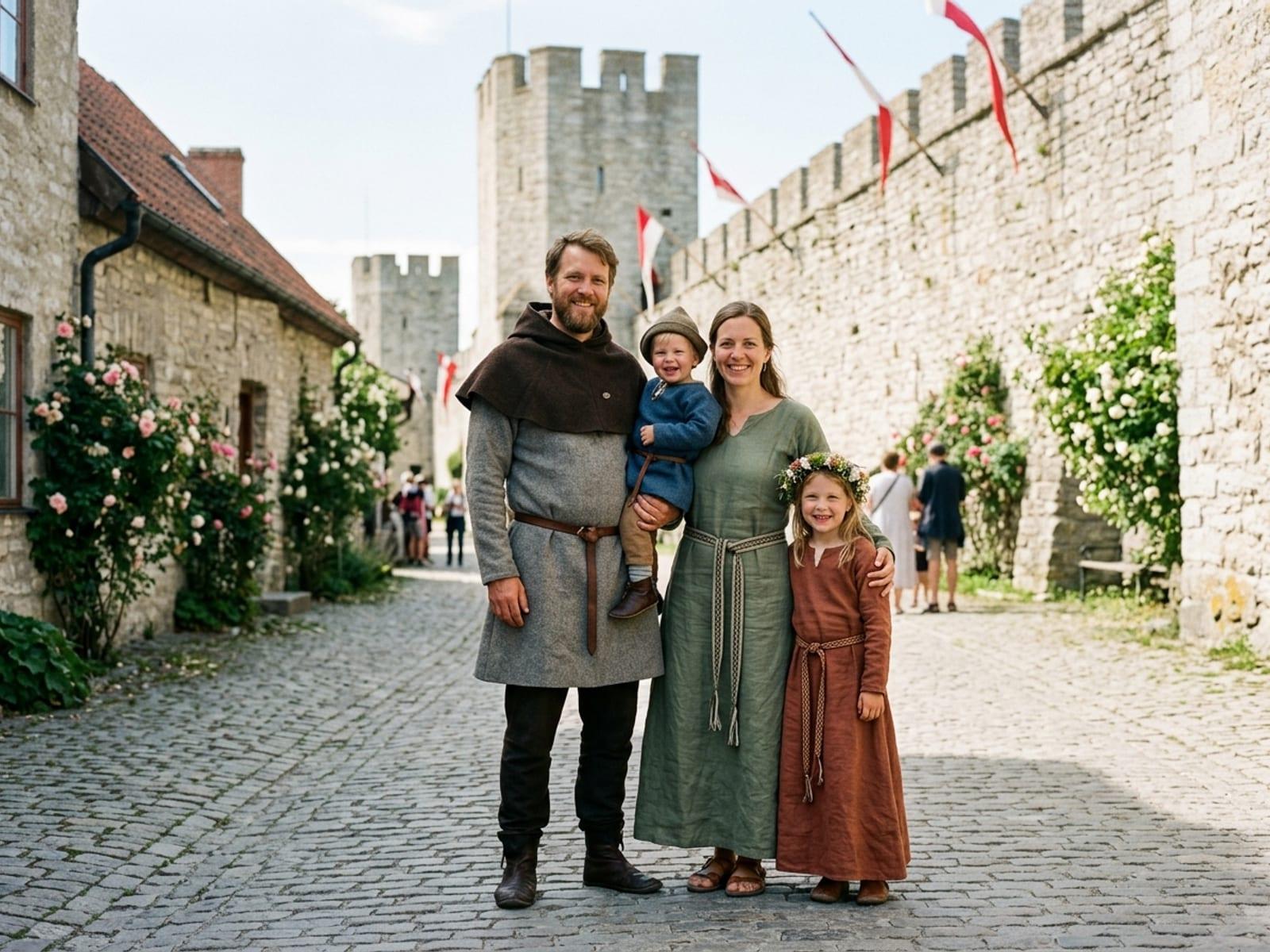
Visby, on the Baltic island of Gotland, is a World Heritage town ringed by more than three kilometers of stone wall. Every August, for eight days, it slips back into the Middle Ages. The festival is Medeltidsveckan, or Medieval Week, and it has been held since 1984, making it Sweden's biggest history festival. Drums and bells echo around street corners, and people in cloaks and long gowns stroll the cobbles. Put your child in a simple medieval outfit, stand them in front of the wall, and the photo already looks like a page from a storybook.
Eight days that remember the battle of 1361
In the Middle Ages, Visby grew rich on Hanseatic trade. Its wall was built in two phases, in the 13th and 14th centuries, and about 3.44 km of the original 3.6 km still stands. Twenty-seven of the large towers survive, so wherever you walk in town, there's a tower in view. The old town, with its church ruins, stone warehouses and merchants' houses, was added to UNESCO's World Heritage list in 1995 as the Hanseatic Town of Visby.
What Medieval Week commemorates happened in July 1361. King Valdemar IV of Denmark, known as Valdemar Atterdag, wanted control of the island's trade routes, and on July 22 he landed on Gotland's west coast. On the 27th, near Visby, his army of knights and mercenaries met an island force made up mostly of farmers, and the islanders were crushed. Excavations in 1905 uncovered many skeletons still wearing armor in mass graves outside the wall.
After the battle, the story goes, the townspeople of Visby surrendered and paid a huge ransom to keep the town from being plundered. That ransom, though, is considered legend, with no reliable record behind it. In 2022 the festival recreated the battle itself, with field camps and fighting staged as closely as historical research allows.
The festival lasts eight days, from the Sunday of week 31 to the Sunday of week 32. In 2026 it ran from August 2 to 9. Check the official site for the 2027 dates once they're announced.
Jousting, markets and a fairy-tale meadow
The biggest draw is the jousting in the medieval arena at Strandgärdet, a seaside field outside the wall. Armored knights on horseback level their lances while thousands of spectators look on. The official site notes that tournaments are stopped if there's a risk of thunder. Jousting is ticketed, and you can buy tickets in advance.
Craft markets set up in the old town, selling leather shoes and belts, cloaks, pottery and candles. There are more than twenty venues, and medieval-style taverns and eateries, talks, workshops, music and street performers pop up all over town. Many events in the old town are free to wander into, so even with nothing planned you'll come across bands and street performers.
With children, look in on Riddargård, the children's area at Strandgärdet, as well as Sagoängen, the fairy-tale meadow, and the jesters' meadow. What's on each day is listed in the official program.
The festival sells a wristband called the festival band, which goes on sale in spring. Having one lets you pre-book events. Check prices on the official site when you buy.
Wear a costume, or come as you are
In the official site's words, everyone is welcome just as they are. Some people come in medieval dress, some as Vikings or pirates, and some tourists in everyday clothes. Still, so many people are in costume that adding even one medieval touch helps your family blend into the scene.
You don't need a full outfit. A linen dress with a braided cord belt, a wool shawl around the shoulders, or a flower wreath on a child's head is plenty. The festival markets sell cloaks and shoes, and some people assemble their costume on the spot. The official site also mentions social media groups where people swap tips on making costumes. The August sun on Gotland can be strong, so bring hats and sunscreen. Sea breezes can make evenings cool, so pack an extra layer.
The town is full of cobblestones and slopes. Even in medieval dress, wear shoes you're used to walking in and your feet will thank you.
Cobbles and crowds with children in tow
During the festival, people pour in from all over the island and beyond. According to Gotland's tourism site, Medieval Week draws more than 100,000 visits each year. The lanes of the old town are narrow, and pushing a stroller through them is hard work. Use a carrier for small children, hold hands with those who can walk, and agree on a meeting point in case you get separated.
The jousting is thrilling, but the pounding hooves, cheering and clash of lances are loud, so ear defenders help children who are sensitive to noise. Arrive early to get seats, and bring sun hats and drinks.
At night the focus shifts to medieval taverns and adult events, and the mood of the town changes. With children, it works well to pack what you want to see into the daytime and early evening and rest at your lodging at night. August is also crayfish season, so if your lodging has a kitchen, buy some boiled crayfish and spend an evening trying the Swedish crayfish party (kräftskiva) way of eating them. You don't need to stay all eight days. Two or three days, one for the jousting and one for an easy wander through the old town, is enough to soak up the atmosphere.
Before you set off, you can try a family photo against the stone wall with pokesta's AI photos ($1 per photo).
Getting to the island by ferry or plane
You reach Gotland from the mainland by ferry or plane. Destination Gotland runs ferries to Visby from Nynäshamn, south of Stockholm, and from Oskarshamn in Småland, each taking about three hours. If you sail from Oskarshamn, a summer itinerary can take in Astrid Lindgren's World in Vimmerby, also in Småland. By air, there are daily flights from Stockholm Arlanda to Visby Airport (VBY), about 5 km north of town.
Medieval Week coincides with the busiest weeks of the island's summer. Ferries and accommodation fill up early, so start booking as soon as the dates are announced. If you can't find a room on the island, campsites are another option. Entry requirements for Sweden depend on your nationality, so check your own government's official information.
References