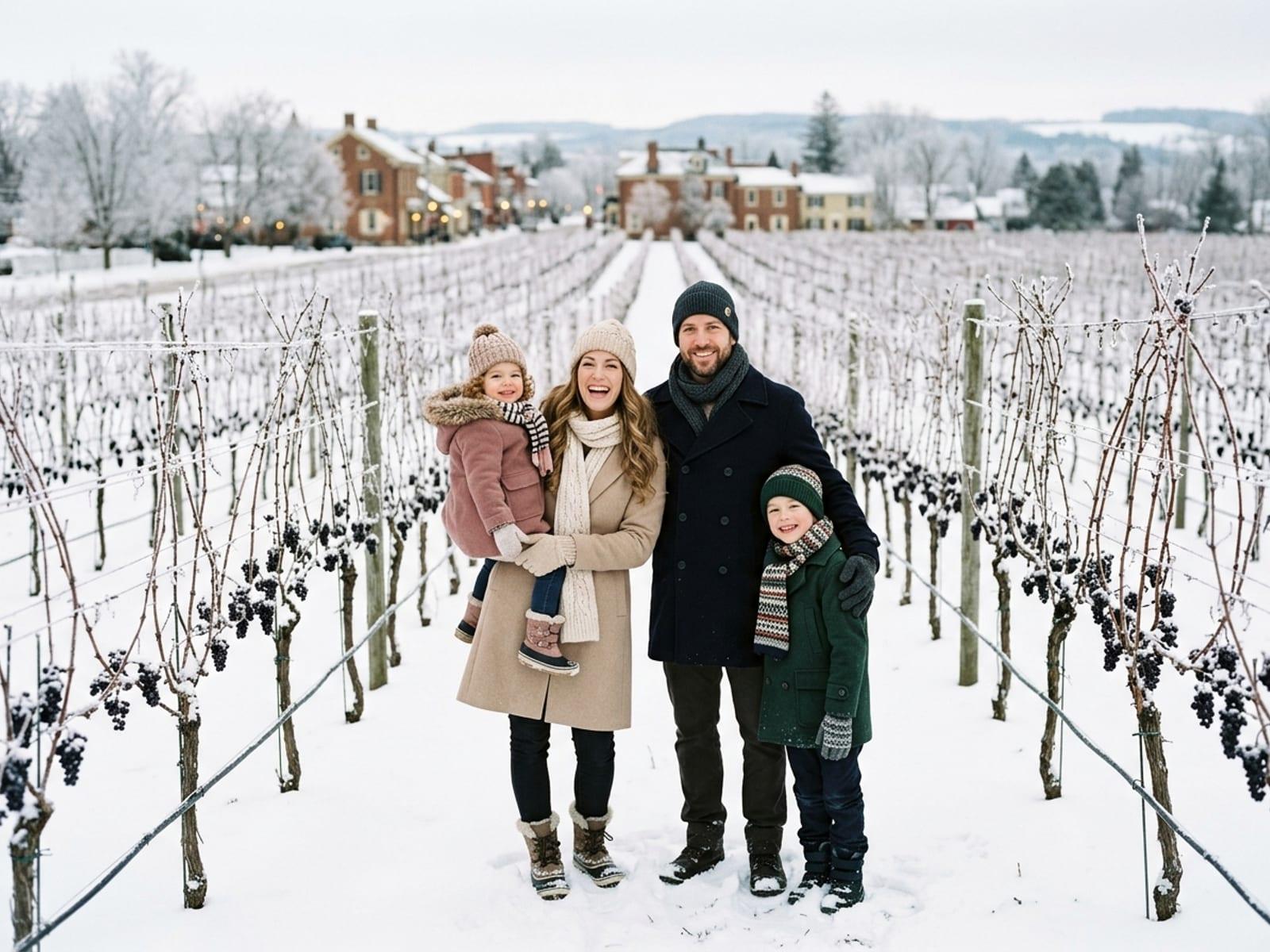
Icewine is a sweet dessert wine pressed from grapes left to freeze on the vine in winter. Canada is the world's largest producer, Ontario makes roughly 90 percent of it, and most of that comes from the Niagara Peninsula, which holds its Icewine Festival every January (January 15 to 31 in 2027). Tastings are for adults only, so with children, limit the wineries to one or two and spend the rest of the day walking around Niagara-on-the-Lake.
Freeze first, then pick
The rules for icewine are strict. The grapes must freeze naturally on the vine. In Canada, picking can't start until the temperature drops to -8°C or lower, and grapes frozen in a freezer don't count. When the frozen berries are pressed, the water stays behind as ice, and only a small amount of juice comes out, concentrated in sugar, acidity and aroma. Under the VQA quality standards in Ontario and British Columbia, the juice also has a minimum sugar level: grapes that don't reach 35 Brix (the unit on a refractometer) can't be called icewine and go into late-harvest wines and the like.
Harvest day depends entirely on the weather. Growers leave the grapes hanging and wait for a deep freeze, then pick as fast as they can once it comes. If it isn't cold enough, all they can do is wait. After one producer, in a mild winter, trucked grapes up a cold mountain to freeze them, British Columbia tightened its rules further in 2000. Because frozen berries yield so little juice, icewine has always been treated as something more precious than ordinary wine, in line with the work it takes.
The grape most used in Ontario is the white Vidal. There are also icewines from Riesling and from the red Cabernet Franc. Aroma and acidity differ quite a bit by grape, so at a tasting it's worth asking for small pours of different varieties side by side.
How Canadian icewine made its name
Canada's icewine history is surprisingly recent. One early example dates to 1972 in British Columbia's Okanagan Valley, made from grapes hit by an unexpected frost. In Ontario, Inniskillin winery in Niagara-on-the-Lake began commercial production in 1984, and when its 1989 Vidal icewine won the top prize at the Vinexpo international wine fair in France in 1991, the wine's reputation spread worldwide almost overnight. By the early 2000s Canada had become the world's top icewine producer, and in 2001 the EU agreed to allow imports of Canadian icewine. Today it's made in Quebec and Nova Scotia as well as Ontario and British Columbia, and Canada is said to produce more icewine than all other countries combined.
The Icewine Festival in January
The Icewine Festival is held each January by the organization behind Niagara's grape and wine festivals. The 2027 dates are January 15 to 31. Events include the Discovery Pass, which gets you icewine and food pairings at three or six participating wineries; a gala on the last Saturday of January at the former power station beside Niagara Falls; and the Icewine Village, an outdoor event on weekends along Queen Street, the main street of Niagara-on-the-Lake.
At the Icewine Village, there are seasonal bites and warm drinks alongside the icewine tastings. Dates and tickets change from year to year, so check the official site.
Visiting wine country with children
To be honest up front: a trip built around icewine tastings is a trip for adults. Only adults of legal drinking age under provincial law can taste, and the official festival information doesn't list anything for children. If you bring kids, have the adults take turns at just one or two wineries and spend the rest of the time exploring the town. Whoever is driving should skip the tasting or use a tour or shuttle.
That town, Niagara-on-the-Lake, is a small place of about 20,000 people where the Niagara River meets Lake Ontario. It's the only town in Canada whose head of council holds the title of Lord Mayor. In 1792, the first parliament of Upper Canada, the forerunner of Ontario, met here. The town was burned during the War of 1812 and later rebuilt around Queen Street. On the edge of town stands Fort George, built between 1796 and 1799, and across the river is New York State. Weaving a bit of history into your walk helps children understand how the town came to be.
So that kids don't spend too long waiting while adults taste, bring picture books or small toys. January here is cold. Everyone needs a wool coat or down jacket, a hat, gloves and boots with good grip on snowy sidewalks. If you want photos in the vineyards, whether frosted or snow-covered grape clusters are still hanging depends on that year's harvest, so check with the wineries before heading out. For a picture of your family standing in a snowy vineyard, you can try pokesta's AI photos, at $1 per photo, with your first one free.
Pack the bottles in checked luggage
If you're bringing icewine home, put it in your checked luggage, since liquids in carry-on bags are limited. Wrap the bottles well in clothes or padding. Rules on bringing alcohol into a country vary by destination, so look up those and your duty-free allowance before you travel.
If you come across sweets or snacks with icewine in the name, check the ingredients before giving them to a child. Some use the wine itself for flavor and may still contain alcohol.
When to go and how to get there
The icewine harvest depends on how cold the winter gets, and the festival is in January. If you want more of Canada in winter, the Quebec Winter Carnival follows in February. The town itself is worth a visit year-round, and from April to December it hosts the Shaw Festival, a theater festival that stages plays by George Bernard Shaw and others.
The gateway airport is Toronto Pearson International Airport (YYZ). If you're staying in Toronto and heading out on a Saturday, the farmers' market at the St. Lawrence Market opens early, so you can pick up bread and fruit for breakfast in the car. From Toronto, the highway curves around the western end of Lake Ontario to Niagara-on-the-Lake, and the town of Niagara Falls is an easy stop on the way back. In winter, snow and ice can change road conditions, so if you're not used to that kind of driving, a tour is the easier choice.
Canada's entry requirements depend on your nationality, and some travelers need an eTA (Electronic Travel Authorization) before flying. Check the Government of Canada's official website, and look at your own government's travel advice for safety information.
References