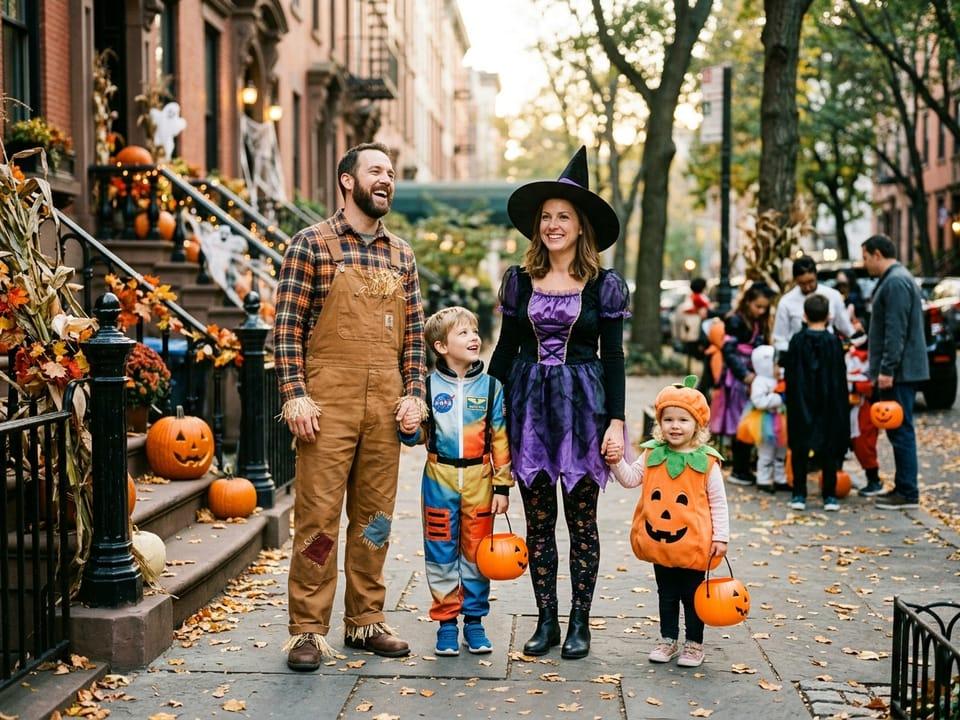
Halloween 2026 falls on a Saturday, and the sun sets around 5:45 to 6:00 p.m. in New York, Chicago, Seattle and Los Angeles, with the last of the twilight gone about half an hour later. That's before most families set out. So take the costume photos at home in the last hour of daylight, before anyone puts a coat on, and treat the pictures from the street as a bonus lit by porch lights. Rain and cold change the evening, but they don't have to cost you the photo.
Halloween night is still on daylight saving time
Daylight saving time ends at 2 a.m. local time on the first Sunday in November, which in 2026 is November 1, according to the National Institute of Standards and Technology (NIST). Halloween evening is the last night on daylight time, so sunset comes later than it will a week afterward. U.S. Naval Observatory figures for October 31, 2026 put sunset at 5:53 p.m. in New York, 5:46 p.m. in Chicago, 5:53 p.m. in Seattle and 6:01 p.m. in Los Angeles, with civil twilight ending between 6:15 and 6:27 p.m. Hawaii and most of Arizona don't observe daylight saving time, though the Navajo Nation in Arizona does. The Observatory's one-day calculator gives the times for your own town.
Shoot the costume at home before sunset
The hour before sunset is the easiest light of the day: low, warm and kind to faces. Pick a spot in open shade, such as the front porch, the side of the house or under a tree, and turn your child toward the brightest part of the sky. Frame wide enough to show the whole costume, shoes and treat bucket included, because those details disappear in the dark. With a toddler, this is also the window when the costume is still on and still clean. Our outdoor first birthday guide explains open shade and golden hour in more detail.
Give it ten minutes, not an hour. One photo of each child alone, one of the siblings together, one with the adults, and one of the decorated door if you made the effort. Then you can head out with the important pictures already taken.
After dark, use the porch light and stay visible
Phone night modes, such as Night mode on iPhone or Night Sight on Pixel, work by gathering light over a second or more, which is perfect for a lit pumpkin and hopeless for a child mid-sprint. Ask your child to freeze like a statue for a count of two, brace the phone against a railing or your own chest, and tap their face to focus. Stand them under a porch light or beside a glowing jack-o'-lantern rather than under a streetlight that lights them from straight above. If you'd rather have a sharp candid than an atmospheric one, turn the flash on. It freezes motion and flattens the background, often a fair trade at 7 p.m. The exposure and focus tricks in our phone photo settings guide work just as well on a six-year-old superhero.
Being seen matters more than any picture. The American Academy of Pediatrics (AAP) asks families to choose bright, reflective costumes, add reflective tape or glow-in-the-dark items to costumes and treat bags, carry a flashlight after dark and always go with young children. It also asks everyone to use sidewalks, cross at crosswalks and avoid distracted walking, and that includes the parent holding the phone. Stop on the sidewalk to take a picture, never mid-crossing. Reflective tape has a side benefit: in a flash photo it shows up as a bright stripe that looks like part of the costume.
Cold or wet, plan the costume around the coat and the umbrella
In much of the country a warm layer is non-negotiable by late October. Size the costume to fit over a thermal shirt and leggings, so the coat is the only thing you add later. Some costumes survive a coat better than others. A hat, cape, wings or a pair of ears still reads as a costume over a puffer jacket, while a full-body print disappears entirely, which is another reason to take the main photo before the coat goes on. The AAP's reminders hold for winter layers too: hats shouldn't slide over the eyes, and costumes shouldn't be long enough to trip on.
For rain, check the forecast in the morning and decide early. A clear dome umbrella keeps the costume visible in photos, and a clear poncho does the same for a child who wants both hands for the candy bucket. Wet pavement reflects porch lights, so a rainy street can photograph better than a dry one if you crouch low. In a downpour, a trunk-or-treat in a parking lot or an indoor event at a school, church, library or mall gives you light and a roof. Keep a microfiber cloth in your pocket for the lens.
Book a photographer for a dry afternoon, not for the 31st
A photographer and trick-or-treat night rarely mix. Paid Halloween photos usually mean a fall mini session at a pumpkin patch or a studio set in the weeks before, in daylight, with a short slot and a session fee. That gives you a polished costume portrait without depending on the weather that evening, though a rained-out date or a child who refuses the costume means rescheduling on the photographer's terms. Your own photos cost nothing, adapt to the weather and the mood, and show your real street, but the light is only good for that last hour. If you want both, book the professional picture for a mid-October afternoon and keep the 31st for candy and your phone.
If the night photos didn't come out
Sometimes the light, the weather and the kids all go the other way, and the camera roll fills with grainy shapes under a porch light. pokesta can turn the phone photos you already have of each family member into an AI Halloween family picture on a decorated porch or a leafy sidewalk at dusk. It's a generated image, not a record of your street that night, so hold on to the real ones too. At $1 per photo with your first photo free, make one from a recent daytime photo of your kids and see whether it fills the gap.
References