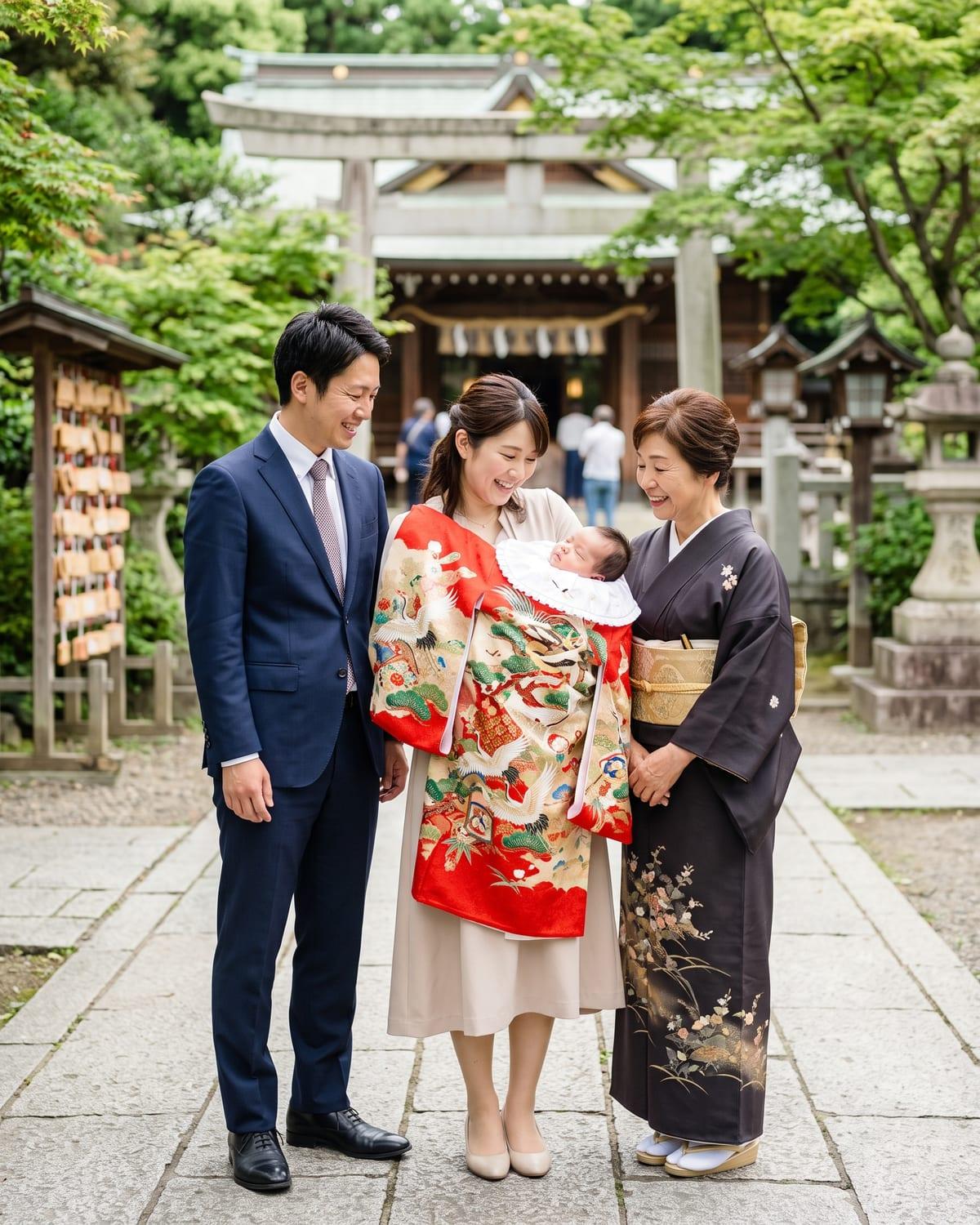
Yes, you can hold a newborn's Omiyamairi (the first shrine visit, usually about a month after birth) and an older child's Shichigosan (the autumn shrine visit for children aged three, five and seven) on the same day. Otori Taisha in Sakai, Osaka, says families may receive the Shichigosan blessing together with a sibling there for Omiyamairi. We found no official shrine notice that gives a combined offering. As a guide, add up the two ceremonies' amounts, which comes to 17,000 yen at Otori Taisha (10,000 yen for Omiyamairi plus 7,000 yen for Shichigosan), and confirm by phone. Also, a shrine visit plus a photo shoot is a long day for a one-month-old and a mother who has just given birth. If you're torn, do the shrine visit together and move the photos to another day; that split is usually the easiest on everyone.
Add up the offerings, then phone the shrine
Whether two children can share one blessing ceremony, and how the offering (hatsuhoryo, the fee paid to the shrine) is counted, depends on the shrine. Each shrine sets its own amount per ceremony, as in these examples (checked on official sites in November 2026; Otori Taisha's Shichigosan figure comes from its 2025 notice, and amounts can change).
| Shrine |
Omiyamairi |
Shichigosan |
Doing both together |
| Otori Taisha (Sakai, Osaka) |
10,000 yen |
7,000 yen per child |
Allowed with a sibling there for Omiyamairi; no combined amount given |
| Sumiyoshi Taisha (Osaka) |
10,000 yen |
10,000 yen for one, 15,000 yen for two siblings |
Not stated |
| Kawagoe Hachimangu (Kawagoe, Saitama) |
10,000 yen |
Not listed (individual blessings from 5,000 yen) |
Not stated |
Otori Taisha's two amounts add up to 17,000 yen. Sumiyoshi Taisha's add up to 20,000 yen, but it also has the 15,000 yen rate for two siblings. That rate covers two Shichigosan children, though, and the page doesn't say whether a baby there for Omiyamairi counts the same way. The two readings differ by 5,000 yen, so bring the added-up amount and check by phone before you go.
A Studio Alice column says that when one envelope carries several names, the basic amount is the per-person offering times the number of people. It adds that whether shared names are accepted varies by shrine or temple, and that you may receive only one set of gifts. On the envelope itself, Santai Jinja in Gunma tells families combining Omiyamairi with a sibling's Shichigosan to write both names on it. The same column shows siblings' full names written from the right, oldest first.
A short phone call covers what you need: can both children join the same ceremony, what is the offering for each, should the money go in one envelope or two, and will each child receive their own gifts? Neither Otori Taisha nor Sumiyoshi Taisha takes reservations; reception on the day runs from 9:00 to 16:00 at Otori Taisha and from 9:00 to 15:50 at Sumiyoshi Taisha.
Several shrines in Japan go by the name Sojagu. Bitchu-no-kuni Sojagu in Soja, Okayama, lists prayers from 5,000 yen per person and takes Shichigosan blessings at any time between 8:00 and 16:00 from late October to early December, with no reservations except for off-site rites. It still performs them outside that period but can't give out chitose-ame candy. Hitachi-no-kuni Sojagu in Ishioka, Ibaraki, said in a 2024 notice that it held Shichigosan prayers every 30 minutes from 9:00 to 16:00 and recommended booking for weekends and holidays. Neither notice covers doing Omiyamairi at the same time.
Ask about photography in the same call. Otori Taisha allows photos anywhere on the grounds, but not inside the prayer hall during the ceremony, and photographers can't enter the waiting room or the hall. Kawagoe Hachimangu lets a photographer accompany families during the blessing only if they use the shrine's own photo studio.
The strain lands on the baby, the mother and the older child's dressing time
Combining the two events stacks up the hard parts. The biggest is the health of the baby and mother. Omiyamairi is commonly held around day 30 to 33 after birth, but check at the one-month checkup whether an outing is fine, and follow your obstetrician's or pediatrician's advice. Pushing the date later to suit recovery is safer than pulling it earlier to catch the autumn Shichigosan season.
Next comes the older child's kimono. Dressing and hair take time, and feeds and diaper changes pile up while you wait. Get the older child ready at home or at a salon nearby, and simply drape the iwaigi (the celebratory kimono laid over the baby) at the shrine; that removes one task once you arrive. For keeping an older sibling occupied, see Omiyamairi with an older child.
Autumn shrine grounds can feel very different in sun and shade. When you ask about reception hours, also ask whether you can wait indoors or in the car, and where you could feed the baby.
Studio, location photographer or DIY: compared for two children at once
Here's how the options look when you photograph both children together. Prices were listed on each official site in October 2026 and vary by season, branch and plan, so check before you book.
|
Photo studio (e.g. Studio Alice) |
Location photographer (e.g. fotowa) |
Do it yourselves |
| How cost works |
Flat 5,500 yen session fee per family, plus prints |
24,200 yen weekdays, 29,700 yen weekends and holidays, 75+ digital photos |
Just gear like a tripod |
| Strain on baby and mom |
Indoors, weather-proof, but about two hours |
About 60 minutes at the shrine, done in one outing |
Stop whenever you need |
| Rescheduling |
No cancellation fee if a child falls ill on the day |
Free date change until the day before |
Entirely flexible |
| Results |
Even studio lighting, kimono patterns in sharp detail |
The family at the torii gate and shrine |
Everyday expressions, uneven quality |
| Best for |
Group photos with grandparents included |
Capturing the visit itself |
Low cost, health first |
A studio is clearly worth it when you want two children dressed and styled in one place, or a large group shot with both sets of grandparents. Studio Alice includes siblings' costumes, dressing and hair in its session fee, and lends an iwaigi free with an Omiyamairi booking. The iwaigi is due back by noon the day after the shoot, though, so if you plan to wear it to the shrine, the shoot and the visit can't be far apart.
A location photographer can capture both children before and after the blessing. As noted above, some shrines restrict photography during ceremonies or limit outside photographers, so check the shrine's rules first. For rain, fotowa says photos can be taken under eaves or inside shrine buildings, and asks families to talk with the photographer in advance about going ahead or rescheduling. A newborn shouldn't spend long on wet shrine grounds, so when in doubt, change the date.
Split off the photo day and nobody has to push through
Keep only the shrine visit on the shared day. That protects the baby and mother and still gives the older child their moment. On the day, the older child wears the kimono, the baby wears the draped iwaigi, and a few phone photos are enough. Take the sibling photos as soon as you reach the grounds, while the older child still has patience left.
Keep the day's order simple: reception, blessing, photos on the grounds, home. Skip the celebratory meal or move it to a day when the baby can stay home. A seven-year-old will spend hours in a tied obi, so it's fine to change them out of the kimono soon after the visit. Set the time you'll be back home based on the baby's feeding schedule, and the day won't drift.
Book the studio for another day, once mom has recovered. At a studio that charges per family, as Studio Alice does, bringing the baby to the older child's Shichigosan shoot doesn't add a second session fee. For posing two children, see Shichigosan sibling photos.
If you really want professional photos on the same day, book a location photographer for just 60 minutes and keep it to the grounds before and after the blessing.
A photo of both children together can still come later
Sometimes the baby's health keeps postponing photo day, and the season passes without a photo of both children dressed up. In that case, pokesta can create a commemorative image of the baby in an iwaigi and the older child in Shichigosan kimono, using the photos of each family member already on your phone. It's $1 per photo and you can do it from home. The result is a newly created image, not a record of the day, but it can hang next to the photos from your actual visit. The first photo is free, so try it with a photo of your children: create an Omiyamairi photo.
References
- Otori Taisha, "Shichigosan blessings at Otori Taisha" (in Japanese) https://www.ootoritaisha.jp/2025/11/753/
- Otori Taisha, "Prayers, amulets and goshuin" (in Japanese) https://www.ootoritaisha.jp/kitou/
- Sumiyoshi Taisha, "Shichigosan" (in Japanese) https://www.sumiyoshitaisha.net/worship/753.html
- Sumiyoshi Taisha, "Hatsumiya Mairi" (in Japanese) https://sumiyoshitaisha.net/worship/hatsumiya.html
- Kawagoe Hachimangu, "Prayers (Magokoro Sanpai)" (in Japanese) https://www.kawagoe-hachimangu.net/about-1
- Santai Jinja, "What envelope for the Omiyamairi offering, and how much?" (in Japanese) https://www.santai-jinja.jp/blog/omiyamairi-hatsuhoryo/
- Bitchu-no-kuni Sojagu, "Prayers" (in Japanese) https://www.soja-soja.jp/pray/
- Hitachi-no-kuni Sojagu, "Shichigosan prayers now accepted" (in Japanese) https://sosyagu.jp/%E3%81%9D%E3%81%AE%E4%BB%96%E3%81%AE%E7%A5%AD%E3%82%8A%E3%83%BB%E5%82%AC%E3%81%97/2664.html
- Studio Alice, "Can the offering be in joint names?" (in Japanese) https://www.studio-alice.co.jp/shortcut/omiyamairi/column/detail74.html
- Studio Alice, "Omiyamairi and newborn photos" (in Japanese) https://www.studio-alice.co.jp/shortcut/omiyamairi/
- fotowa, "On-location Omiyamairi photography" (in Japanese) https://fotowa.com/first-shrine-visit