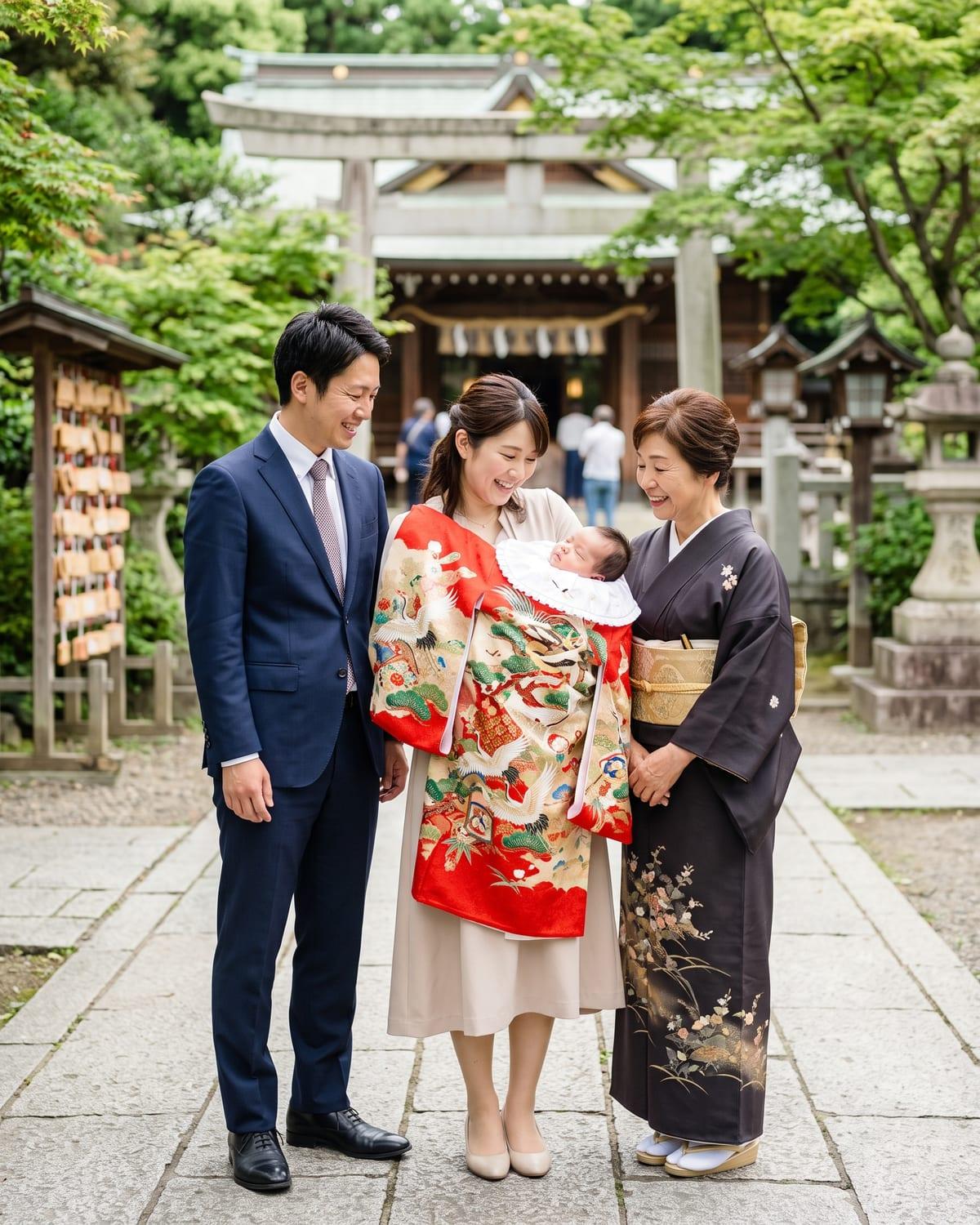
For a summer baby, Omiyamairi (a newborn's first visit to a Shinto shrine, traditionally about a month after birth) is all about managing the heat. The surest protection is to avoid the middle of a midsummer day. There's no need to stick to the one-month mark; pushing the visit back until it's cooler is fine, and if you do go, get it done in the morning. Drape the iwaigi, the ceremonial kimono, only for the moment of the photo, and plan the day so you spend as little time outdoors as possible.
You don't have to go at exactly one month
Traditionally, Omiyamairi has been done around the 31st or 32nd day after birth for boys and the 32nd or 33rd for girls. Today, though, the date is usually chosen around the baby's and mother's health, and there's no need to push through the worst of the summer heat; postponing to a more comfortable season is considered fine. Shrines allow flexibility too. Kawagoe Hachimangu, for example, gives the window for the first shrine visit as days 31 to 100 for boys and days 33 to 100 for girls.
You don't have to move everything at once, either. Take the family photos at a studio first, go to the shrine on your own as a family once it cools down, and hold the celebratory meal on another day. Split up like that, each day is much less of a strain.
If you go, go early, right when the shrine opens
If you decide to go in midsummer, choose the morning. Many shrines start taking blessing visitors at around 9:00, so if you leave home to arrive when they open, you can finish before the sun gets strong.
Even when it still feels cool to an adult, it may not be for the baby. Japan's Consumer Affairs Agency points out that children are shorter and so receive more radiant heat from the ground than adults, and urges parents to assume a child is in a hotter environment than they are. Some local governments also warn that babies in strollers are exposed to heat from the ground. Gravel and stone paving on the shrine path reflect more heat the higher the sun climbs.
If you're driving, cool the car with the air conditioning before putting the baby in, and find out in advance how far the parking lot is from the shrine hall. Never leave the baby alone in the car, even for a moment.
In a baby carrier, the adult's body and the baby's are pressed together, and heat builds up between them. A cooling insert for the carrier, or a parasol that shades you both, takes the edge off. For a baby this young, hydration means breast milk or formula, so feed right before you leave home. In case the nursing room at the shrine is busy, bring a bottle of ready-to-drink liquid formula that can be served at room temperature.
The iwaigi goes on only for the blessing and photos
In summer, the rule for babies and adults alike is to be formally dressed only for the moment of the photo. An iwaigi traps heat, warming not just the baby but whoever is holding them. Leave it off while moving and waiting, and drape it only for the blessing and the commemorative photos. An iwaigi isn't required in the first place, so in midsummer you can choose a white baby dress alone.
For the baby, choose breathable, sweat-absorbent fabrics such as gauze, plain cotton jersey or rib knit. Even when it's hot, put on an undershirt, and bring a spare set. Rather than bare feet, put on thin socks: at a shrine visit or blessing, bare feet can come across as bad manners.
If mom wears kimono, there's ro, a loosely woven kimono fabric that lets air through. In Western clothes, an airy dress or coordinated set works. Dad can carry his jacket while walking and put it on only when entering the hall and for photos. Pale colors that don't absorb heat and fabrics that don't trap it make everyone more comfortable. If there's an older sibling, skip sandals and bare feet for them too.
Photos that hold up against sweat
Sweat is the main summer photo problem: sweat on the baby's forehead and neck, a shiny face on whoever is holding the baby, a baby dress clinging to damp skin. Resting in the shade for a few minutes and wiping off the sweat before you shoot makes a big difference. Give a gauze handkerchief to both the photographer and the person holding the baby, so either can wipe quickly. Whoever is holding the baby tends to get sweaty bangs stuck to their forehead, so a quick check with the phone's front camera just before shooting saves you from noticing it later.
Shoot in the shade of trees or a building, not in the sun. Midsummer sun from directly overhead casts hard shadows on faces and raises the baby's temperature too. Under the trees the light is soft, and the pattern on a white iwaigi won't wash out.
A surprise pitfall is a fogged-up lens. Step out of an air-conditioned car or waiting room into humid air and the chilled phone lens mists over, giving you hazy, washed-out photos. Wait a few minutes once you're outside, or wipe the lens and check it before shooting.
Decide in advance how many photos you need. One family group shot in front of the main hall and one close-up of the baby being held in the shade. Once you have those two, the rest can wait until you're somewhere cool. In summer, heading back indoors sooner does more for the baby's mood and the expressions in your photos than staying out for more shots. For group photos with the grandparents, bring the baby in only after everyone else is lined up, to cut the baby's time in the sun by even a minute.
Signs that mean "get somewhere cool now"
Babies can't tell you they're too hot. If the baby's face is flushed, if they're sweating or crying differently from usual, or if they seem limp, stop the photos and move to an air-conditioned place. Loosen their clothes and cool the neck, armpits and groin. In Japan, the Consumer Affairs Agency points parents to #7119, the emergency advice line, if they're unsure whether to see a doctor.
When you book, ask whether there's an air-conditioned waiting area where you can wait for the blessing. On the other hand, an over-chilled waiting room can make the baby cold, so bring a light cape to adjust.
In summer, cut the time outdoors, not the time for photos
For a midsummer Omiyamairi, the basics are: postpone if you can, go in the morning if you can't, and stay outside only while you're taking photos. A few minutes in the shade, with the sweat wiped off, are enough for good pictures. See how other families handled summer visits in the Omiyamairi posts. For choosing the date in general, see When to do Omiyamairi, and for year-round outfit advice, see What to wear for Omiyamairi.
References