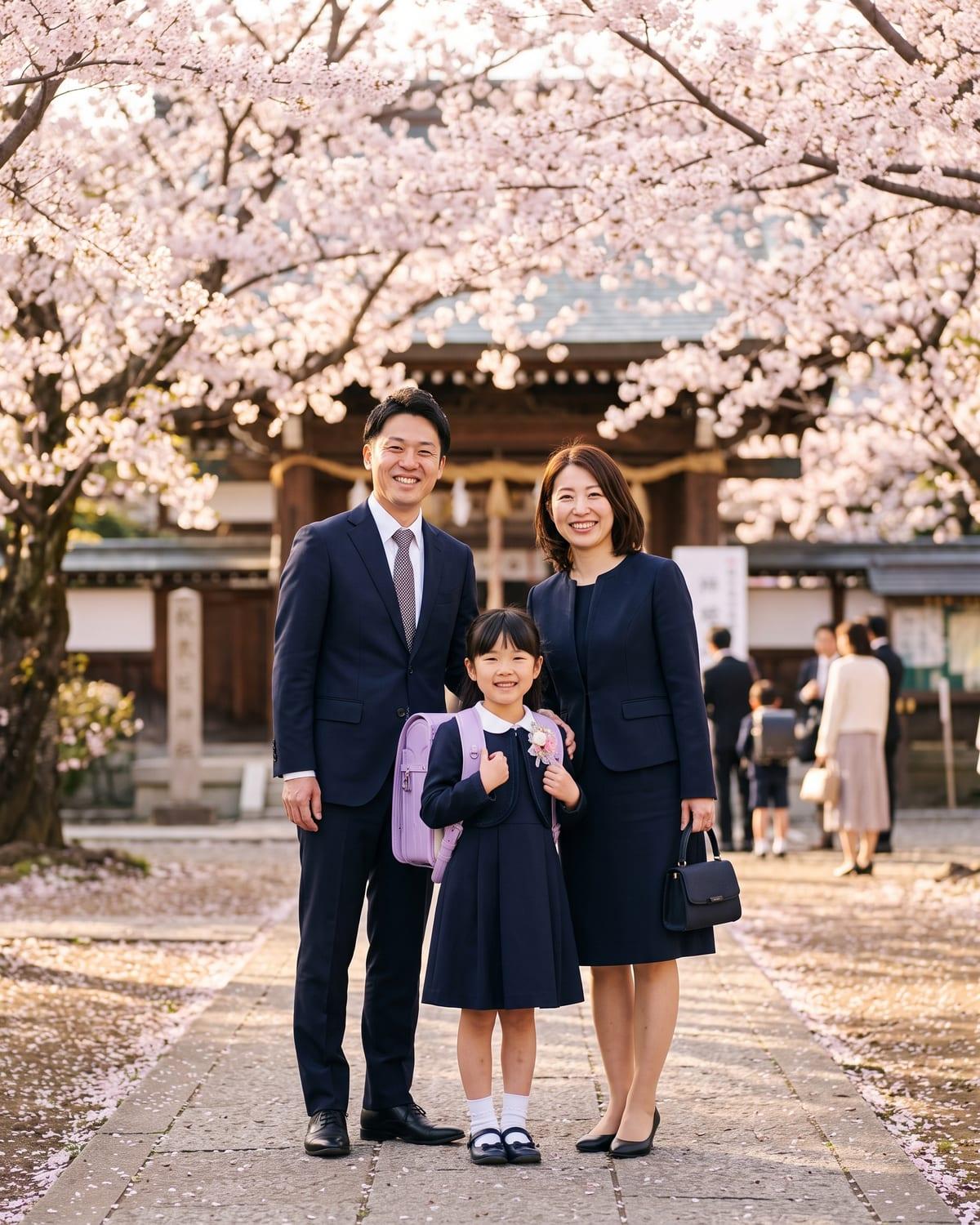
Take a photo on the morning your child starts preschool, then another in the same spot on the morning they graduate. Put the two side by side and you'll see at a glance that the baggy uniform now fits, and that their head has reached the door handle. In Japan, children start kindergarten or daycare with a Nyuenshiki (an entrance ceremony held for new children, usually in April), which makes that first morning a natural starting point. With fixed-point photos, shooting the same way every time matters more than shooting well. On day one you only need to decide three things: the place, a record of the framing, and which days you'll shoot. How you set up that first photo largely decides whether you keep going.
Choose a spot that won't change before graduation
The school gate is the obvious idea, but it isn't a good one. On event days it's covered in signs and decorations, and other families are waiting their turn. You may not be able to get in on weekends, and a renovation could replace the gate or fence altogether. To shoot the same frame year after year, you want somewhere you can stand whenever it suits you.
Your own front door is the easiest place to keep going. The door, nameplate and mailbox barely change over the years, and with a steady background, the only thing your eye picks up is your child. If you live in an apartment with little space outside the door, the inside of the entryway, in front of a shoe cabinet, works too.
If you expect to move, settle on a background you can take with you instead of a place: always the same chair, or always in front of a wall of the same color. Even in a new home, the ratio of chair to child shows the growth.
After the first shot, write down the framing
Most fixed-point series become hard to compare because the photographer stands somewhere different and holds the camera at a different height each time. If you lower or raise the camera to match your child's height, their head lands at the same spot in every frame and the growth disappears. Fix the camera height to the house, not to the child.
The method is simple. Mark where the photographer stands using a grout line or the edge of the doormat, and settle roughly how high the phone is held, say at chest level. Don't zoom; leave it at the standard lens. Decide on portrait or landscape at the start; for a full-length shot, portrait is easier. Turn on the grid lines and note which square the door frame or another fixed line falls in, so you can match it next year.
Save those notes with the first photo in a shared family note: "Stand at the right edge of the mat, phone at chest height, door handle on the lower-right grid line." Next year, even if someone else is holding the phone, the photo will match.
Where your child stands, and something to measure against
Mark your child's spot on the floor too, and leave plenty of room above their head. Children grow a lot between three and six. If the first photo is a snug fit, a few years later their head will be cut off.
Including something that doesn't change makes growth easier to compare. A parent works well: adult height barely moves, so you can see a child who reached a parent's waist creeping up toward their chest. Another option is having your child hold the same stuffed toy every year. Watching the toy look smaller and smaller is a record in itself.
Uniforms and school bags are often bought a size up at the start. A first photo with sleeves down over the backs of the hands is the one that will hit hardest next to the graduation photo, so don't roll them up. Tips for uniform photos are in our article on uniform and smock photos.
Shoot once or twice a year, and plan around the usual reasons for stopping
Good candidates are the morning of the entrance ceremony, the day your child moves up a class each year, and graduation morning. Preschool graduation ceremonies in Japan usually fall in mid-to-late March, so pairing them with April's starts and class moves gives you two shots a year at nearly the same point in the seasons. Same season means similar clothes and similar light.
Keep the time of day consistent as well. If you always shoot before drop-off, the light comes from the same direction. A child who starts at three has three years until graduation; one who starts daycare as a baby may have close to six. For longer stretches, once a year, perhaps on the morning of a birthday, is easier to sustain.
People usually stop for the same three reasons: they forget the day, the child refuses, or the weather is bad. You can deal with all three on day one.
Put the shoot days in your phone calendar as a yearly repeating event and add where the notes are saved. On days your child doesn't want to cooperate, take three shots and stop. They don't need to be smiling; a reluctant face is still that year's face. Decide from the outset that rainy days mean shooting inside the entryway, and you'll never have to postpone.
Decide how you'll name and store the photos so they're easy to line up later. If you add each one to a shared album called "Same spot," you'll never have to hunt for them. For more on organizing, see our article on sorting your entrance ceremony photos.
On graduation day, line them up by the background
Once graduation is over, put the photos side by side. How you arrange them changes a lot, so take a little care here as well.
First, crop every photo to the same size. Use something fixed in the background, like the door frame or a line on the floor, as the reference, not your child's head. With the background aligned, you can watch the top of their head rise a little each year. Crop so their face is centered and the growth vanishes.
Arranged left to right by year is the clearest layout. Three years fit in a single row; six years work as two rows of three, which stays readable on a phone screen. Add the date and your child's age in small text under each photo. After a few years, even parents can't remember which photo was which age.
If you want to print and frame them, make one combined image first; it fits a frame more easily. It also works as the last page of a graduation album or as a graduation update for grandparents.
One more idea: write down something your child said or loved that year to go with each photo. "Age three: loves trains." "Age five: can write their name." A few words keep what a photo can't show.
The first photo doesn't have to be good
The morning of the ceremony is hectic, and the first photo rarely turns out the way you pictured. Take it anyway; from next year it becomes the reference. What matters is writing down the place and the framing. If the photos you line up on graduation day share the same background and the same light, that alone makes a fine record.
You can see other families' photos in everyone's entrance ceremony posts.
References