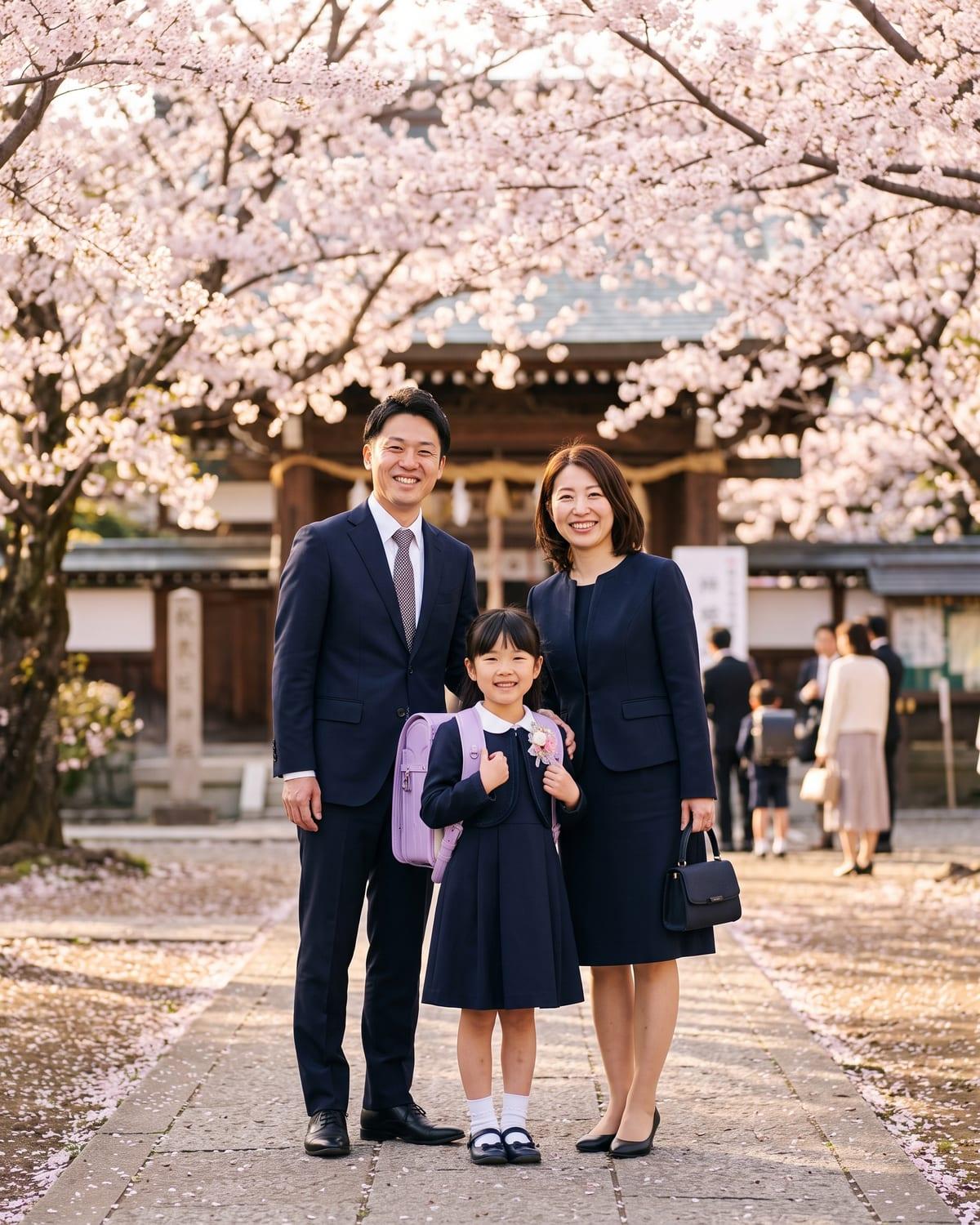
Many Japanese kindergartens have children wear a uniform, a hat and a smock (a loose overshirt worn for play and crafts), and families usually buy them big enough to last until graduation. In photos from the first day, that means sleeves swallowing the hands and a hat sliding down over the eyes. That's part of what starting kindergarten looks like, but a little adjusting before you shoot changes the result a lot. Line up the shoulder seams, fold the sleeves inward, set the depth of the hat. Hold the camera vertically at your child's waist height. That's enough to make a baggy uniform look like clothes waiting for your child to grow into them.
With an oversized uniform, start with the shoulders
Many families order the uniform large with growth in mind. In an article on kindergarten preparation published on Suginami City's website in Tokyo, the writer says they ordered about two sizes up so it would last until graduation, and had it hemmed. When big clothes look sloppy, the cause is usually where the shoulders sit, more than the sleeve length.
Once the jacket is on, check how close the shoulder seam is to the edge of your child's shoulder. If it has dropped well down the arm, the whole jacket looks like it's sliding down. Tug the back hem down a little, close the front and do up the buttons, and the shoulders rise. If the collar stands away from the neck, sort out whether the shirt or blouse collar goes outside the jacket according to the school's rules.
Hanging the uniform up the day before you shoot makes the creases from the box much less noticeable. Even if you only iron the shirt collar and cuffs, the collar sitting right under your child's face will look crisp in the picture.
Fold sleeves inward, and set the hat depth with the elastic
If the sleeves cover the backs of the hands, fold the cuffs inside. Folding them outward shows the lining or adds bulk that makes the arms look thick. For the length of a photo session, simply tucking them in is enough; there's no need for safety pins. It will come loose as your child moves around, so fix it just before you shoot.
If trousers or a skirt are too long, fold the hems inward too. When the indoor shoes or outdoor shoes are hidden, the feet look heavy in full-length photos.
After putting the hat on, check that it isn't covering the eyes. If it's big, the brim drops over the eyes and shades the top half of the face. Adjust the depth with the hat's elastic, or slip a piece of soft towel inside so it sits higher. Don't tighten it just for the photo; ask your child, "Does that hurt?" as you adjust.
For the smock, cuff elastic means hands that show
A smock goes over the uniform or gym clothes, so it's often bought in a roomy size. A HugKum article notes that larger sizes tend to have longer sleeves, so it suggests picking one with elastic at the cuffs. The elastic stops the sleeve at the wrist, and your child's hands show properly in photos.
Children move more naturally in a smock than in the uniform. Hand them drawing supplies, or photograph them building with blocks, and you get pictures that hint at their days at kindergarten. Shooting what their hands are busy with says "smock" better than having them stand straight for the camera.
Full-length from waist height; get the back and the chest too
If an adult takes a full-length uniform photo standing up, shooting down, the child's head looks big and their legs short. Crouch, hold the camera at your child's waist height, and turn the phone vertical. Leave a little space above the head and below the feet so the frame doesn't feel cramped. With the grid turned on, vertical lines stay straight.
Choose a spot with a simple background: in front of your door, a white wall at home, a hedge in the garden. With a navy or gray uniform, a light background makes your child's outline clearer. Set up so light falls on your child from the front or at an angle from the front. Phone cameras struggle with backlight, and a child with the sun behind them comes out with a dark face. If the brim is casting a hard shadow, stepping from sun into shade softens the edge.
A photo from behind is another one that belongs to this moment. A back with a big school bag, the elastic at the back of the hat, a jacket hem a little too long. You don't need to worry about expressions the way you do from the front, so it's an easy shot even with a nervous child. Take it from a little way back as they walk from the front door to the gate.
Separately from the full-length shots, take one close in on the chest. The name badge, the school emblem, the buttons, the ribbon at the collar. They're too small to see in a full-length photo, but years later it's details like these that remind you, "That's what the name badge looked like." While your child's hands are still small, it's worth photographing them holding the hat brim with both hands, or gripping the strap of their school bag.
Some children hate wearing the uniform. The neck feels tight, the jacket is heavy, the hat elastic is annoying. In that case, promise up front that the photos will be quick. Agree on "three photos and we're done," and take it off as soon as you've finished; it'll be less of a fight next time. Start with the shots you care about most while they're freshly dressed and still in a good mood.
Repeat the same shot six months and a year later
An oversized uniform fits a little better each time it's worn. The jacket that was baggy at the start fits just right after the summer break, and by graduation the sleeves are short. To capture that, take a photo in the same spot and framing as on the first day, every time the seasons turn. How to choose the spot and framing, and how to keep it going year after year, is covered in our article on same-spot photos from entry to graduation.
If you're having uniform photos taken at a studio, all of these adjustments still apply. For checking whether you can bring the uniform and when to book, see our article on studio photos for starting kindergarten.
Big is part of the record
Even with the sleeves folded and the hat adjusted, a first-year uniform still looks big. That's fine. A slightly baggy uniform is a photo you can only take that year. Adjust just enough that the face, hands and feet show clearly, and keep the rest, size and all. Years later, lined up with the others, it'll be the picture that shows best how much your child has grown.
References