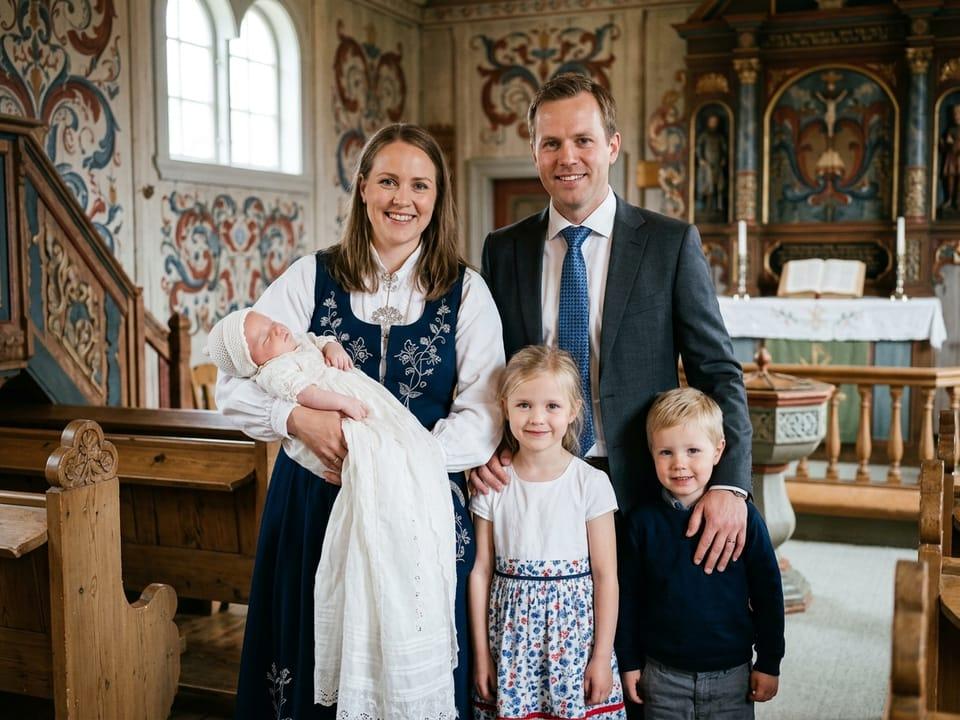
At a winter baptism in Norway, take the family photos inside the church after the service, and keep any outdoor picture to a minute or two with everyone's coats on. On 21 December the sun is up in Oslo only from 09:18 to 15:12, and in Tromsø it doesn't rise at all between late November and mid-January, so the daylight coming through the church windows around a midday service is often the best light you will get.
A baby in a thin gown loses heat fast, and wind makes it worse
Helsenorge, the national health portal, explains that a healthy infant should have a stable body temperature but doesn't regulate it the way older children do, and can therefore quickly become too cold or too warm. Cold, wind and humidity all affect a baby, so individual judgement is needed. Its winter advice for small children adds the details: children get cold faster than adults, hands, feet, nose, ears and cheeks are most at risk of frostbite, and wind makes the effective temperature lower than the thermometer shows.
A christening gown is the opposite of what that advice recommends. Helsenorge suggests dressing in layers, with wool regulating warmth better than cotton, covering the head and neck, and checking that hands and feet are warm. A sweaty neck means the child is overdressed and can cool quickly afterwards. In practice, put a thin wool body and wool tights under the gown, carry the baby to church in a bunting bag or snowsuit over the gown, and keep a hat on until the bonnet goes on inside. Norwegian babies often nap outdoors in winter, but that is in a pram with a sleeping bag and a weather cover, which is a different situation from holding a baby in a gown on the church steps. Even for those outdoor naps, Helsenorge advises watching the child's body temperature closely at around minus 10 to minus 15 degrees, especially when it's windy.
Once inside, unwrap: the church is warm
The opposite risk matters too. Helsenorge points out that if you take a child dressed for winter into a warm place, such as a shopping centre, you should take off blankets or the bunting bag. A heated church in December can be the same. Unzip the outer layer as soon as you sit down, so the baby isn't already damp with sweat when it's time to go back out. A sweaty, overheated baby is also an unhappy one, which shows in the photos.
Plan the photos around a few hours of light
Daylight is the second problem. According to MET Norway, the Norwegian Meteorological Institute, the sun in Oslo rises at 09:18 and sets at 15:12 on 21 December 2026, and even at midday it climbs less than seven degrees above the horizon. In Tromsø, Store norske leksikon gives the polar night (mørketid) as 26 November to 17 January, when the sun stays below the horizon all day. The dates can shift by a day from year to year.
That changes the order of the day. In the south, the window between late morning and early afternoon is your best outdoor light, and the half hour after sunset brings a short blue twilight that looks good with snow and a lit church. In the far north, there is no sunlit picture to wait for, so rely on the church's own lights and on the glow from the snow outside.
Inside the church, use the font, the windows and the lights
The best place for a winter family photo is by the font after the service. Many parishes welcome pictures there after the service, though it's worth asking during the baptism conversation; our guide to who should photograph the baptism covers parish photo rules. Ask the staff whether the lights can stay on for ten minutes.
Turn the family so the windows light their faces from the side, not from behind. On a phone, night mode works well in a dim church as long as everyone holds still for two seconds, so count it out loud. If you step outside, do it last, with coats and hats on, the baby wrapped and only the face showing, and keep it to one or two quick frames. The gown can be photographed indoors, and a coat in the picture simply tells the truth about a Norwegian December.
Studio, photographer or your own phone in the dark months
A studio is the one option that ignores the weather and the dark. The light is the same at 15:00 in January as in June, the room is warm, and if the baby catches a cold the session can usually move, so ask about the studio's policy. Prices and what you can skip are in what a studio christening session costs.
A photographer booked for the day is worth more in winter than in summer. Fast lenses and, after the service, extra lights can do what a phone struggles with in a dark church. But the baptism date is fixed, and on a minus-fifteen day with wind, the outdoor shots may simply be cancelled. Your own phone is fine for window-lit pictures and the lunch at home, and it is the least stressful option for a baby who has had enough. If the gown is thin cotton, our guide to borrowing or buying a christening gown includes a merino wool option.
For the snowy fjord picture, use AI instead of the cold
If you'd love a family picture outside a white church in the snow but won't take a newborn out into minus temperatures for it, there's a warmer route. pokesta can create a christening family portrait with AI from the phone photos each of you already has, inside a painted wooden church or outside by a fjord. It costs $1 per photo and the first is free, so try it with a recent picture of your baby before booking an outdoor shoot. It's a created image, not a photo of the day, which is exactly why the baby can stay indoors. Create a winter dåp portrait
References