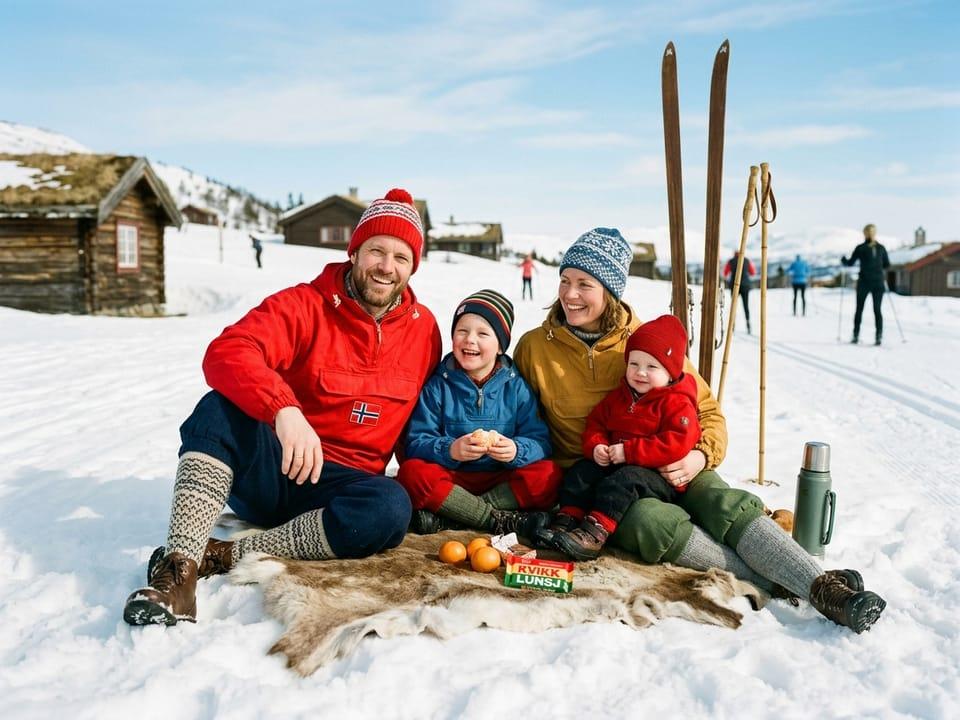
On a sunny Easter slope, faces come out dark because the phone sets its exposure for the bright snow, so tap on a face and set the brightness there. Stand the family with the sun coming from the side, not straight into the children's eyes, and keep sunglasses on until the moment you press the shutter. Keep the phone in an inside pocket between shots: Apple rates the iPhone for use between 0 and 35 °C, and below that the battery can drain quickly or the phone can switch off. And no view is worth leaving safe terrain for.
Bright snow makes faces dark, so expose for the face
Store norske leksikon sums up the classic outdoor Easter in four things: high mountains, a ski trip, fine weather and an orange in the sun against the cabin wall. That last picture is also the hardest one to photograph. A phone tries to make the whole scene an average brightness, and a slope of white snow in spring sunshine pulls everything darker, including the faces.
The fix takes two seconds. On an iPhone, press and hold on a face until the exposure lock appears, then drag the sun symbol up a little. On most Android phones, tap the face and use the brightness slider. If a child's face still looks grey, move so there is less snow in the frame. The dark log wall of the cabin, the solvegg, is the friendliest background you have: it balances the snow and keeps the light warm.
Remember that Easter moves. It falls on the first Sunday after the first full moon after the spring equinox, so Easter Sunday can be anywhere from 22 March to 25 April. In 2027 it is 28 March, and in 2028 it is 16 April. A late-March Easter has noticeably shorter days than a mid-April one, so plan around the light on your own dates, not last year's.
Turn the children sideways and take sunglasses off on three
Snow doesn't just brighten the picture; it adds to the sunlight. The Norwegian Radiation and Nuclear Safety Authority (DSA) notes that reflection from water, sand and snow makes solar radiation stronger, and advises protection whenever the UV index is 3 or higher. DSA researchers have also found that UV in southern Norway has become markedly stronger in spring, and that the Finse mountain plateau gets about 135 percent of the annual UV dose of the south-eastern lowlands.
So don't make children face the sun. Turn the family so the sun comes from one side, or put it behind them and let the snow bounce light back onto their faces. Backlight works well on snow if you expose for a face. Keep sunglasses and goggles on until you count down, have everyone take them off on "three", shoot a burst, and put them straight back on. Children's eyes need that protection more than the photo needs another try.
Morning and late afternoon give lower, softer sun. Midday light is harshest, and it is also when UV is at its strongest.
Keep the phone warm in an inside pocket
Apple says the iPhone and iPad are designed for use at ambient temperatures between 0 and 35 °C. In colder conditions, battery life can be temporarily shortened and the device may turn off; it may also refuse to charge. Battery life returns to normal once the phone warms up.
On the mountain, that means the phone lives in an inside pocket, close to your body, and comes out only for the picture. Do the same with a power bank. A phone left in an outer pocket can show plenty of charge and still shut down without warning. For a family shot with the self-timer, set the phone on a mini tripod or prop it on a mitten on a snow ledge, use a ten-second timer, and take three frames before it goes back in your jacket.
No photo spot is worth an avalanche slope
The Norwegian mountain code, Fjellvettreglene, was written after a series of accidents and deaths during Easter 1950, and a deadly Easter in 1967 led to a new campaign. Two of its rules are worth repeating on any photo trip: take weather and avalanche warnings into account, and turn back in time, since there is no shame in turning around. The Norwegian Trekking Association (DNT) points to yr.no and varsom.no for those forecasts.
DNT's avalanche advice is concrete. Avalanches can start on slopes steeper than 30 degrees and higher than five metres, and you can trigger one from flat ground below by setting off the slope above you. Cornices on ridges can break, and ice on regulated lakes and around inlets and outlets is unreliable. In practice: don't walk under a steep slope or out onto a ridge edge for a better angle. The picture by the cabin wall is just as good.
Studio, photographer at the cabin, or your own phone
|
Studio in town |
Photographer in the mountains |
Your own phone |
| How the cost works |
Session plus images |
Session, images and travel |
No fee |
| Tired or cold children |
Warm room, short session |
Booked time, whatever the mood |
Shoot when they're happy |
| Moving the date |
Easy |
Weather and travel decide |
Any hour of the week |
| Result |
Even light, no glare, no mountains |
Landscape and people together |
Snapshots, real moments |
| Suits |
Families who want a formal print |
Big family gatherings at the cabin |
Most families |
A photographer is worth it when the whole extended family is at the cabin at once and everyone, including whoever usually takes the pictures, should be in the frame. For everyone else, the best hour of a week-long trip beats any fixed appointment.
Take your chance on the good hour, and make the rest at home
Some Easters bring fog all week, or half the family stays behind in town. pokesta can create a påske family portrait with AI from the phone photos you already have, on a sunny slope with oranges and a thermos or against a cabin wall. It is a picture generated by AI, not a record of your trip, so treat it as a different kind of keepsake. Each photo costs $1 and the first one is free, so try it with a recent photo of your child before Easter comes round: create an Easter mountain family photo. You can also see what other families have posted.
References