
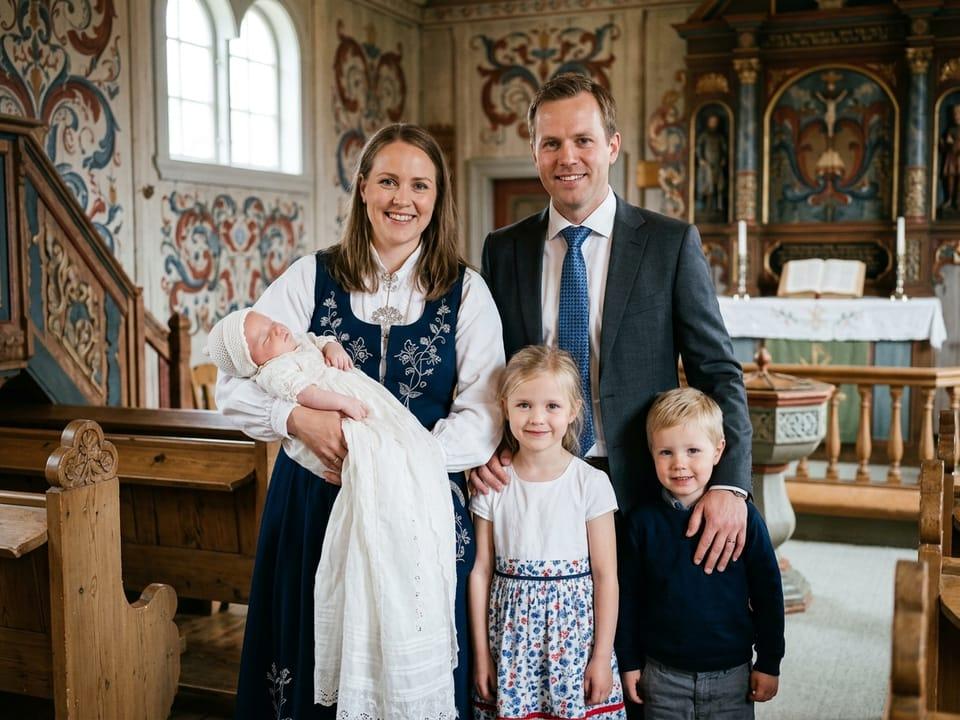
A baby crying at a dåp is nothing the priest or the congregation hasn't heard before. In Den norske kirke, the Church of Norway, a baptism usually takes place inside the main Sunday service, and the priest pours three handfuls of water over the child's head, which few babies enjoy. Feed the baby shortly before the service, sit where you can slip out, and give one relative the job of photographing the water moment from the pew without flash. Then ask the parish in advance whether you can take the posed family photos by the font, the døpefont, once the service is over.
Where the baptism sits in the service
According to Den norske kirke, baptism normally happens during the Sunday main service or in a separate baptismal service. The family is asked to arrive five to ten minutes before it starts. At the font, the priest asks the child's name, and only the first name is used in the baptism itself. The priest pours water over the baby's head three times, and a baptismal candle is lit, which the family takes home. Godparents, called faddere, and others from the baptismal party often take part with readings and prayers. A fadder must be at least 15, and at least two of them must be present at the baptism.
The baptism itself takes only a few minutes, but it sits inside a service with hymns, readings and a sermon, and you won't know the exact moment unless you ask. When you meet or talk to the priest beforehand, ask roughly when in the service the baptism comes, where the family will stand and whether siblings can come up to the font. Several babies may be baptized on the same Sunday, which changes the timing and means other families will be in your photos too. The church's own planning tips note that services are usually over by lunchtime, which is useful when you plan the party.
Why babies cry in church, and what actually helps
Most crying at a dåp has ordinary causes: hunger, tiredness, being passed between unfamiliar arms, a warm gown, the organ and, of course, the water. Helsenorge notes that newborns often feed 8 to 12 times a day and that their awake periods usually last 30 to 60 minutes. A service longer than that will very likely include a feed, a nap or both.
So count back from the start time on your parish's website. Feed the baby just before you leave home or in a side room at the church, so they're full but not starving when the baptism comes. Bring a bottle, dummy or whatever settles them. Dress the baby in a vest at home and put the gown on at church, so they don't overheat in the car. If the baby is restless before the baptism, one parent can walk at the back or step out; Den norske kirke's advice for its Christmas services is that small children can walk around or take a break, and a baptism Sunday is no different in spirit.
If the baby cries at the water, let it happen. It lasts seconds, the priest has seen it many times, and a slightly cross face at the font is a genuine memory too.