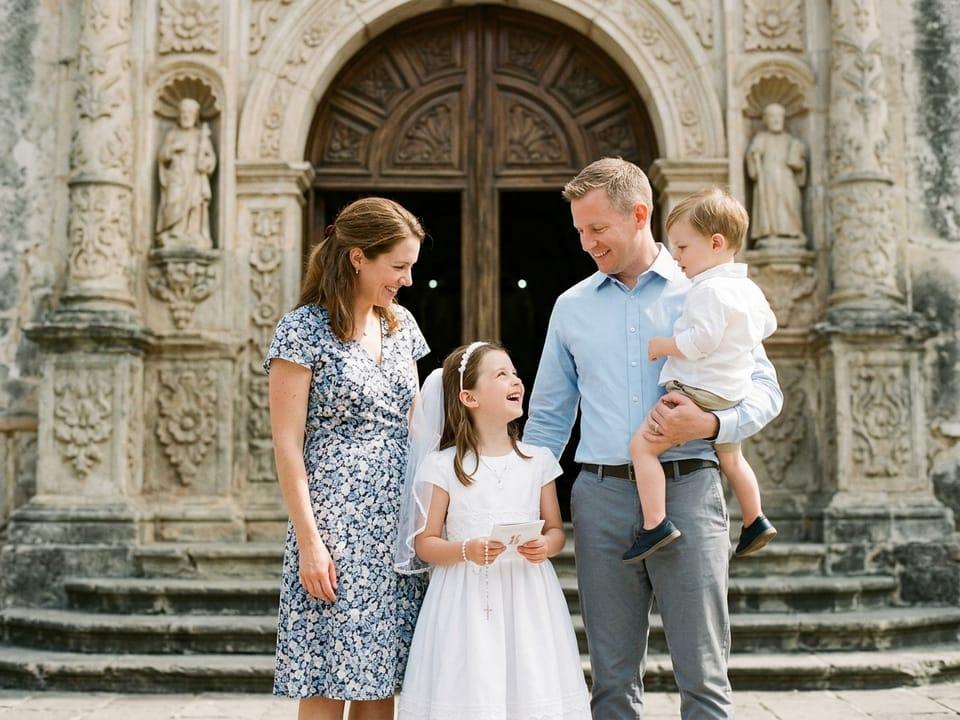
The First Communion photos that are easiest to get right are the ones you take at home in the hour before you leave for church, when the outfit is still spotless and a window gives softer light than the church steps at noon. Give the candle, the rosary and the Bible a few frames of their own, keep anything that stains well away from the white, and the portraits are done before the day gets busy. The plan works the same for a First Holy Communion in Dublin or Manila as for a primera comunión in Lima, Madrid or Guadalajara.
Take the portraits before Mass, not after
Inside the church, the parish decides what you can photograph, and some parishes are strict about it. Saint Theresa Parish in Ashburn, Virginia, for example, asks families not to take any pictures during Mass, has a studio photograph each child receiving Communion, and welcomes family photos with the priests once Mass is over. Children there must be in their preparation rooms an hour before the start, and the parish schedules its individual portraits before that call time. Wherever you are, the calmest time for photos of your own is at home, before you leave.
Work backwards from the time you need to leave. Anyone receiving Communion keeps the Eucharistic fast, nothing but water or medicine for at least an hour beforehand, so breakfast comes early anyway. Dress the child last, after breakfast and a trip to the bathroom, then allow about twenty minutes for photos and ten more for a veil that won't sit straight. You can take more after Mass, but by then the veil has been sat on, a white shirt may have met a classmate's juice, and the child mostly wants to celebrate. In Mexico the traditional First Communion breakfast of tamales and atole champurrado, a thick hot drink of corn and chocolate, is served after Mass, which suits the photos well. Portraits first, champurrado after.
Window light, and a background that isn't white
Pick a window the sun isn't shining straight through, or wait until it has moved round. Stand the child about an arm's length from the glass and turn them partly towards it, so the light falls across the face from the side instead of flattening it from the front. Never put the window behind them. The phone exposes for the bright glass and the face goes dark.
White is the hard part. A white dress or suit fills much of the frame, and phones tend to turn lace, embroidery and pleats into one flat patch. Tap the child's face on the screen, then slide the brightness down a little until the fabric shows texture again. Leave the flash off. Hold the phone at about the child's chest height; from an adult's eye level the child shrinks and the camera looks down on a moment that should feel upright.
A mid-tone background makes white stand out: a wooden door, a beige or terracotta wall, a curtain in a warm colour, a few plants. A bright white wall does the opposite and lets the dress melt into it. You don't need to tidy the room, only the rectangle the camera sees, so check the edges of the screen for a laundry basket or a stray toy before each shot.
If your home has a small altar, or an image of the Virgin of Guadalupe or the Santo Niño, it may be the most meaningful backdrop you have. Treat it as you would in church. Add flowers beside it if you like, but don't shuffle the image around to suit a camera angle or set it on the floor while you move furniture.
The candle, rosary and Bible deserve their own frames
Each object carries meaning. Catholic.net, a Spanish-language Catholic portal, explains that children carry a white candle in the right hand, lit from the paschal candle, which stands for the risen Christ. The word rosary means a crown of roses, and the child's rosary expresses trust in the protection of the Virgin Mary. A Bible in the child's hands is a sign of inviting Christ to accompany them through life. Not every parish uses a candle, though, and some ask that hands stay empty when children receive Communion, so home may be the only place these objects get photographed properly.
Take a few still-life frames on a windowsill or a small table covered with a plain cloth: the candle with its ribbon, the rosary laid in a loose curve, the Bible or missal open at the page with the child's name. The keepsake given to guests, called a bolo in Mexico, was traditionally a holy card printed with the names of the child, the parents and the godparents and the date, and one of those belongs in the set too. Set things down gently, and handle a blessed rosary the way you would in church.
Fire is the real risk. A veil is fine, light fabric, hair is often sprayed, and a Communion candle may carry ribbon or silk flowers. The U.S. Fire Administration advises keeping candles at least 12 inches (30 cm) from anything that burns, using stable holders, and considering battery-operated flameless candles instead. For photos, the simplest rule is that the decorated candle stays unlit in the child's hands. If you want a flame in the picture, light a plain candle in a holder on the table, pin the veil back, and keep an adult beside it until it's blown out.
Keep the white clean until the last photo
Stains do more damage to the photos than to the outfit. Feed the child before they dress, or put an old adult shirt on them back to front as a smock. Keep chocolate, red juice and anything with mole out of reach until the portraits are finished. A boy in white trousers who kneels on the patio will have grey knees for the rest of the day, so fold a towel under any kneeling shot. Take a small kit to church: wipes, safety pins, spare pins for the veil, and a lint roller if the suit is navy.
Outdoors, lay a clean sheet on steps or grass before anyone sits. If the outfit has gloves, they can go on for the portraits. Some parishes ask that children not wear gloves to receive Communion while others allow them, so check what yours expects before the gloves go in the car.
When to pay a photographer, and what changes by country
Home photos cover the portraits. They can't cover the inside of the church when your parish allows only its own photographer, a big family group in which you also want to appear, or studio-lit prints for the grandparents' wall. If those matter, our guide to First Communion photos on a budget explains how to pay for just the part you need.
Customs differ by country, and so does what you'll want in the frame. In the Philippines, First Communion services often fall around the Feast of the Immaculate Conception on 8 December, and boys may wear a barong tagalog. Parishes in Lima have traditionally held First Communions on that same feast. Irish boys pin a white rosette and medal to the jacket; see our guide to First Communion outfits in Ireland. Spain has its own bridal-style dresses and admiral-style suits, covered in First Communion photos in Spain. For how to pose the child once the room is ready, see First Communion photo poses.
If a godparent or grandparent can't be there, pokesta can create a photo of the family together in First Communion clothes with AI, using each person's own phone photos ($1 per photo, the first one free).
Three frames before the car leaves
If time runs short, take three photos and stop: the child full-length by the window, a close-up of their hands with the rosary or candle, and one with the people who brought them to this day. Anything after that is a bonus.
References