
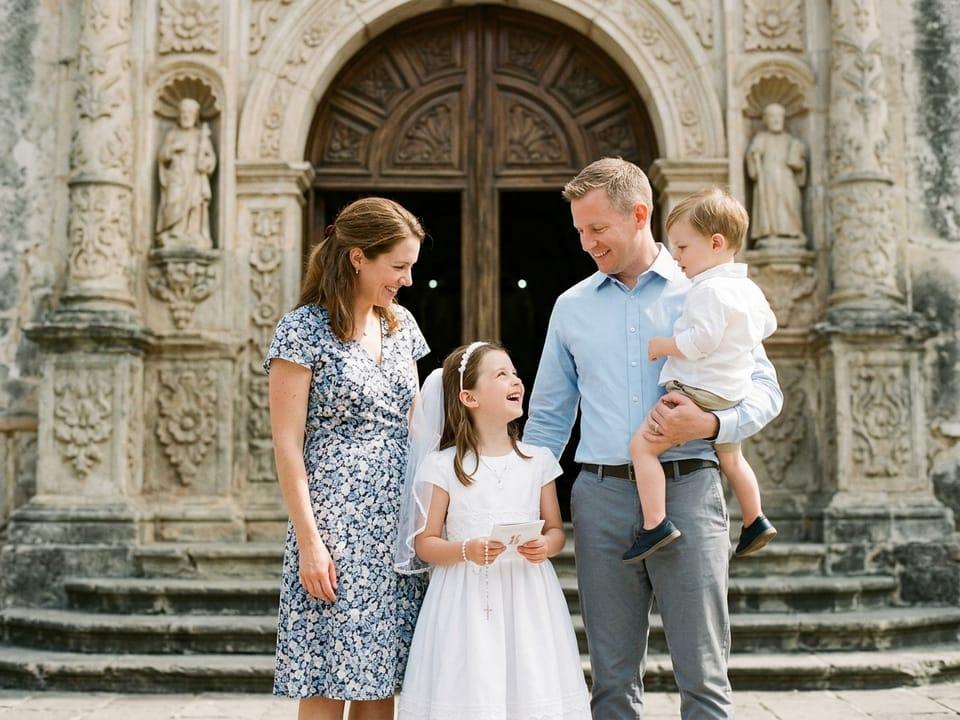
Read the dress code from your parish or school before you rent, buy or borrow anything, because it settles more than any shop will. Renting usually makes sense for a long white dress worn for one morning, as long as the shop has the size and the dates you need. Buying makes more sense for a suit or a simple dress your child will wear again, and a hand-me-down costs least of all if you start early enough to clean and alter it. The order of questions is the same for a vestido de primera comunión in Lima or Guadalajara as for a boy's suit in a US parish.
The parish's rules come before the shop
The classic outfit is familiar across the Spanish-speaking world. Catholic.net, a Spanish-language Catholic portal, describes girls in a white dress reaching the ankle, trimmed with lace, flowers and embroidery, with a crown of flowers holding a short veil. For boys it names a military-cut outfit, white trousers and shirt under a navy or white jacket with gold buttons and braid, as the most usual choice. Your parish may ask for something quite different.
Rules differ even inside one country, and two parishes in the United States show how far. Saint Philip and Saint James Church in Phillipsburg, New Jersey, which publishes its guidelines in English and Spanish, asks for a white First Communion dress with no bare shoulders and nothing too short. The veil is optional, gloves aren't allowed, and nothing may be held in the hands during Mass. Boys wear a white suit (esmoquin blanco in the Spanish version), and the white armband, the brazalete, is optional. Saint Theresa Parish in Ashburn, Virginia, wants a white dress with a white veil and allows gloves, but rules out strapless dresses and spaghetti straps. Its boys may wear a dark jacket, dress trousers, a white shirt and a tie, with white suits also acceptable.
When a Catholic school organises First Communion for a whole class, as schools in Peru and elsewhere sometimes do, the circular sent home is where these rules appear. Ask before spending anything: is a veil required, are gloves allowed, must a boy wear white or will navy do? Not every ceremony calls for white at all; our guide to First Communion photos on a budget describes a Mexican school where the dress code was the everyday uniform. In Spain, some parishes have all the children wear matching albs instead of bridal-style dresses, which takes the question away altogether; our guide to First Communion in Spain covers that, and First Communion outfits in Ireland covers the Irish rosette and medal.
Read the rental terms before you look at the dresses
A rental fee looks small next to a new dress, but the conditions are where the surprises are. In Spain, the consumer magazine Consumer set out the usual rental terms in 2021. Half the price was paid on booking and the rest on collection, and if you cancelled, the money already paid was generally not refunded. The shop did the cleaning. Outfits went out for the weekend of the ceremony and came back on the Monday, late returns could cost a surcharge of 20% a day, and anything lost or damaged was charged at full value. The magazine advised booking at least two months ahead for the best choice of styles and sizes and time for a fitting. Its figures were around €50 to €60 for a girl's dress, about €80 with accessories, and roughly €400 on average to buy a girl's dress new with its accessories.
Those are Spanish prices in euros from 2021. In pesos, soles or dollars the amounts will differ, and they change with the city, the season and what's included, so use that list as questions rather than a price guide. Ask any rental shop whether the veil, crown, petticoat and gloves are included, whether the hem can be pinned or tacked, what counts as damage, and what happens if the date moves. If you want portraits on another day, say so when you book; a weekend rental won't stretch to a session the following week. Book the fitting in the shoes your child will wear, since the hem depends on them.