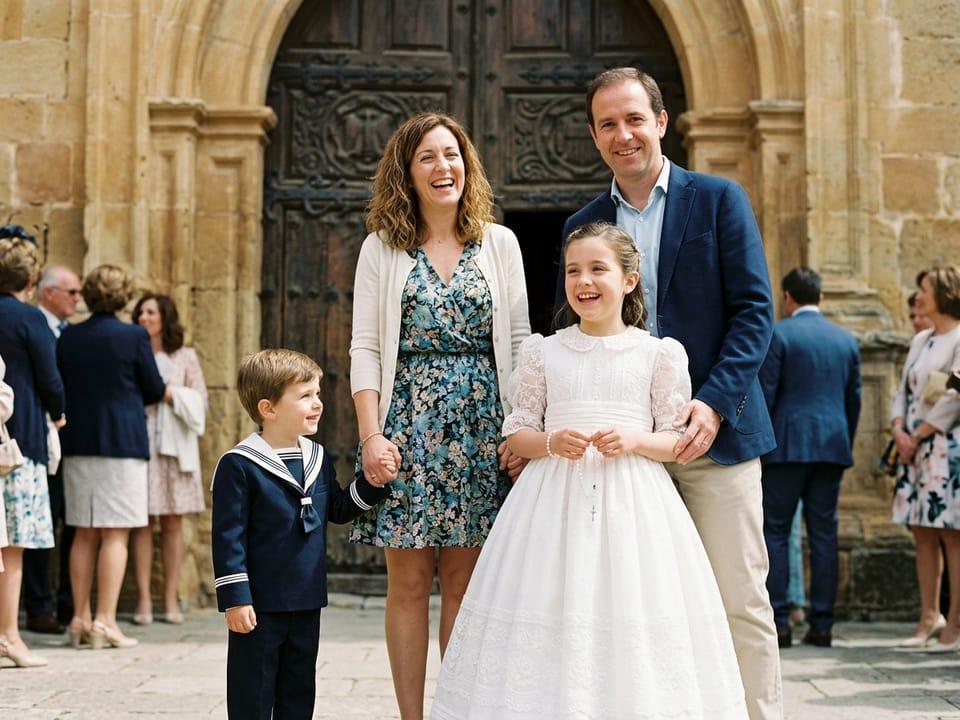
For Catholic families in Spain, a child's Primera Comunión is a celebration on the scale of a wedding. After their catechesis, children receive the Eucharist for the first time; girls wear white dresses, boys wear sailor suits or admiral-style dress uniforms, and the day ends with a big family meal. Many families book a professional photographer, while the Church itself has voiced unease about the social ostentation that has grown up around the occasion. Find out first who is allowed to take pictures inside the church, keep the unhurried portraits for another day, and deciding what to pay for gets much easier.
Around age nine, in spring, one class group at a time
The age for First Communion varies, and the date is set by the parish. To take one example, at the parish of San Pedro Mártir in Madrid, catechesis starts at around seven, in the second year of primary school, and runs for three years; children make their First Communion in the third year, at around nine, in the fourth year of primary school. Its 2027 timetable spreads the communions over Saturdays from 1 May to 5 June, with two services a day at 11:00 and 13:00, one catechesis group at a time. A few days before, the children make their first confession, followed the same day by a rehearsal.
Guidelines issued in 2009 by the diocese of Orihuela-Alicante, in the south-east of the country, describe a different path: a "religious awakening" course followed by two years of sacramental preparation, with First Communion at Easter time. Since the length of preparation and the season differ from diocese to diocese, decide soon after you get the date whether you want a photographer, because popular photographers and studios get booked up well ahead. Where two groups follow each other on the same Saturday, there won't be long for photos outside the church afterwards either.
Inside the church, it may be the parish photographer only
First Communion is a sacrament given during Mass, and the rules on photography inside vary a great deal from parish to parish. In a 2020 information sheet, the same Madrid parish said that only its regular photographers may take pictures during the celebration and that no other photographers are allowed, to avoid a constant stream of photographers around the altar. Those photographers take some photos during the service and the final group picture, and families who want them can also book photos before the ceremony, in the church garden with parents and siblings or individually in a classroom. Children having those photos arrive an hour early (the others fifteen minutes before). The first six rows are kept for parents and siblings, and the children sit on the altar around the priest.
The Orihuela-Alicante guidelines go as far as warning that the meaning of the first Eucharist is obscured if what people remember most is the spectacle and the bustle of photos and videos. The same document recommends an entrance procession in which the children walk up the central aisle with the priest, and says the children may carry up the bread and wine at the offertory. Watch those moments quietly from your pew rather than stepping into the aisle. The moment your child receives Communion belongs, above all, to your child and the priest. The catechesis parents' meeting is usually the best place to find out the rules.
The reportaje: studio or outdoors
First Communion photos fall into three groups: pictures in church on the day; a portrait session on another day, which in Spain is usually called the reportaje; and family photos at the meal afterwards. You don't need a professional for all three. If your parish restricts photography in church, you can spend the ceremony simply watching and save the portraits for a separate session.
A studio gives you controlled light and a clean background. White dresses tend to blow out to plain white on a phone, but studio lighting can hold the lace and embroidery. You don't depend on weather or time of day, and there is somewhere to change. The downside is that children often freeze up in an unfamiliar room. Bring things that mean something to your family, such as the Bible or rosary from catechesis or a medal from the grandparents. Even against the same backdrop as every other child, the pictures become your child's own, and small hands have something to hold.
Shooting in a park, the old town or a grandparent's garden brings in the light of the season and a sense of where you live. In Valencia, for instance, a city-centre green space like the Turia Gardens, laid out in the old riverbed, is an option. Midday sun casts hard shadows on faces, so aim for early morning or late afternoon. White outfits get dirty fast: change on location and bring a blanket to sit on. Veils and hair pieces move in the wind, so pack extra pins.
Before you book, ask about numbers, delivery and the parish
Asking these up front avoids most "that's not what I expected" moments:
- Roughly how many edited photos you get, whether digital files are included, and whether an album is compulsory
- Whether siblings and grandparents can join, and how long the session lasts if they do
- How long delivery takes
- If they will also shoot in church, whether they have worked at, or have permission from, your parish
Ask to see full sets from previous communions and check whether the children's expressions look natural.
Taking the photos yourselves: window light and chest height
At home or nearby, soft window light works best. When photographing a child in a white dress or shirt, tap their face on screen and then pull the brightness down a touch so the white keeps its detail. Lower the phone to about your child's chest height so you aren't looking down on them.
Children of this age tend to stiffen the moment you say "smile". Give them one small thing to do instead: walk toward you, look at a sibling, think of a prayer they learned in catechesis. As with the Three Kings' morning, when children find their presents on 6 January, the less you stage it, the better the picture. Add a few close-ups, such as hands holding the rosary, white shoes and the hair wreath, and the album will flow.
At the meal, take the group photo before dessert, while outfits and faces are still fresh.
Before buying outfits, check the parish rules and agree on priorities
For boys, the options run from a simple sailor suit to admiral- or captain-style dress uniforms with braid, cords and a cap, a custom described as deeply rooted in Spain. More recently, outfits modelled on other Spanish military dress uniforms, such as those of the Army or the Royal Guard (Guardia Real), have also become popular. For girls, a bridal-style white dress is the classic choice, though in recent years some parishes have all the children wear matching albs instead.
On the meaning of the white dress, the Orihuela-Alicante guidelines link it to the white garment of baptism and say it expresses the dignity of a Christian. They ask families to avoid luxury that offends poorer brothers and sisters and to steer clear of theatricality or anything that looks like a costume, and they praise children who wear a new festive outfit they can go on wearing on Sundays and holidays. The Madrid parish's 2020 sheet likewise recommended practical clothes, ideally everyday wear the children can use again. Check what your parish expects before you buy anything. For the rest of the family, soft or muted colours let the child's white stand out and keep group photos calm.
The same guidelines also suggest that children and their families might decide together to spend less on the meal or gifts and give the savings to Cáritas, the Catholic charity. How much to spend on outfits and photos is your family's call. Agree first on what matters most to you, and how much of the photography to hand over will more or less decide itself.
If grandparents live far away or someone couldn't make it, pokesta can create a photo of the whole family together in First Communion clothes with AI, from each person's own phone photos ($1 per photo, the first one free).
References