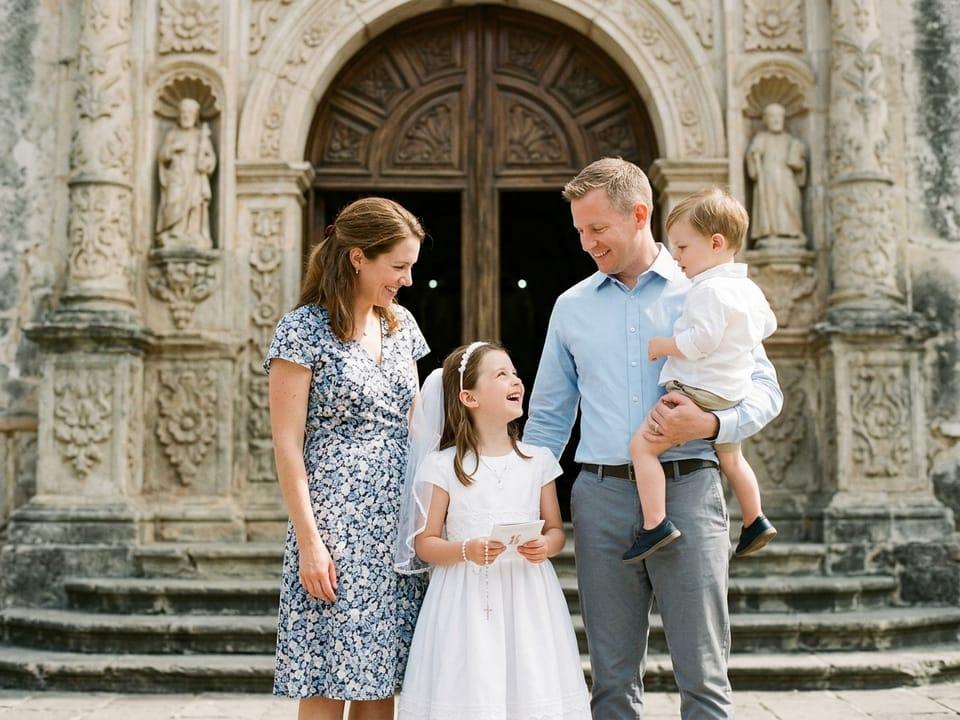
The best First Communion photo poses are gestures your child already knows from catechesis: hands joined in prayer, a candle held upright, a Bible held close to the chest. Ask for those rather than a model's pose, take them at home or after Mass rather than during it, and then add the family and the padrinos. Keep anything playful away from the religious objects, and the photos will look the way the day felt.
Start with what the child already does in church
Children make their First Communion at different ages, generally between seven and twelve according to Spanish-language Wikipedia, and some families wait until fifteen or sixteen. At seven or eight, holding still for a camera is hard, and an invented pose falls apart in seconds. A gesture practised for months in catechesis does not.
For praying hands, have the child press the palms together with the fingers pointing up, at about the height of the breastbone, elbows relaxed against the body rather than pushed out. Fingers interlaced and resting low in front of the waist is the other version, quieter and easier for a fidgety child to hold. Take three variations: eyes on the camera, eyes down, eyes closed.
Rather than asking for a prayerful face, ask whether your child would like to say a prayer they know, the Our Father or a short prayer to their guardian angel, and photograph quietly while they do, without directing. If they'd rather not, skip it. A prayer repeated ten times for the camera stops being a prayer, and children notice.
Kneeling works if the child is comfortable with it: on a cushion in front of a home altar or on a kneeler, with a folded towel under white trousers. Shoot from the side so the line of the back and the joined hands reads clearly.
The candle, the Bible and the rosary, held simply
Catholic.net, a Spanish-language Catholic portal, notes that children carry the white candle in the right hand, lit from the paschal candle as a sign of the light of Christ. For a portrait, two hands work better than one: one around the candle at chest height, the other just below it, the candle upright and any ribbon or decoration turned towards the camera. Leave it unlit for posed photos. If you want a flame, read the candle safety notes in our guide to First Communion photo ideas at home first, and keep the veil well back.
Hold the Bible or missal against the chest with both hands, cover facing out, or open on the lap with the child reading the first line aloud. A rosary can hang from joined hands with the crucifix below, or rest across the open page.
These poses don't belong to the moment of Communion itself. CatholicIreland.net, an Irish Catholic site, has advised that, because most people receive Communion in the hand, children shouldn't wear gloves or have rosaries, candles or prayer books in their hands, and some parishes write the same rule into their guidelines. That's one more reason to take these portraits at home, where nobody is in a hurry.
Poses to leave out
Don't restage the moment of receiving Communion with a wafer, a cracker or a pretend host. That moment belongs to the child and the priest. Some parishes arrange for it to be photographed: Saint Theresa Parish in Ashburn, Virginia, has a studio photograph each child at the moment of receiving, while asking families not to take pictures during Mass. If your parish doesn't, let it go unphotographed.
Keep jokes away from the sacred objects too. No blowing out the Communion candle like a birthday cake, no swinging the rosary, no Bible balanced on a head. Silly photos have their place later, in the garden with cousins once the candle and rosary are put away. Jumps, spins and running shots in a white dress make lovely pictures; they just don't need a crucifix in hand.
Family photos with the child at the centre
Put the child in front and slightly forward, in white, with the family in softer colours behind. Parents stand behind the shoulders, angled in towards the child; brothers and sisters fill the sides; grandparents can sit, with the child standing between them. To get everyone in, including whoever usually holds the phone, use a tripod and the timer, as explained in our family self-timer guide.
After Mass, ask whether you may take a picture with the priest, and with the catechist who spent the year preparing your child. Saint Theresa explicitly welcomes family photos with the priests in church after Mass. Elsewhere, ask the parish before stepping back into the sanctuary.
Local customs give you something to pose around. In the Philippines, where boys may wear a barong tagalog, a father and son in matching barong make a natural pair. In Ireland, check that the boy's arms aren't covering the white rosette and medal pinned to his jacket. Where a girl wears a flower crown holding a short veil, as is customary across much of the Spanish-speaking world, shoot from slightly to one side so the edge of the veil shows.
Padrinos: photograph the gift, not only the hug
Godparents aren't required for First Communion, though there may be one or two, according to Spanish-language Wikipedia. Where there are padrinos, their photo can tell a small story. An explainer from Azteca Jalisco points out that the Church doesn't require padrinos to give anything, since their part is example and support; still, a religious medal, an engraved bracelet or a Bible are customary gifts. Photograph the madrina fastening the medal or the padrino handing over the Bible, then a simple portrait of the three of them together.
If a padrino lives abroad and can't travel, pokesta can create a photo of the two of them together with AI, from each person's own phone photos ($1 per photo, the first one free).
Three gestures, then let them go
Plan three poses, the praying hands, the candle and the Bible, plus one family group and one with the padrinos. That's enough. A child who has just made their First Communion should spend the rest of the day celebrating, and the photos are better for not having asked too much. To see what other families shared, visit First Communion posts.
References