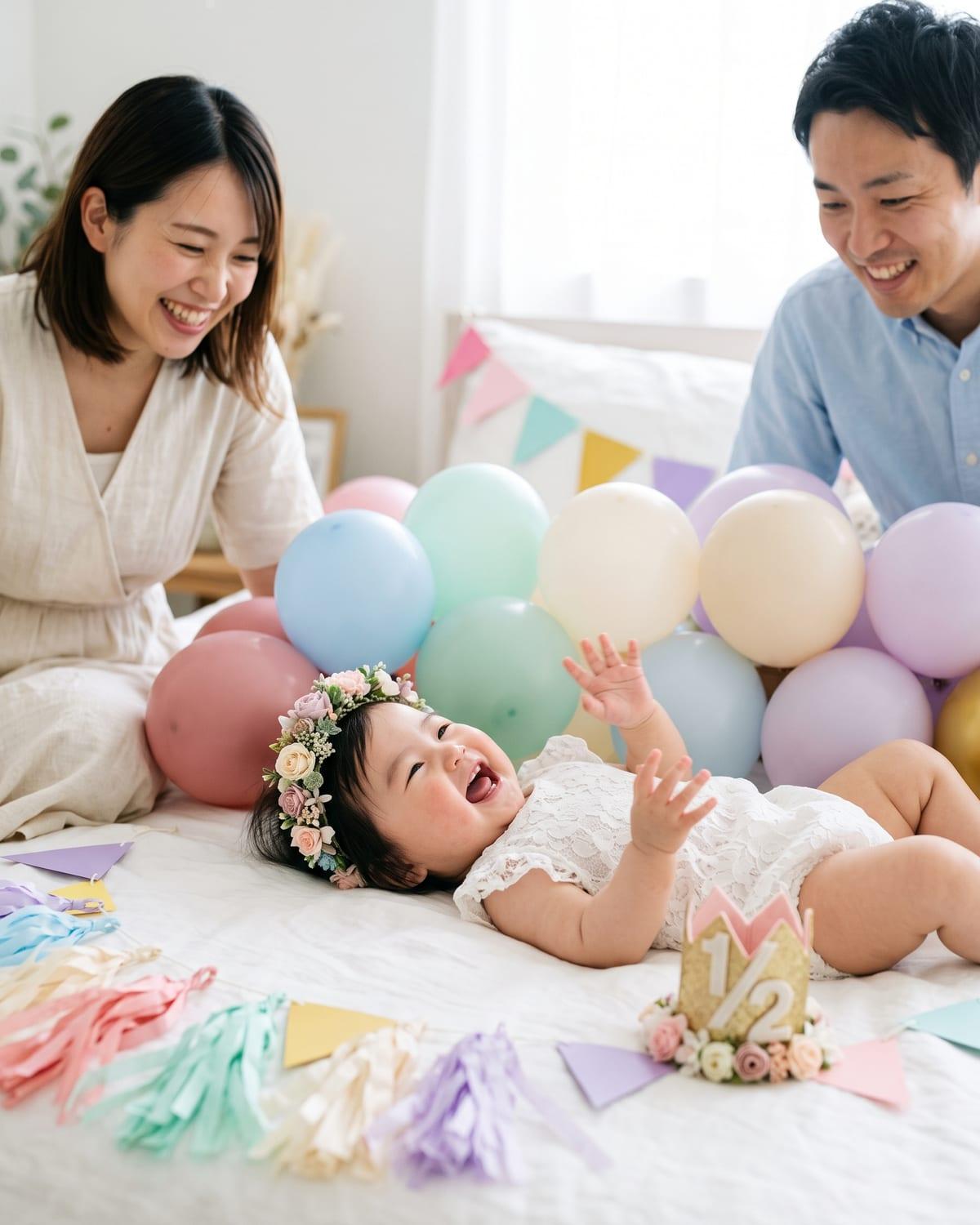
A half birthday at six months is an easy milestone to mark with photos at home. But babies this age can roll over without warning, and even when you sit them up, they don't stay steady for long. The way to get photos that are both adorable and safe is to pick a style that matches what your baby's body can actually do. At this age, that usually means lying-down shots on the floor, with sitting shots as an extra while an adult holds the baby steady.
Six months: rolling over, yes; sitting up, not yet
In the 2023 national infant growth survey by Japan's Children and Families Agency, more than 90% of babies aged 6 to under 7 months were reported as able to roll over, while sitting unassisted didn't pass 90% until 9 to under 10 months. In other words, around the half birthday many babies are rolling all over the place, and only a minority can sit steadily on their own.
So plan on lying-down shots as the main event, and treat sitting shots, with an adult supporting the baby, as a bonus. Every baby develops at their own pace, so go with what your child can do right now.
Shoot after a feed and a nap
Baby photos mostly come down to catching a good mood. Aim for the stretch after a full tummy and a good sleep, when their eyes are wide open. If that lines up with bright daytime hours, you get window light too.
Plan to wrap up within about 15 minutes. Get the decorations and outfit ready while the baby is asleep so you can start as soon as they wake up. If they start to fuss, don't push it. Call it a day and try again another time. You'll usually end up with better photos that way.
Lying-down shots: on the floor, not the sofa or bed
For lying-down shots, lay the baby on their back and photograph from above. A blanket or a piece of patterned fabric as a backdrop is enough to set the mood.
Always do this on the floor. A sofa or an adult bed might look like an easy place to set up a backdrop, but a baby can roll off in an instant. Japan's Consumer Affairs Agency warns that for children aged 0 to 1, a fall from a bed even a few dozen centimeters high can result in a head injury.
Choose a thin, flat fabric for the backdrop. Plump cushions or thick blankets near the face can block the nose and mouth if the baby rolls onto their tummy. Throughout the shoot, an adult should stay within arm's reach, ready to turn the baby back the moment they start to roll.
Don't hold the phone directly over their face
When you shoot from above, holding the phone right over the baby's face means it lands on them if it slips. Stand at the baby's head or feet and shoot from a slight angle. A phone strap or ring grip makes a drop less likely. Avoid climbing onto a chair or step stool to get higher, since the person taking the photo could fall.
It's tempting to fill the frame with the baby, but pull back a little to include the backdrop and decorations. Later, you'll be able to tell at a glance which day the photo was taken.
Sitting shots: it's fine if the support shows
A sitting shot means an adult propping up a baby who can't sit on their own yet. There are a few ways to do it.
The safest is for an adult to sit behind the baby and hold them around the hips with both hands. The adult's hands and arms will be in the picture, but a baby held up by a parent's hands makes a photo that captures six months in its own way. If you'd rather not show the hands, keep the same hold and frame the baby from the chest up, so the hands fall outside the shot.
You can also sit the baby in a nursing pillow that wraps around their back and sides. Even then, an adult must stay within immediate reach and steady the baby if they start to tip forward or sideways. Babies can topple face-first into the cushion, so never take your eyes off them. Keep a floor seat on the floor, never on a table or sofa.
Decorations go outside baby's reach
Put "1/2" letter banners, garlands, milestone cards and other decorations where the baby can't reach them. Around six months, babies try to put everything they touch in their mouths. Small stickers, paper decorations and scraps of balloon can cause choking.
For lying-down shots, arrange decorations above the baby's head or around their body, farther than they can stretch. For sitting shots, sticking them to the wall behind is safest. Anything on the floor can be held down with masking tape so it stays put even if the baby kicks it. For ideas on making and arranging decorations, see Half-birthday decorations.
Sound right next to the camera brings out expressions
Babies look toward voices and sounds. When you want them looking at the camera, have someone other than the photographer shake a rattle or call their name right beside the phone. If you're shooting and talking at the same time, speak from right next to the lens and their eyes will follow.
You don't have to chase smiles. Grabbing their toes, chewing on a hand, a wide-eyed puzzled stare: the little gestures you'll only see at six months are all worth keeping.
Don't forget a photo with the family
It's easy to get so absorbed in solo baby shots that you forget photos with the family. Take at least one of a parent holding the baby and one of siblings lying alongside. To get everyone in the picture, prop up the phone and use the self-timer (see Whole-family photos with a tripod and self-timer).
If you have no photo with grandparents who live far away, another option is to generate a half-birthday photo with AI on pokesta, using photos of each family member. You can try it once for free after signing up, and after that it's $1 per photo. It isn't a substitute for the pictures you took of your baby that day. It's a way to bring family members who couldn't be there into one photo.
On the floor, short, and within arm's reach
Shoot on the floor, stop after about 15 minutes, and keep an adult within arm's reach the whole time. One lying-down shot and one with the family is plenty for a half birthday. From next month on, keep taking monthly photos in the same spot on the same fabric, and comparing how your baby grows becomes easy.
Related articles:
References