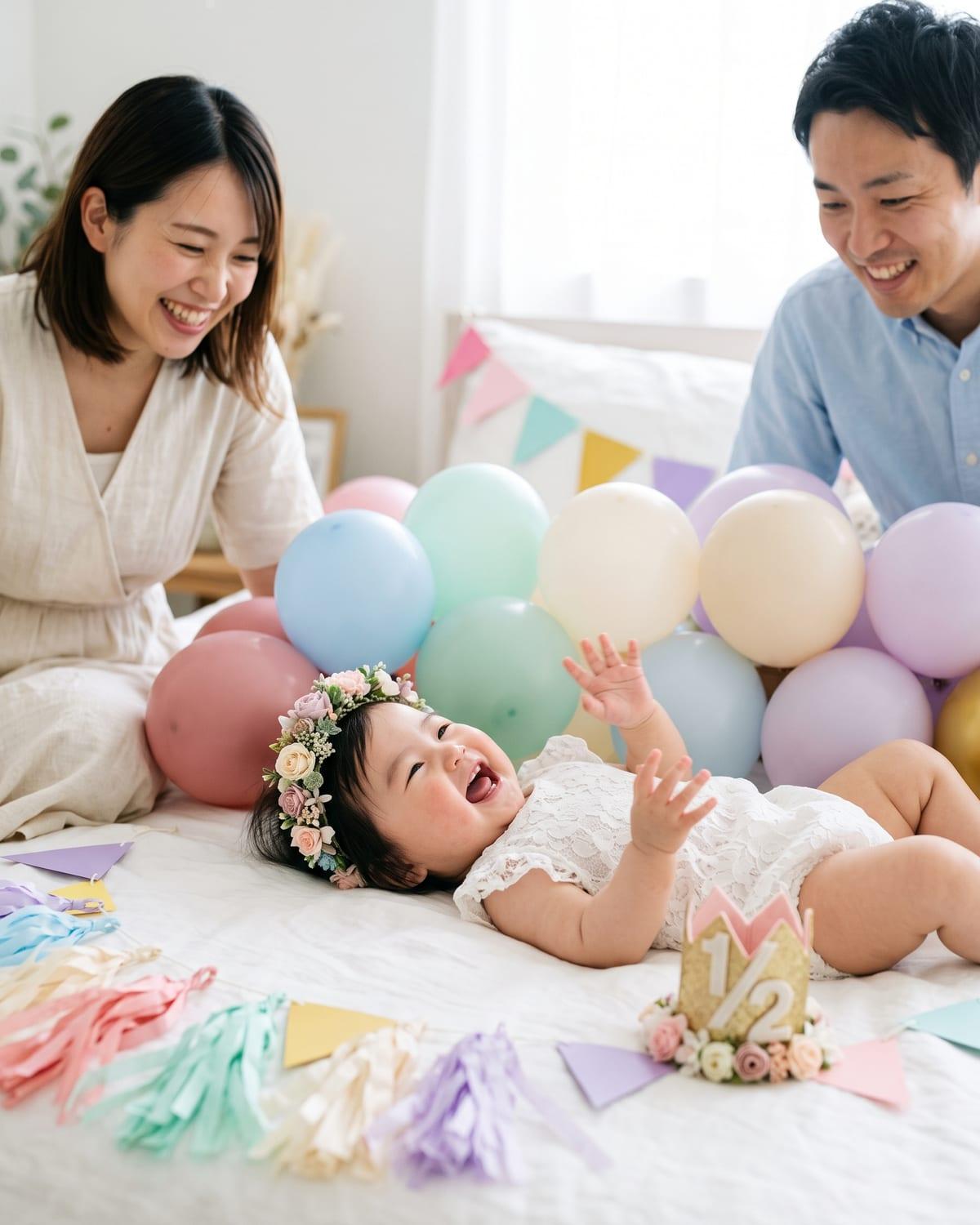
For a half birthday, the day a baby turns six months old, which many Japanese families mark with a small celebration and photos, home can feel too cluttered, while a studio with a professional photographer can feel like more than you need. In between sit self-photo studios and rental spaces. In both, you take the photos yourselves, but what you're renting differs. A self-photo studio gives you the camera and lights; a rental space gives you only the room. With a baby along, the key is to check before booking where you can feed and change, whether the floor is fit for laying a baby down, and what you can bring in, and to decide the order of shots for your short slot in advance.
Self-photo studios include the equipment; rental spaces are just the room
At a self-photo studio, the lights, backdrop and camera are all set up, and your family takes photos whenever you like with a remote shutter. The style took off in South Korea. In Japan, studios began opening around 2021 in places like Tokyo, Kyoto and Kobe, and news reports described them as popular mainly with people in their teens and twenties, with families using them too. In July 2025, the children's photo studio chain Studio Mario launched its own "self-photo studio" service, beginning at a single store in Sagamihara: you book the studio privately, shoot as much as you like within the plan time, and receive all the image files.
Many studios divide time into slots of 15 to 30 minutes, and at some you can check the files right after shooting. Because the lighting is set up properly, you get a clean background and even light, quite different from a photo by the window at home.
A rental space is a room you book by the hour. Listings include stylish interiors and rooms with white walls and natural light that suit photography, but you generally bring your own camera and lights. If you're shooting with a phone and tripod, the way window light falls decides how the photos turn out, so the time slot you book matters too.
What to check before you book
Some things you can't tell from the photos on a studio's website when you're bringing a baby. Before booking, check the notes on the site, or ask, about the following:
- Is there somewhere to feed and change the baby, and is the room private?
- Can you bring the stroller in, and is there somewhere to park it?
- Can you lay the baby on the floor (are shoes worn inside, and what is the floor made of)?
- Can you bring your own outfits, props, balloons and so on?
- How do you receive the photos (same day or later, and all of them or a selection)?
- Does the price change if more adults come?
The floor is the one people most often forget. Whether shoes are worn in the shooting area varies from studio to studio. You don't want to lay a baby directly on a floor that people walk on in outdoor shoes, or on top of a set platform, so if you want lying-down shots, always confirm how the floor is handled.
In a 15-minute slot, count on 10 minutes of shooting
Self-photo studio slots are short, and when your time is up, the next family comes in. If you assume all 15 minutes go to shooting, changing outfits and a fussy baby will eat it up in no time. Leave five minutes for setting up and packing up, and plan on ten minutes of actual shooting.
Work back from the start time and feed the baby before you arrive or while you wait. If you can, dress the baby at home before leaving. Decide the order of shots as a family beforehand. For example: the first three minutes for the whole family, the next three for the baby lying down, and the rest for the baby with each parent. The golden rule is to take the family photo you most want first, while the baby is still in a good mood.
Book a slot that doesn't clash with the baby's nap. Early morning slots tend to mean quieter roads and a happier baby. Some studios have hard-to-find parking or entrances, so aim to arrive about ten minutes early, and change the diaper before you check in.
If the baby starts crying partway through, don't push on. You can photograph them being held and soothed just as they are. A family photo with a crying baby in someone's arms often becomes one you laugh at fondly years later.
Keep the baby away from light stands and cords
Studio lights usually sit on stands with thin legs, and cables run across the floor. For lying-down shots, spread the fabric where the baby's hands and feet can't reach the stand legs or cords. Adults can trip on cords too, so look around the room together at the start and note where they run.
Don't sit or lay the baby on set chairs, sofas, wooden crates or other props. Most six-month-olds can't sit on their own yet, and Japan's Consumer Affairs Agency warns that for babies aged 0 to 1, even a fall from a few dozen centimeters can cause a head injury. Use the props as background and keep the baby on the floor. For safety preparation in general, see Safety tips for photographing babies who can't sit yet.
What's worth bringing
Even if the studio lends out props, it's safer to bring anything that touches the baby's skin from home: a thin fabric or swaddle to lay on the floor, a change of clothes, diapers and wipes, gauze cloths, and a toy that makes a sound. A nursing cover helps if the room isn't private. If the studio hands over the files on the spot, check how much free storage your phone has. With unlimited shooting, you'll end up with more photos than you expect, so clearing out unneeded photos and videos the night before means you won't run out of space halfway through the transfer.
For a rental space, add a phone tripod and a white cloth or sheet of drawing paper to use as a reflector. Book a time when window light reaches the room, spread your fabric beside the window, and you can shoot the same way you do at home with a different background.
First time? Try one short slot
Self-photo studios and rental spaces both let your family shoot without feeling watched. On the other hand, there's no photographer to soothe the baby or adjust poses. Taking the photos and keeping the baby happy is all down to the family. If it's your first time, rather than booking a long slot, try one 15- or 20-minute slot and see whether your baby settles in that space. For how this compares with a studio where a photographer takes over, see Do you need a studio for half-birthday photos?.
References