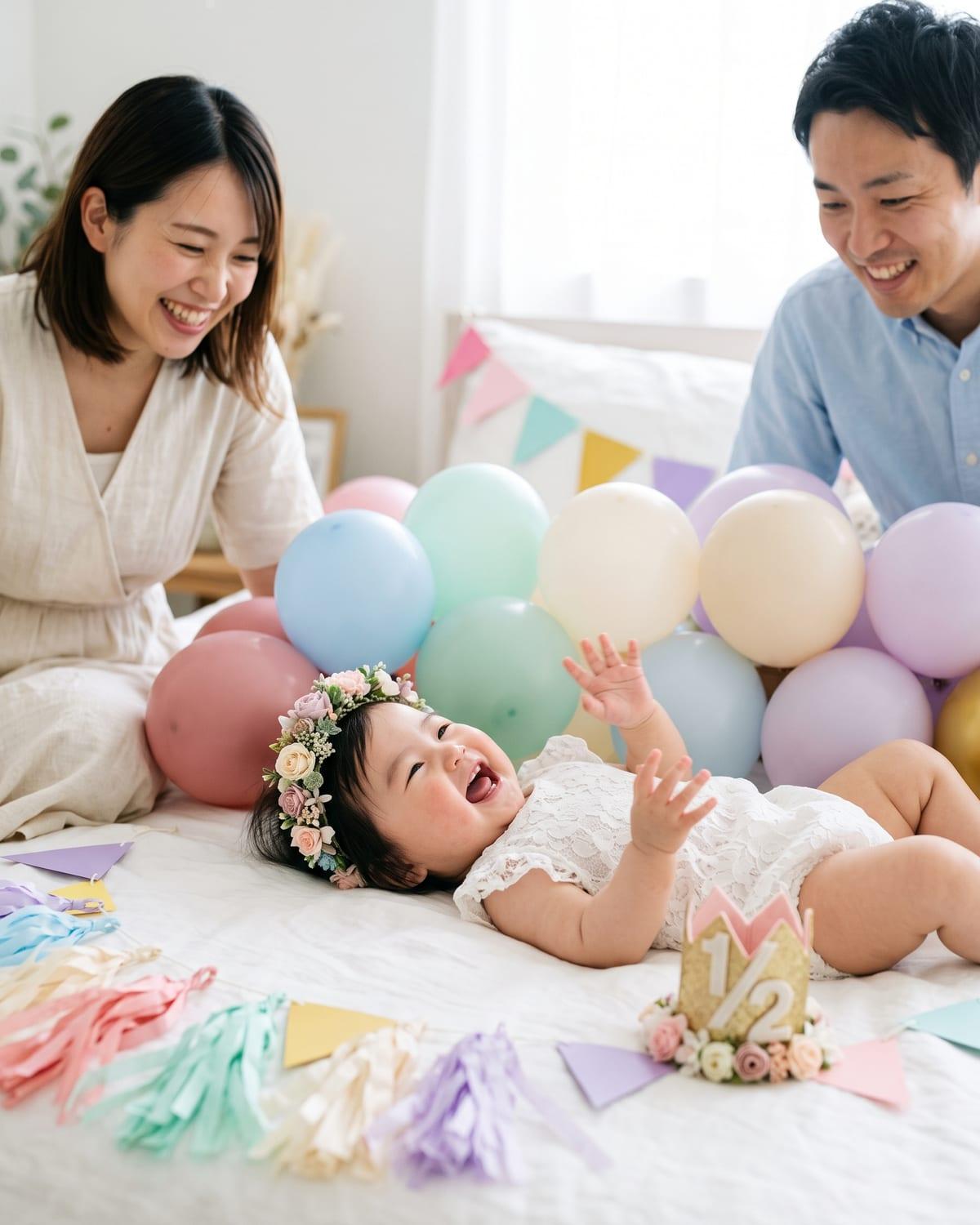
Put a newborn photo next to a half-birthday photo, taken on the day a baby turns six months old, which Japanese families often celebrate as a small milestone, and you'd think six months of growth would jump out. Often it doesn't. If the two photos were taken from different distances or at different zoom levels, the difference in size simply vanishes. The way to get a comparison that works is to pick one newborn photo first, then match the object you're comparing against and the camera position when you take the six-month shot.
About 18 cm taller and two and a half times heavier
According to the 2023 national survey of infant growth by Japan's Children and Families Agency, average length at birth is 49.3 cm for boys and 48.6 cm for girls. At 6 to under 7 months, it's 67.7 cm for boys and 66.4 cm for girls. Average weight goes from 3.06 kg for boys and 2.95 kg for girls at birth to 7.95 kg and 7.54 kg at 6 to under 7 months.
On average, then, babies grow around 18 cm and become about two and a half times heavier in their first six months. Every child grows at their own pace, but a change that big will show clearly in photos as long as the conditions match. Put the other way round: if your comparison shows no difference, the conditions were off.
Start by choosing one newborn photo
Plan the comparison from the newborn photo, not the six-month one. Scroll back through your phone and look for a picture with these qualities.
The baby's whole body is in it, at least from head to toe. Something that gives a sense of scale is in it too: an adult's hand, a swaddle blanket, a stuffed toy. And you can tell where it was taken from. Was it shot from directly above or from the side? How far away? Use the pattern of the floor or fabric and the way the toy looks to estimate the distance.
Photos taken in a hospital bed or an incubator can't be recreated at six months. In that case, a photo from the first few days after coming home will be much easier to match.
Match the comparison object and the camera height
Once you've chosen the original, match two things in the six-month photo.
The first is the comparison object: the stuffed toy that sat beside the newborn, the swaddle they were wrapped in, a parent's hand. With the same object in the same spot, the baby's size stands out against it. If the original has nothing like that, choose something you can use from now on and include it in every photo after the first birthday too (see How to keep up monthly baby photos for a whole year).
The second is camera height and zoom. If the original was taken from directly above, shoot the six-month photo from above at about the same height. Use the same zoom setting as well. Phones let you switch between 0.5x, 2x and so on, but the 0.5x ultra-wide makes near things look bigger and far things smaller, so it's no good for comparisons. If the original was taken at the standard 1x, shoot the new one at 1x.
When shooting from above, don't hold the phone directly over the baby's face; stand at their head or feet and shoot at a slight angle. Lay the baby on the floor, not on a sofa or bed. Japan's Consumer Affairs Agency warns that for babies aged 0 to 1, even a fall from a few dozen centimeters can cause a head injury.
Lay out the newborn outfit rather than putting it on
Bringing back the outfit from the day your baby was born or came home from hospital makes the comparison far more striking. Most newborn clothes won't fit anymore, though. Instead of squeezing the baby into them, spread the outfit out beside them. A baby stretching out next to a tiny undershirt says more about six months of growth than anything else.
When you pair them, don't resize the baby to match
There's a common mistake when putting the two photos together: enlarging and cropping one so both babies look about the same size on screen. Do that, and the babies look identical and the growth disappears.
What you should match is the background and the comparison object. Adjust the two photos so the same toy appears at the same size in each, and leave the baby alone. In the six-month photo, the baby will look so big they almost spill out of the frame. That's the whole point.
The usual layout puts the newborn on the left and six months on the right, so time moves from left to right. Portrait-orientation photos sit well side by side; landscape ones work better stacked top and bottom, so the combined image doesn't end up with lots of empty space. You can join them in a photo collage app, or print both and mount them on card.
Under each photo, add the date and the baby's length and weight at that point in small type. In Japan, these numbers are recorded in the Maternal and Child Health Handbook (boshi techō) at birth and at each checkup; wherever you live, your baby's health record will have them. Numbers alongside the visual difference help you remember those six months more concretely when you look back years later.
Hands and feet compare better than close-ups of the face
If whole-body comparisons aren't working, compare a part of the body instead. If you have a newborn photo of the baby gripping an adult's finger, take the same shot at six months. A hand that could barely hold one finger at birth can now grab two or three. The conditions are easier to match than with the whole body, and the change is obvious.
A foot resting on an adult's palm is another good one. The adult's hand hasn't changed in six months, so it works as a ruler. Close-ups of the face, by contrast, are surprisingly poor for comparisons, because expression and angle change the impression so much.
Next time: the first birthday, same object, same height
Once you've got a half-birthday comparison you're happy with, write down what you used and how you shot it: the toy's name, the fabric color, how high you held the phone, the zoom level. Take another photo under the same conditions on the first birthday and you'll have a three-step growth record. If you made hand or footprints, line those up too to make the change even clearer (Half-birthday handprint and footprint art).
If you'd like a comparison photo with the whole family in it but no parents appeared in the newborn photos, pokesta can generate a half-birthday family photo with AI from each family member's phone photos (one free photo after signing up, then $1 per photo).
References