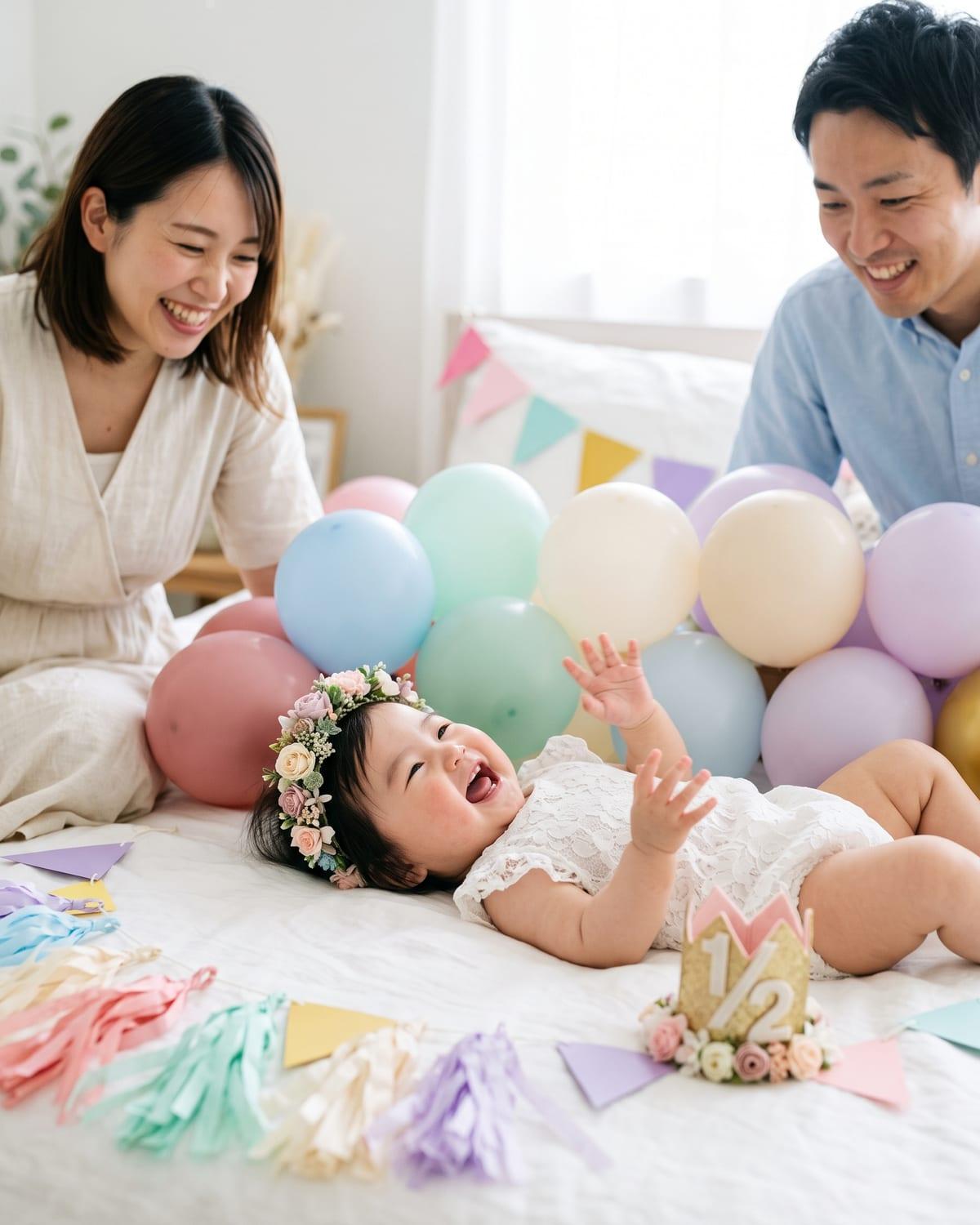
Monthly milestone photos mean photographing your baby in the same spot every month, on or around the day they turn another month older. For the first few months, enthusiasm carries you and the decorations come out on time. Then somewhere past six months, a "we missed it this month" creeps in. Usually that's because you're starting from zero every month. Decide four things at the start (the spot, the fabric, something to show scale, and a window of dates) and each session takes five minutes and three photos.
They stall because you're rethinking "how" every month
What stops monthly photos is usually something small. The month-day fell on a weekday, and the baby was already asleep by the time you got home. Getting the decorations out felt like a chore, so you pushed it to next week, and then it was next month. The baby started rolling over and the setup you'd used until last month stopped working.
All of these come from deciding again, every time, where to shoot, what to use and how to frame it. Monthly photos aren't a creative project; they're a record. It's because you shoot under the same conditions each month that the growth shows when you line them up. So make every decision in the first month, and from month two onward you can shoot without thinking.
Shoot within three days either side of the month-day
If you insist on the exact date, things fall apart the first time it lands on a busy weekday or a sick day. Decide up front that anywhere within three days before or after counts. If the baby was born on the 15th, any day from the 12th to the 18th is fine. That's a seven-day window, so every month it includes both a Saturday and a Sunday. For babies born on the 29th to 31st, some months don't have that date, so decide in advance that "the last day of the month counts as the month-day."
Put a monthly recurring event in your phone calendar three days before the month-day, with the alert set to something like "Monthly photo this week," and you won't forget. Add it to a calendar you share with your partner so that whoever is free can take the photo.
The clothes don't have to be the same every month, but keeping the color tone consistent makes the set look calm when it's lined up. Decide on, say, a white or cream undershirt or a plain pale romper, and you won't have to think about what to change them into.
Try to keep the time of day the same too. If you always shoot after the morning nap, the window light comes from about the same direction, and the color and brightness of the photos match.
One spot, one fabric, and tape marks on the floor
Pick a single spot on the floor, a little way from the window. A sofa or an adult bed may look like an easy place for a backdrop, but Japan's Consumer Affairs Agency warns that for children aged 0 to 1, even a fall of a few dozen centimeters can cause a head injury. You'll be doing this for a year, so choose floor space that stays safe once the baby is rolling and crawling.
Set aside one piece of fabric just for monthly photos and don't use it for anything else. With the same fabric every month, the background never changes, so the difference in the baby's size stands out clearly. Use small bits of masking tape on the floor to mark where the corners of the fabric go, where the baby's head goes and where the photographer stands. With the marks in place, you and your partner will get the same framing whoever shoots.
Keep everything together in one box or bag (the fabric, the cards showing the month, and the stuffed toy you use for scale) and store it where you can grab it quickly. If getting it out takes more than three minutes, that's the month you'll skip. Ideas for making cards and adding lettering are in Photos with milestone cards and letter boards.
For scale, one and the same stuffed toy
Growth comes across most clearly when the baby is beside the same object every month. Choose one stuffed toy and put it in the same place next to the baby each time. As a newborn, the baby is about the same size as the toy; by six months they're noticeably bigger; and by their first birthday they're hugging it in their arms. That change says more than any height or weight figure.
Aim for a toy about the size of a newborn, or a little smaller. Too small, and after a few months the comparison stops meaning much. Too big, and the baby looks tiny next to it for the first few months.
A toy with an embroidered face is safer than one with plastic eyes and nose, since the baby will chew it and grab at it.
When the baby starts moving, it's fine to change how you shoot
In the 2023 national infant growth survey by Japan's Children and Families Agency, more than 90% of babies were reported as able to roll over by 6 to under 7 months, sit unassisted by 9 to under 10 months, and crawl by 10 to under 11 months. The second half of the year of monthly photos is the stretch when babies won't keep still.
Once they're rolling, don't hold out for a photo on their back. Fire off a burst the instant you lay them down, and you're done. Once they can sit on their own, switch to sitting them on the fabric and shooting from the front. As long as the fabric, the toy and the spot stay the same, the set still reads as one continuous record even when the framing changes.
When crawling starts, they'll make a break for it off the fabric. Have another family member call them with a toy from the far side of the fabric, and you'll catch their face as they head toward the camera.
Put the photo in an album on the spot
Choose one photo the same day and add it to an album on your phone called something like "Monthly photos." When you have all twelve, you can line them up straight away, and opening the album shows you last month's photo, which helps you match the framing.
When you add it, it's worth writing one line in the caption about something new that month, like "6 months: rolls all over the floor." Small moments you'd never recall from the photo alone come straight back with one line. On the first birthday, print all twelve on one sheet and you have a year's record ready to hang on the wall.
If you still miss a month, don't worry about filling the gap. Just carry on the next month. A year of growth comes through fine with a month missing.
The six-month photo on the half birthday is one where you'll probably also want the whole family in the picture. If someone couldn't be there, you can create a half-birthday family photo with AI on pokesta from each person's own phone photos (one free try after signing up, then $1 per photo).
Decide four things, take three photos
The spot and the fabric, the toy for scale, and the window of dates. Settle those four in the first month, and after that it's three photos and done. When you lay out all twelve a year later, the fact that every month was the same becomes the best part of the record.
References