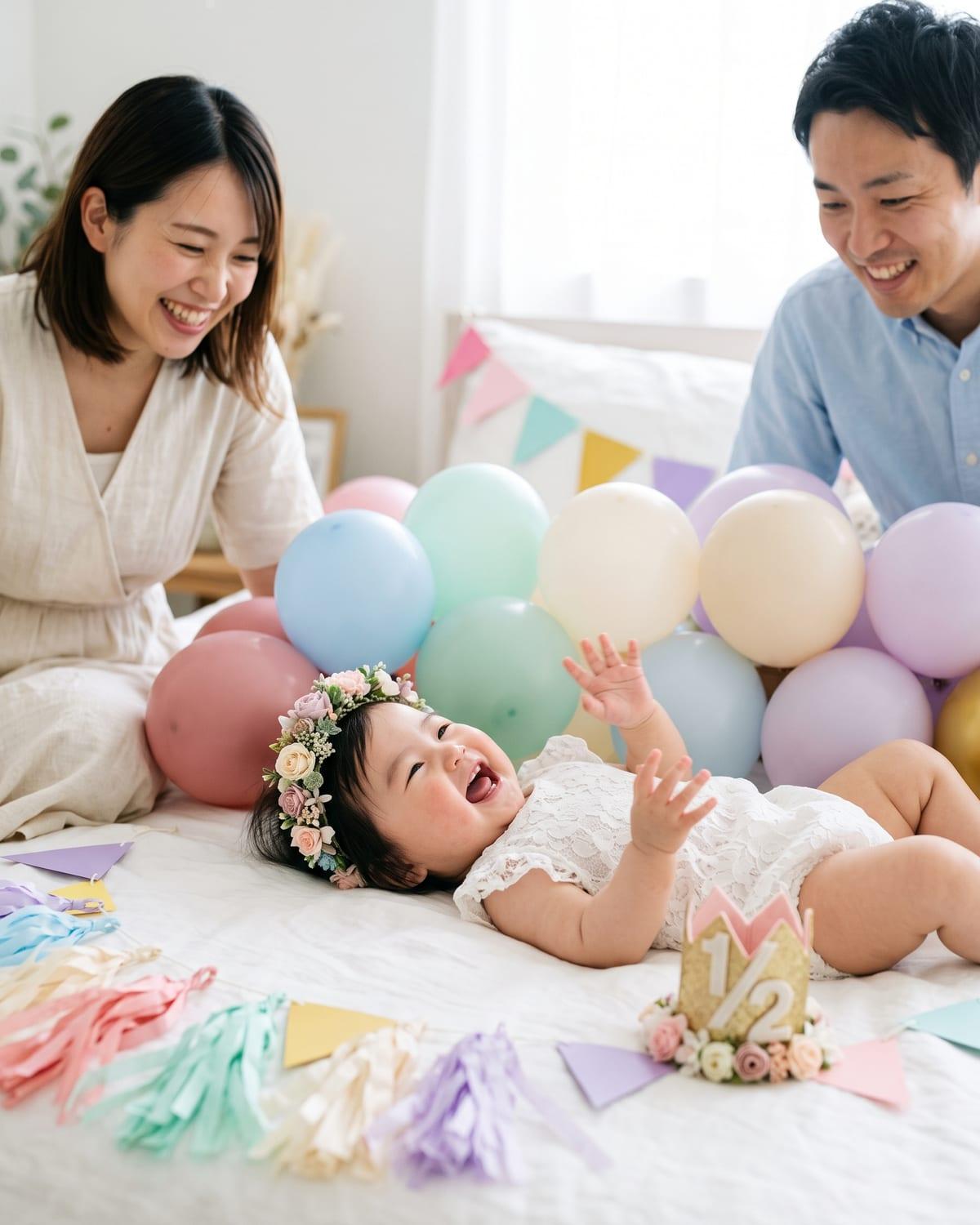
They can roll over, but they can't sit on their own yet. When you photograph a baby around six months old, for a half birthday (the six-month celebration popular in Japan) or any other reason, the four risks to watch are suffocation, falls, choking and overheating. You already think about all of these day to day. But a photo shoot brings things into the baby's space that aren't usually there: decorations, accessories, lights. Most of the danger comes from those unusual extras.
A body that moves but can't hold itself up
In the 2023 national infant growth survey by Japan's Children and Families Agency, 97.6% of babies aged 6 to under 7 months were reported as able to roll over, and 30.1% as able to sit on their own.
For whoever is holding the camera, that means two things. First, a baby you lay down can change direction in a few seconds. Second, a baby you sit up usually can't hold their own body steady yet. So an adult stays within arm's reach for the entire shoot. Everything below rests on that.
Suffocation: nothing soft around the face
Of the things used in photo shoots, the ones most linked to suffocation are soft fabrics, cushions and stuffed animals. Japan's Consumer Affairs Agency advises choosing firm bedding for babies, warning that if a baby ends up face down on something soft, the face can sink in and block the nose and mouth. It also says not to leave towels or stuffed toys that could cover the face around the sleep space, and not to leave pillows or bibs with ties near the face.
Long-pile faux fur or fleece backdrops look adorable in photos, but a rolling baby's face sinks right into them. Use a thin, flat fabric for the backdrop, and keep cushions and stuffed animals well away from the face. If you sit the baby inside a nursing pillow, stay where you can catch them immediately, so the face doesn't sink in if they tip forward.
Take bibs and hats with ties off as soon as the shoot ends. Don't put a baby down to sleep wearing them.
Photos of a sleeping baby need even more care. The Consumer Affairs Agency explains that sudden infant death syndrome (SIDS) can occur whether a baby sleeps on the tummy or back, but tummy sleeping raises the risk, so babies should be put to sleep on their backs unless a doctor has advised otherwise for medical reasons. Don't turn a sleeping baby onto their tummy or side for a cuter shot. With sleep art, where props are arranged around a sleeping baby, be especially careful to keep the area around the face clear.
Falls: the floor is the only set
Beds and sofas are tempting places to shoot. It's easy to make a backdrop there, and they're closer to the photographer's eye level. But the Consumer Affairs Agency warns that a fall from a bed even a few dozen centimeters high can cause a skull fracture or injury inside the head.
Shoot on the floor. For the same reason, don't sit a baby on a changing table or dining table for photos. If you use a floor seat or bouncer, buckle the harness and never put it up on a table or sofa.
Watch your own footing too. Climbing on a chair or step stool to shoot from above risks losing your balance and dropping the phone, or yourself, onto the baby. Holding a phone right over the baby's face is also risky if you drop it, so avoid that.
Choking: small things that multiply during setup
According to the Tokyo Fire Department, about 1,000 infants and young children each year are taken to hospital after choking on or swallowing dangerous objects. By age, 0-year-olds account for the most cases, and among 0-year-olds the numbers start rising from seven months. The most common causes at that age are wrappers and bags, such as snack packaging, and cigarettes.
Getting ready for a shoot puts exactly those wrappers and bags on the floor: plastic bags from new decorations, backing strips from double-sided tape, paper offcuts. Bin them as soon as you open things, and scan the floor before you start.
Check the size of the decorations themselves. The Consumer Affairs Agency explains that a 3-year-old's mouth opens to about 4 cm, so anything smaller can go in. The Tokyo Fire Department's rule of thumb: anything that fits through a toilet paper tube is dangerous. Keep decorations that pass through a tube out of the baby's reach.
LED lights and flameless candles bring battery risks too. The Consumer Affairs Agency warns that a swallowed button battery can pass electric current inside the digestive tract and damage it in a short time. It asks families to keep battery-powered products out of children's reach, check that battery covers haven't loosened, and tape them shut if needed.
If you have an older child, tell them as well. The Consumer Affairs Agency notes that older siblings sometimes take out button batteries and leave them where a younger sibling can see them, and advises explaining the swallowing risk to siblings too. On photo day, an older child trying to help may line up toys or small decoration parts beside the baby. A concrete rule is easy for kids to follow: "Nothing that fits through a toilet paper tube goes near the baby."
Heat: windows, lamps and layers
To get bright photos, people often pick a spot by the window. Depending on the season and time of day, sun through glass can warm the floor considerably. Before laying the baby down, put your palm on the spot and check it isn't hot.
Photo lamps are the same. Incandescent and halogen lamps heat up while they're on. Keep them away from the baby, where they won't hit anyone if they fall, and run the cord on the side the baby can't reach. In winter, leave plenty of space between the baby and any heater.
Layered outfits and hats make babies sweat more. Between shots, touch the back of the neck or the back, and if it's damp, take off a layer.
What to check before, during and after
Before: confirm the set is on the floor; the backdrop is thin and flat with no cushions or stuffed animals near the face; no bags or bits of tape are lying around; and small decorations and anything battery-powered are out of reach.
During: one adult never leaves arm's reach of the baby. Watch for sweat, skin color and mood, and wrap up after about 15 minutes.
After: put the decorations and accessories away straight away, and take off bibs and hats before putting the baby down to sleep.
Arm's reach matters more than the shot
Listed out, it looks like a lot. But it all comes back to one thing: for the whole shoot, an adult stays within arm's reach of the baby. If you can split the roles of photographer and watcher, do. If you're shooting alone, watching comes before shooting. The shooting itself is covered in Half-birthday photos: lying-down and sitting shots and Baby sleep art.
References