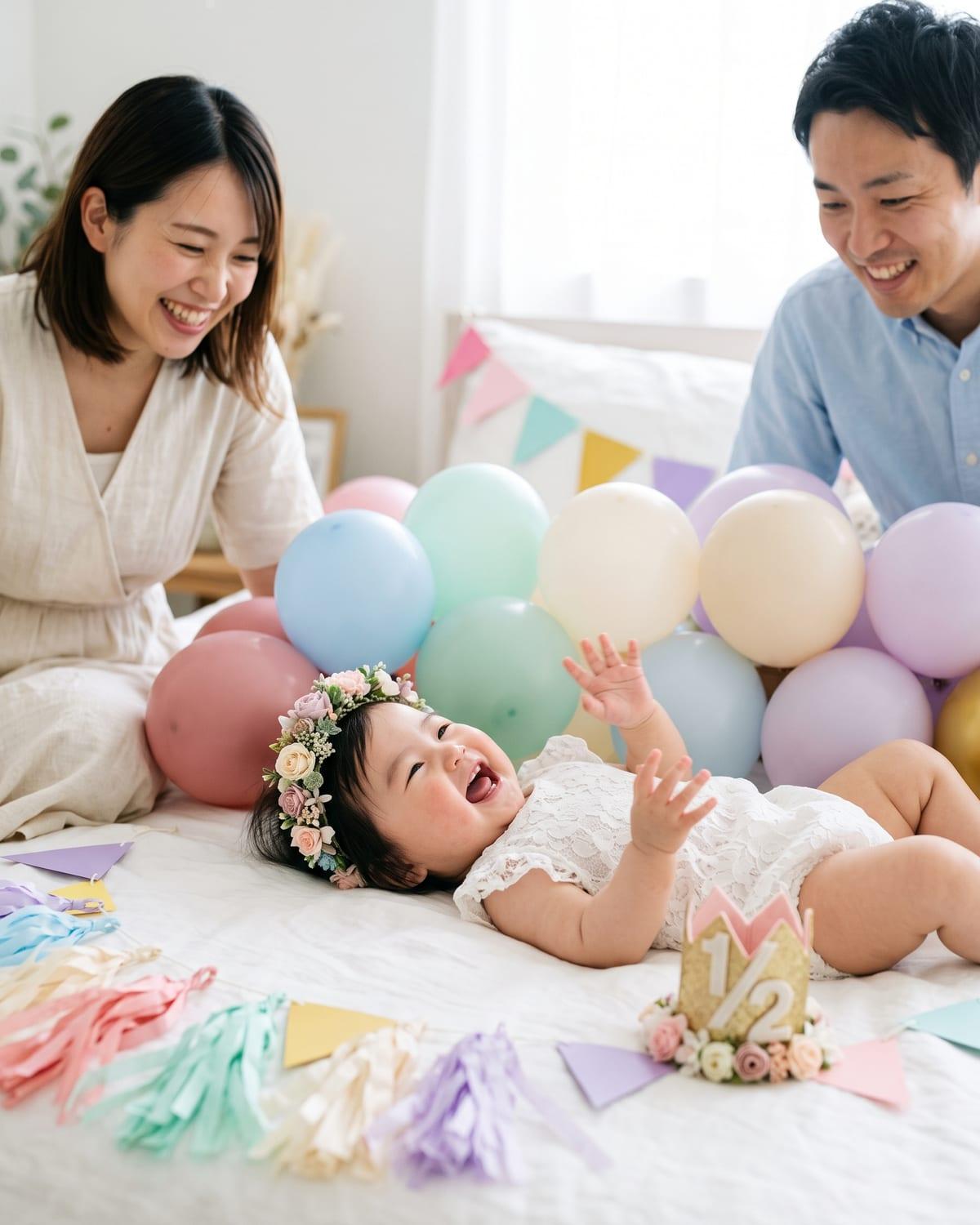
A baby food cake for a half birthday (the six-month celebration popular in Japan) looks like a cake, but inside it's just your baby's usual food. Use only ingredients your baby has already eaten without any reaction. Don't try anything new on the day, and leave out honey, sugar and cream. Stick to those two rules, and shape and color will do the rest to make it feel festive.
Whether to make one depends on how far along solids are
The Guide to Supporting Breastfeeding and Weaning, published by Japan's Ministry of Health, Labour and Welfare in 2019 (now hosted by the Children and Families Agency), says around 5 to 6 months is a suitable time to start solids. The signs it lists include steady head control, being able to roll over and sit for at least 5 seconds, pushing a spoon out with the tongue less often, and showing interest in food. It also stresses that development varies, so ages are only a guide.
At the half birthday, some babies have been on solids for a month and some haven't started. If yours hasn't, there's no need to rush in for the sake of a cake. Gathering around the adults' cake with the baby on your lap for a photo is a perfectly good celebration.
If your baby has only just started and has had nothing but rice porridge, make it from porridge alone. Even all in white, it looks like a real cake when you mold two tiers and stack them.
Only foods your baby has already eaten
The guide describes starting with rice porridge, then adding vegetables such as potato and carrot and fruit once the baby is used to it, and later tofu, white fish and hard-boiled egg yolk. New foods are given one baby spoonful at a time, increasing the amount while watching how the baby does.
For the cake, use only the foods from that list your baby has eaten several times with no change in how they feel. Thinking in colors makes it easier to plan.
- White: mashed rice porridge, potato, tofu
- Yellow and orange: kabocha squash, sweet potato, carrot, hard-boiled egg yolk
- Green: spinach or broccoli florets, mashed
The early weaning stage is for smoothly mashed food. Sieve or mash both the base and the "frosting" so no lumps remain. No seasoning is needed; the guide also says seasonings aren't necessary when starting solids.
What to leave out, and what not to try that day
Honey can cause infant botulism, so it isn't given until after the first birthday. That includes a little drizzle for sweetness. If the adults' cake uses honey, keep separate utensils for the baby's portion.
Leave out sugar, cream and store-bought whipped cream too. It's tempting to make the baby's cake look like the grown-ups', but the colors and shapes of the ingredients are enough. The guide also notes that cow's milk as a drink is best held off until after the first birthday.
And don't introduce a food your baby has never had on the day itself. The guide says there's no scientific evidence that delaying the start of solids, or delaying particular foods, out of worry about food allergy helps prevent it. So there's no need to keep avoiding new foods, but try them on a different day, in the usual way, starting from one spoonful. On a celebration day, relatives may be visiting or you may be heading out, and it's hard to watch your baby closely. The guide also says that if symptoms suggest a food allergy, don't judge it yourself; proceed based on a doctor's diagnosis.
Mold, unmold, stack
Small pudding cups, or a ring cut from a milk carton, make handy molds.
- Line the mold with plastic wrap, pack in mashed porridge or potato, and smooth the top with the back of a spoon.
- Turn it out onto a plate and lift away the mold along with the wrap.
- For a second tier, stack a smaller molded piece on top.
- Spread kabocha or carrot purée in a circle on top with the back of a spoon.
A diameter of 5 to 6 cm is plenty. Your baby will only eat a few spoonfuls, so anything bigger goes to waste. Don't serve more than a normal single meal.
To save effort on the day, use the kabocha or carrot purée you already batch-cook for baby food. If it's frozen, reheat it all the way through in the microwave or a pan on the day, let it cool, then use it. Make the porridge or potato base fresh on the day, since it crumbles easily and looks neater freshly made.
If you're also serving an adult cake, match its colors to the baby's and the two will look like one picture side by side. If the baby's cake is kabocha orange, for instance, top the adults' cake with orange fruit such as mandarin or mango.
To add "1/2," draw it with egg yolk or carrot purée using the tip of a straw or a toothpick. Put the toothpick away as soon as you're done; don't leave it anywhere near the baby.
Photograph it within 5 minutes of making it
The guide notes that children have weaker resistance to bacteria, so hygiene needs close attention when preparing their food. A cake that has sat at room temperature for a long photo session isn't something you want to feed your baby afterward.
So get every part of the shoot ready first, then make the cake. Set up the table backdrop, the plate and the phone position in advance, and once the cake is down, finish within about 5 minutes. Feed your baby either a portion set aside separately from the photo cake, or the cake right after you finish shooting.
Shoot from right beside the cake, at plate height. From above, the two stacked tiers flatten out. With window light coming from the side, the tiers cast small shadows and look three-dimensional. A plain cloth or placemat underneath hides the everyday look of the dining table.
For photos with the baby, sit them on an adult's lap and move the cake out of reach before you start. According to the guide, self-feeding with the hands starts around 9 months, and a six-month-old reaching for the cake can tip over the whole plate. For an eating shot, photograph an adult bringing a spoonful to the baby's mouth. It's very much a picture of this age.
The real star is the face, not the cake
What you'll most want to keep from a baby food cake isn't the cake. It's your baby's face at the first taste of a celebration meal. If it collapses, or your baby turns away after one bite, that's fine. Use foods they already eat, make it small, shoot it quickly. That's enough of a keepsake.
For other things to do on the day, see What to do for a half birthday; for photo ideas away from the table, see Half-birthday photo ideas. To see how other families celebrated, browse everyone's half-birthday posts.
References