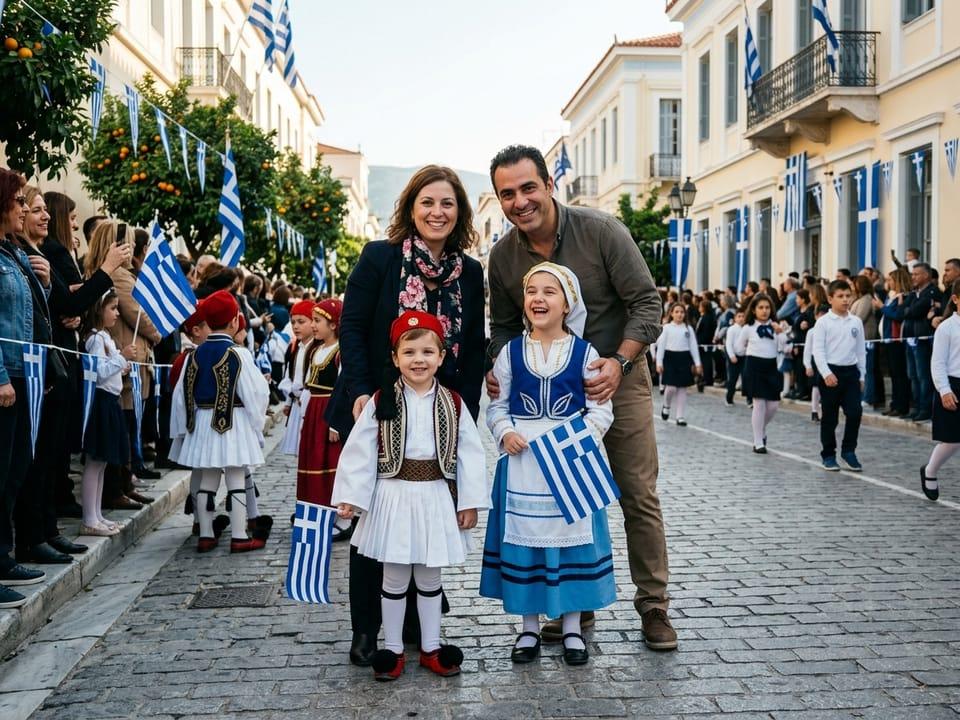
Just before 25 March, Greek kindergartens and primary schools hold their own celebration, with poems, songs and dances the children have rehearsed for weeks. If your child refuses the costume, part of it is usually enough, and a word with the teacher a few days ahead heads off most of the tears on stage. Whether parents may film is up to the school. Under EU data protection rules, photos you take only for the family album generally sit outside the GDPR, but a video full of other people's children is another matter, so keep what you record within the family.
The same advice holds for 28 October, Ohi Day, when schoolchildren again take part in the national-day events.
Find out what's really wrong with the costume
Children rarely refuse a costume for no reason, so watch the try-on and ask. The usual culprits are small and fixable. The embroidered vest scratches through a thin shirt. The fez is heavy, slides over the eyes or pulls the hair. The white tights are tight at the waist. The long tassel tickles the neck. The Amalia skirt is long enough to trip on. Or it simply looks different from what a best friend is wearing.
Put a soft cotton T-shirt under the shirt or blouse. Fix the fez with two hair clips, or agree that it goes on only for the song and the photo. Swap scratchy tights for plain white leggings. Then do a short dress rehearsal at home a few days before: ten minutes in costume while doing something your child enjoys, so the costume stops being the scary part. Letting a reluctant child choose which piece to wear on stage can turn a refusal into a decision of their own. Ask the teacher whether a vest and fez over school clothes would be acceptable.
Talk to the teacher a few days before
Tell the teacher what worries your child: the costume, the audience, a solo line in the poem. Then ask the practical questions. Can your child stand next to a friend, or at the side of the group rather than the front? Could they hold the flag or a prop instead of reciting alone? Where will parents sit, and will your child be able to see you? When do the children change, and can you help? Teachers have seen plenty of reluctant five-year-olds, and knowing in advance lets them plan around it instead of discovering it on stage.
On the day, freezing and tears are part of it
A shy child often freezes the moment they see a room full of adults. Sit where your child can see you, smile, and resist calling out or waving from the aisle, which can make them feel watched. If they cry, slip out together for a few minutes; many children come back in for the last song. Keep the phone low rather than held up above everyone's heads, so your child sees your face instead of a screen. Afterwards, praise the effort, not the performance. A child who stood on stage for one song has done the hard part.
The school sets the filming rules
There's no single rule for every school, so ask the teacher or read the school's notice before the day. The legal frame is the EU's GDPR, which applies in Greece. As Ireland's Data Protection Commission explains in its guidance for parents, photos taken purely for personal and family use generally fall under the "household exemption" and outside the regulation. The same guidance says schools can set their own policies for closed school events, and if another parent objects to a photo of their child that you've posted, common courtesy says take it down. When the school itself photographs the event, it needs a legal basis, and that is often the parents' consent. Greece's data protection authority stresses that children's data is entitled to special protection.
In practice, film your own child's part, share it in the family chat, and crop out other children before it goes any further. Don't post the full class video publicly.
Studio, a photographer at home, or your own phone
For a shy child, the place matters more than the camera. A studio means an unfamiliar room, a stranger behind a big camera and a fixed slot, which is hard for a child who froze on stage the day before. A photographer who comes to your home meets your child on familiar ground, but is still a new face, so it works best if they take time to warm up. Prices vary by studio, photographer and package, so compare on their own price lists, and save the money for when it pays off: a formal portrait of several siblings in costume, or one with grandparents. Your own phone at home, on the day before or after the celebration, costs nothing, and you can stop the moment your child has had enough. For setting up that photo, see where to get the costume photo.
A photo at home is enough, even if the stage didn't go well
Whether your child recited every line doesn't really matter. A calm photo in costume at home and a short clip of their part are a full record of the year. If your child wouldn't put the costume on at all, pokesta can make a portrait of them in a tsolias or Amalia costume with AI from an ordinary phone photo, set on a flag-lined street or in a decorated schoolyard. It's a generated image, not a picture of what happened, so keep it as a keepsake. It's $1 per photo and the first is free, so try it with a recent photo of your child and see whether it's worth keeping.
References