
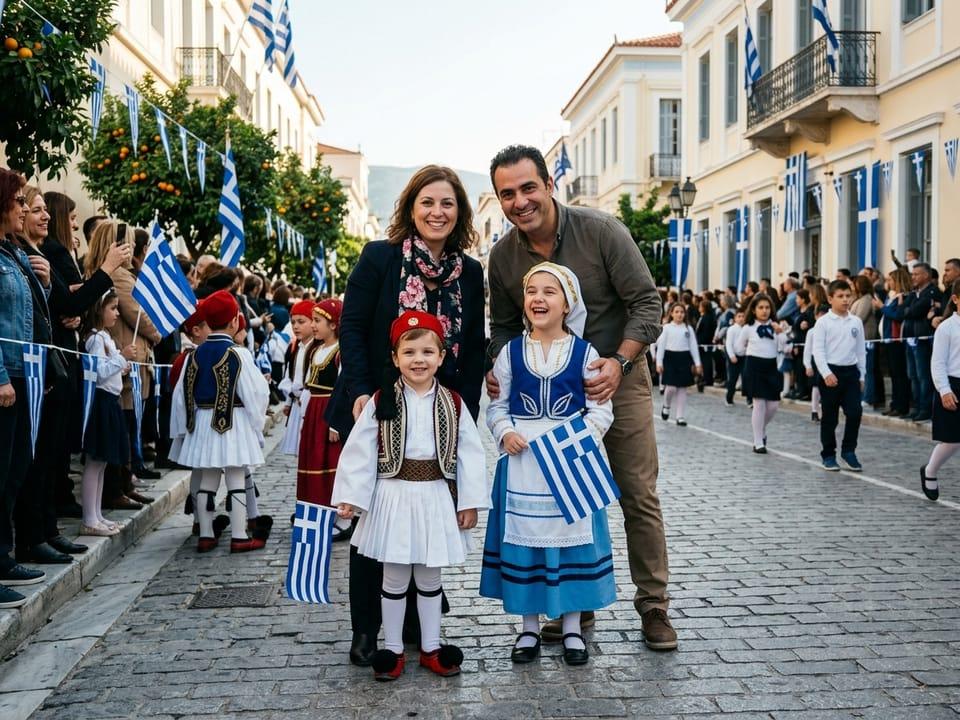
In Greece, a school parade is called off for weather by the regional unit or the municipality, usually on the strength of the previous day's forecast, and the church service and wreath-laying normally go ahead regardless. That is what happened on 25 March 2026 in Heraklion, Chania and Rethymno on Crete, where heavy rain was forecast for midday. Cold is the more common problem. In late March, Athens averages a daytime high of about 16°C and a low of 8.5°C, and neither a fustanella nor a silk skirt was made for that.
School parades are held on both national days: 25 March, Independence Day, which marks the start of the 1821 War of Independence, and 28 October, Ohi Day, which remembers the refusal of the Italian ultimatum in 1940.
Cancellations come from the region or the town, often the day before
On Crete in 2026, the decisions came from the deputy regional governors' offices in Heraklion, Chania and Rethymno, and in smaller places from the municipalities, which separately called off parades in villages such as Alikianos, Voukolies, Kolymbari, Vrysses and Vamos. In Chania the decision followed a forecast issued the Saturday evening before. In Rethymno the notice pointed to the heavy rain the national weather service, EMY, expected for the next day. The doxology, the thanksgiving service in church, and the laying of wreaths still took place.
So check the announcements of your regional unit and your municipality the evening before and again in the morning, along with whatever channel the school uses to reach parents. Don't assume a decision in the main town covers your village, or the other way round.
Also check which day your child actually marches. In Athens in 2026 the student parade was held on 24 March and the military parade on the 25th, with traffic on Amalias Avenue stopped from 10:00 for the students. Ask the school what time the class has to be at the assembly point. The waiting before the start, standing still in a thin costume, is often the coldest part of the morning.
March is colder than the costume
The two national days sit at opposite ends of the cool season. HNMS normals for Elliniko in Athens, covering 1955 to 2010, give March an average high of 15.9°C, a low of 8.5°C and rain on about 11 days. October is milder, with 23.4°C and 15.7°C and about 9 rainy days. Thessaloniki and the inland towns of the north are usually colder still, so a March morning there can feel like winter.
Layer under the costume, not over it. For a tsolias, a thin long-sleeved thermal top fits under the wide white shirt, and thermal leggings go under the white hose without changing the look. For an Amalia dress, thermal leggings disappear under the long skirt and a long-sleeved vest fits under the blouse. Keep a coat, ideally in a colour close to the vest, on your child until the class lines up, and have it ready again the moment they've marched past. Gloves can stay on while they wait. A warm breakfast, a toilet stop before leaving and a small bottle of water help more than anything you could buy.
Little ones who are only watching can wear their costume over a normal jumper. Nobody on the pavement will mind, and the photo still shows the costume.