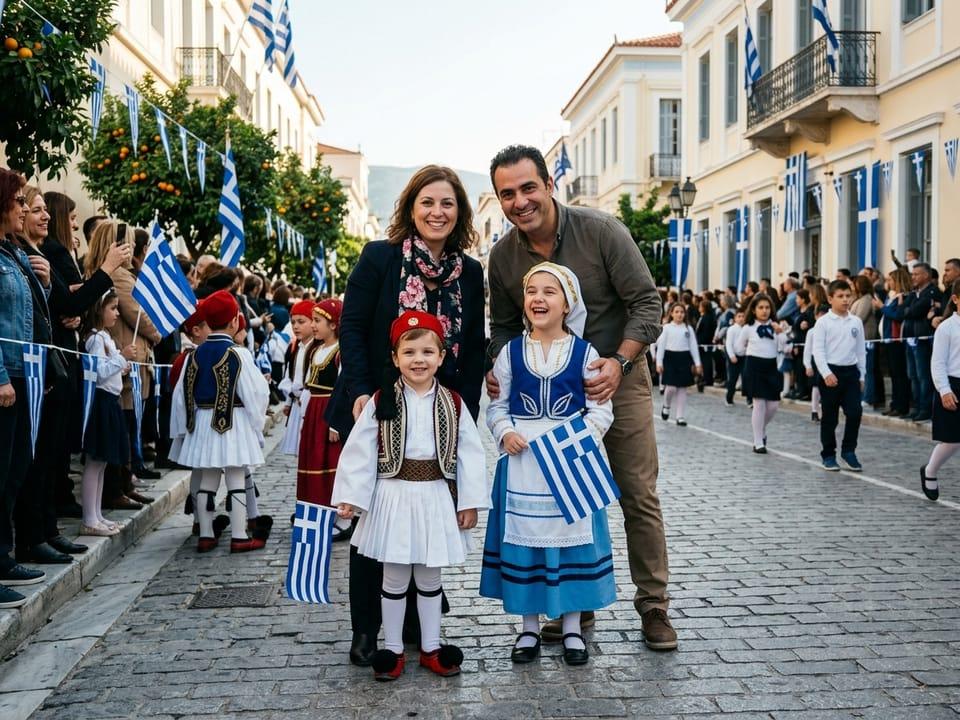
For a costume your child will wear about twice a year and outgrow by the next school year, a hand-me-down or a rental usually makes more sense than buying. If you do buy, the price gap is wide. As of October 2026, the Greek price-comparison site BestPrice.gr listed children's tsolias costumes from toy and costume shops at roughly €24 to €49, while a "LUX" traditional set from one seller, MarketNet, ran from €198 to €228 for a tsolias and from €105 to €197 for an Amalia dress, depending on the extras. Prices change by shop and season, so check the current listing before you order.
What the two costumes actually are
Tsolias is the everyday Greek name for an Evzone, the soldier of the ceremonial guard, and the children's costume copies that uniform: the white pleated fustanella, a wide-sleeved white shirt, an embroidered vest, a fez with a long tassel, white hose held by garters and red tsarouchia shoes with black pompoms. The Evzones have worn a short fustanella since 1868, and today's Presidential Guard keeps the uniform.
The Amalia dress goes back to Queen Amalia, who came to Greece in 1837 as the wife of King Otto and had a court dress made in the style of her new country's clothing. Its parts are a loose white blouse, an embroidered velvet jacket in dark blue or claret, an ankle-length pleated skirt, usually sky blue, and a fez with a long gold tassel. These are the two costumes you'll see most often among younger children on 25 March and 28 October, at the school celebration and on the parade route.
Two price tiers, and a third route built from pieces
The cheaper tier is a costume-shop set. In BestPrice's results in October 2026, toy shops including Toycity, Momandme, Yuppietoys and Bimbo listed children's tsolias sets in sizes from 2 to 12 at €23.92 to €39.99, and the highest price among the visible results was €48.90. These are made for a season or two, and the listings don't always say what's in the bag, so check whether the fez, the belt and the shoe covers are included.
The upper tier is a fuller traditional set. MarketNet listed its LUX children's tsolias at €198 to €227.70, depending on whether tights and shoe covers were added, and its LUX Amalia dress at €105 without necklace or brooch, rising to €196.80 with a three-row coin necklace and a brooch.
Between the two, you can put a costume together from separate pieces. The shop Gounas listed a children's tsolias vest at €60 and a white skirt at €20, and for the Amalia dress a vest at €60, a skirt at €20, a red fez at €12 and a white blouse front at €7. That route makes sense when a relative already has the skirt and shoes, and you only need to replace the part that's worn out or too small.
Borrow first, rent second, buy last
Ask the family before anything else. Costumes travel between cousins and neighbours precisely because so few children wear one for more than a couple of years, and a fustanella that's slightly loose can be taken in with a few stitches. Some cultural associations (politistikos syllogos) and folk dance groups keep costumes of their own and may lend or rent them, often to members' families. Not every town has one that does, so ask locally rather than counting on it.
If you rent from a shop, ask three things before you pay: how many days the rental covers, whether there's a deposit, and who pays for cleaning if the white skirt comes back muddy. Book early, because every school needs costumes in the same week, twice a year.
Buy when a younger sibling will wear it next, or when your child is likely to march for several years. Go a size up, choose an elastic or adjustable waist, and leave the hem long enough to let down. Passing it on to a cousin afterwards, or selling it, takes some of the sting out of the price.
Spend on what the camera sees
In most photos of a child in costume, the eye goes to the head and upper body. On a tsolias that means the fez, its tassel and the vest. On an Amalia dress it's the velvet jacket with its gold embroidery, and the fez again. The white skirt reads mainly as a shape, and tights and shoes only matter in a full-length shot. On a tight budget, a cheap set with one good vest looks better in pictures than an expensive set with a fez sliding over the eyes. Fix the fez at home with a hair clip or a thin loop of elastic before the day.
Studio, photographer or your own phone
The costume is the expensive part, so the photo doesn't have to be. A studio gives you even light and a plain background. Its price is usually built from session time, the number of edited images and prints, and varies by studio and package, so compare on each studio's own price list and ask whether you can bring your own costume. A photographer who comes to your street charges for the session plus travel and earns that fee with a big family group, grandparents included. Your own phone, at home before you leave, costs nothing and can wait for the minute your child is in a good mood. For exactly where to take the picture, see where to get the costume photo.
When the costume is mostly for the photo
Some families want the picture more than the parade, or have a child who flatly refuses the fez. In that case, pokesta can dress your child in a tsolias or Amalia costume with AI, starting from an everyday phone photo you already have, and place them on a flag-lined street, on Syntagma Square or in a schoolyard. The result is a generated image, not a photo of your child in costume on the day, so it's a keepsake rather than a record. It costs $1 per photo and the first one is free, so make one from a recent photo before you decide whether to buy.
References