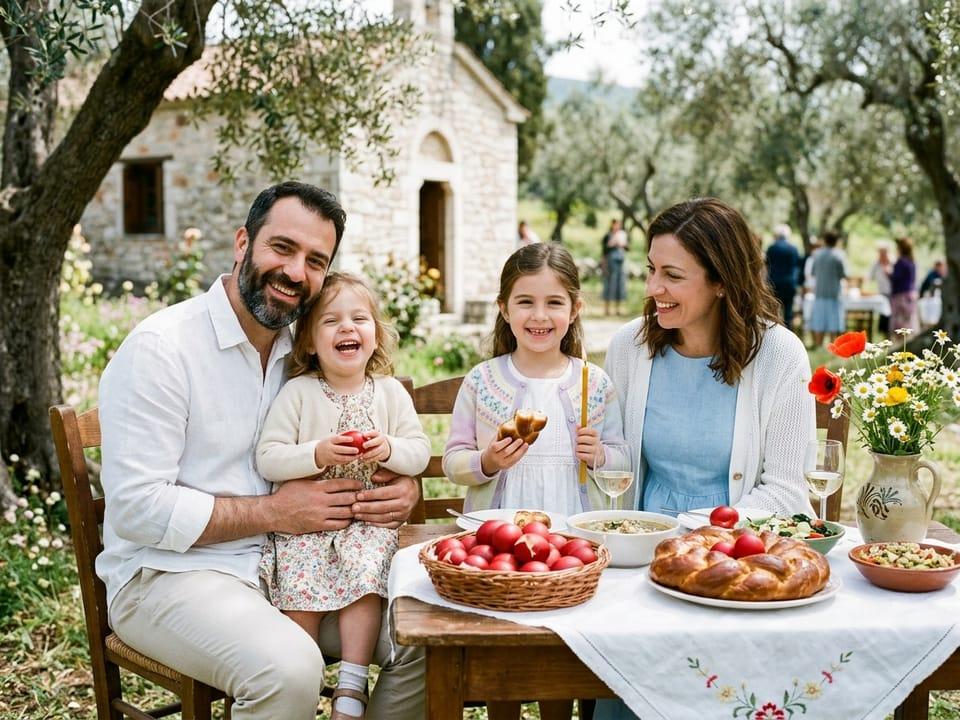
You can take a toddler to the Resurrection service (Anastasi), as long as you plan for the few minutes around midnight rather than the whole night. The service on Holy Saturday usually starts around 11 p.m., and together with the liturgy that follows it runs until 2 or 3 a.m. on Easter Sunday. The moment most families come for, the Holy Light and the first "Christos Anesti", is at midnight. In 2027 Orthodox Easter falls on 2 May, so the night to plan for is Saturday 1 May.
The hard part is 11 p.m. to 1 a.m., not the church
Think about what midnight asks of a two-year-old. It's hours past bedtime, the churchyard is packed, there are lit candles at toddler eye level, and there may be bangs going off nearby. That's a reason to shorten the visit, not to stay home.
A workable plan: arrive about twenty minutes before midnight, stand near the edge of the crowd or close to the gate instead of pushing toward the doors, light the candle, sing "Christos Anesti" with everyone, exchange greetings, and leave. You'll be home before the liturgy is halfway through, and that's fine.
On the day, push the afternoon nap later and let it run long. Give a normal dinner at the usual time rather than waiting for the post-service meal, and dress your child in layers they can sleep in, since a spring night can feel cold after an hour outside. A baby carrier is easier than a pushchair in a crowd. Decide beforehand which adult leaves with the toddler if it all falls apart, so nobody has to negotiate at midnight.
Firecrackers are banned, but plan for noise anyway
The Hellenic Police repeat the rule every Easter. In their 2025 message they said the manufacture, sale, purchase, possession and use of firecrackers and launchers, and any pyrotechnics without a licence, are prohibited, and that burning sparklers is banned during the Easter period. They asked parents to keep children from using or making them, and summed it up as "we light only candles."
Even so, you may still hear bangs around midnight, and some places hold their own Easter fireworks customs, such as the "rocket war" in Vrontados on Chios on the evening of Holy Saturday. For a toddler, a sudden bang in the dark can end the night on its own. Bring ear defenders made for small children and put them on before midnight, not after the first bang. Stand away from open spaces where teenagers gather, and teach older children never to pick up anything they find on the ground. If your child is very sensitive to noise, the morning service below is the kinder choice this year.
Keep the lambada flame away from hair and ribbons
Adults hold white candles at the Resurrection, but children are usually given lambades in colors like red, yellow or light blue, decorated with ribbons and ornaments. Those ribbons, a fluffy jacket and loose hair are what catch fire, not the candle itself.
Tie long hair back. Trim ribbons so they hang well below the flame, or move decorations lower down the candle. Fit a drip guard; a paper cup pushed over the base works. A toddler under three can hold the lambada unlit while an adult holds the lit one beside them, which still makes a good photo. For the walk home with the flame, the adult carries it, and it goes out before anyone gets into a car.
If midnight is too much this year, go in the morning
On the morning of Holy Saturday, churches celebrate the First Resurrection (Proti Anastasi), the vespers of Easter Sunday. At one point the priest throws bay leaves to the congregation and proclaims "Anasta o Theos" (Arise, O God). One published account gives 9 a.m., with 11 a.m. in Corfu and just after 6:30 in Zakynthos, so check your own church's Holy Week schedule.
For a toddler this is often the better service: they're awake, it's daylight, and catching bay leaves is something a small child can actually join in. Your photos will be sharper too. Then at midnight you can listen for the bells from the balcony, or simply let everyone sleep and save your energy for the lamb and red eggs on Sunday (see Greek Easter Sunday in the village with toddlers).
Studio, a hired photographer or your own phone
For the midnight service itself, hiring a photographer rarely makes sense. Light is low, the crowd is dense, you need the priest's agreement, and you'd be paying for time while your toddler may well be asleep on your shoulder. Where professionals earn their fee is the Sunday gathering, with many relatives and one chance at a group photo, or a studio portrait on a weekend before or after Easter.
|
Studio portrait |
Photographer at home or church |
Your own phone |
| Cost |
Session fee; varies by studio and season |
Paid by time; Easter weekend is a holiday |
Nothing extra |
| Toddler's mood |
You pick a daytime slot |
Tied to service and meal times |
Stop the moment they're done |
| Changing plans |
Ask about rebooking terms when you book |
Fixed date |
Nothing to change |
| Result |
Posed, even light, Easter clothes |
Real moments, big group shots |
Grainy at night, but it's the real thing |
| Best for |
A formal portrait for the wall |
The Sunday family table |
The midnight minutes |
Prices depend on the studio, the season and the package, so check each one's own website. With a phone, turn off the flash, hold the lit candle a little in front of your child's face, and shoot a short burst at midnight. Our Greek Easter photo guide covers candlelight shots in more detail.
Let midnight be five minutes, and make the portrait at home
A good Easter night with a toddler might be ten minutes in the churchyard, one candle, one greeting and home to bed. If that means you never got the photo of everyone in their Easter clothes, pokesta can make a Pascha family portrait with AI from phone photos you already have, lambades and spring clothes included. It's a generated image, not a record of the night, and it's $1 per photo with the first photo free, so you can try it with a recent photo of your child before you book any session.
References