Preschool Graduation in Spain: Tears on Stage, June Heat and the School's Rules on Phones
pokesta Editorial Team · Updated October 31, 2026
The graduación infantil that many Spanish schools hold in June, with small gowns, caps, a song and a diploma, marks the end of Educación Infantil, the voluntary stage that runs up to age six. Three worries come up again and again, and none of them has to spoil the day. A school may ban or limit filming, and Spain's data protection authority (AEPD) confirms it can. Children cry or freeze on stage, but the act is short. And June is hot: the average daily maximum is 28.2 °C at Madrid's Retiro and 32.2 °C at Seville airport, according to AEMET's 1981–2010 normals. Put water and shade first, and take the gown photos after the ceremony.
The phone rules protect your child as well
The AEPD's guide for schools says that families who photograph or film an event open to them, purely for personal and domestic use, are outside data protection law. The same guide says a school can use the autonomy the education law gives it to decide that families may not film school events at all. Either way, the line is publication: images should not go openly on the internet unless everyone who appears in them has consented, through their parents if they are under 14, and relatives who spread images beyond family and friends take on that responsibility themselves.
Some schools have a teacher or a hired photographer take the pictures instead. The AEPD describes how that should work: the images are shared in a restricted area, such as a password-protected section of the school intranet, limited to events the child took part in, with a reminder not to pass them on openly. So a rule of "photos from your seat, nothing on public social media" is not the school being difficult. Sending a clip to a grandmother is private; posting a video of the whole class on an open Instagram account is not.
If the school allows phones, stay in your seat and zoom. Thirty parents in the aisle block the view for everyone and make the children nervous.
When your child cries or won't go on stage
Five-year-olds cry at graduations for ordinary reasons: noise, a crowd of adults, a hot gym, spotting a parent and wanting them. The teachers have seen it many times, so let them handle it. Calling your child's name from the audience usually makes it harder for them to stay in place.
What helps happens before. Tell your child where you will sit, and that a small wave is enough. Make sure they have eaten, been to the toilet and, if they still nap, aren't running on empty. If they refuse to walk up, a child sitting on a teacher's lap in a slightly crooked cap is still part of the day, and nobody will remember the tears by September.
June heat matters more than the perfect shot
Many of these ceremonies take place in a gym, an assembly hall or the playground at the end of the school year, and a gown is an extra layer. Dress your child in something light underneath, bring a water bottle for them and for yourself, and if you wait outside, find shade. Familia y Salud, the family health site of the Spanish association of primary care paediatricians (AEPap), recommends drinking plenty, avoiding the sun in the middle of the day, wearing light, light-coloured clothes and resting somewhere cool.
The same page describes the warning signs. Heat exhaustion shows up as weakness, nausea, vomiting, headache, dizziness or cramps. Heat stroke is more serious: a change in consciousness, a temperature above 39.5–40 °C and hot, dry skin. In that case, cool the child straight away with cold compresses on the neck, armpits and groin, and call 112. A sibling in a pushchair or a grandparent on a plastic chair in the sun needs the same attention.
Take the gown photos after the ceremony
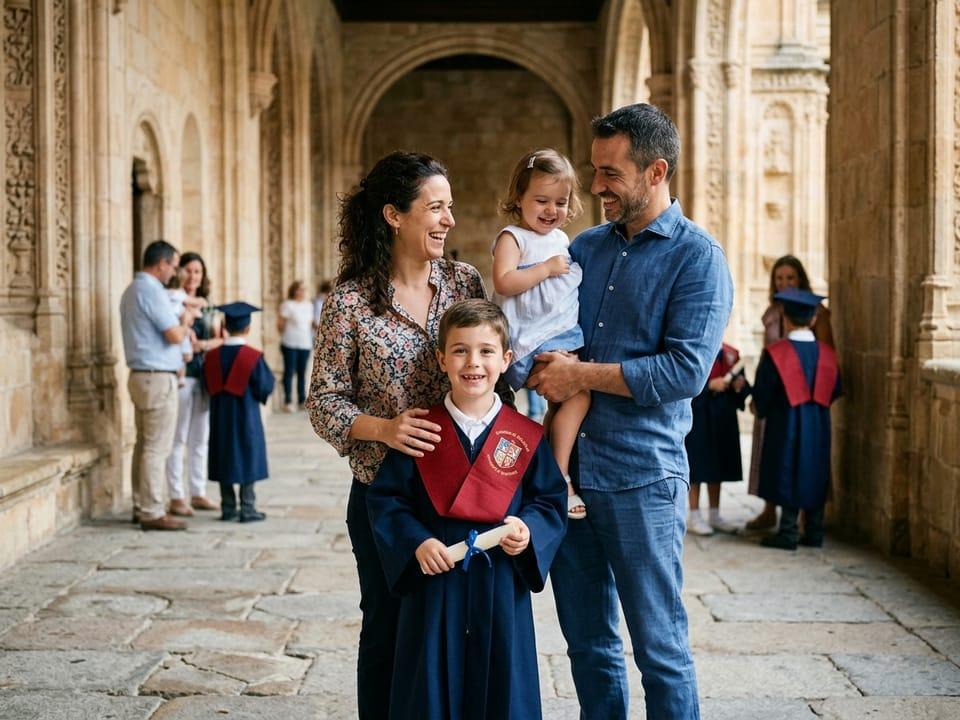
The best pictures of the day rarely come from the stage. Ask the teacher beforehand whether the children keep their gowns and caps for a few minutes after the act. If they do, take your child to a shaded corner of the playground or the classroom door, crouch to their eye level and photograph them with whoever came: parents, siblings, grandparents. Open shade gives soft, even light on faces; direct midday sun gives squints and dark eye sockets.
Shoot in bursts, because five-year-olds don't hold a pose. A cap tossed in the air, the diploma held upside down and a hug from a sibling make better pictures than a stiff line-up.
The school's photographer, a session another day or your phone
There are three ways to get a picture, and they suit different families. The school or AMPA photographer covers the class: the orla and group photos, sold as a package to families who want them, with no parents in them; our guide to the school orla and what it costs explains what is optional. A family session with a photographer on another day costs more, but you can choose a cool morning, the child is rested and the date can move if they are ill. Your phone on graduation day costs nothing and catches the real moment, but you depend on the heat and your child's mood.
For a preschool graduation, a paid session only makes sense if relatives are travelling for it or you want a framed family portrait in the gown. Price ranges for family sessions in Spain are in our guide to graduation family photos.
When the day doesn't give you the picture
If your child cried through the whole act, or the gown went back in its bag before you could get a photo, you still have options. pokesta can make a graduation family portrait with AI from phone photos you already have of your child and the rest of the family. It is a generated image rather than a record of the ceremony, so keep it alongside your real snapshots, not instead of them. It costs $1 per photo, and the first one is free: try it with a photo from this week and see whether it's the picture you missed.