
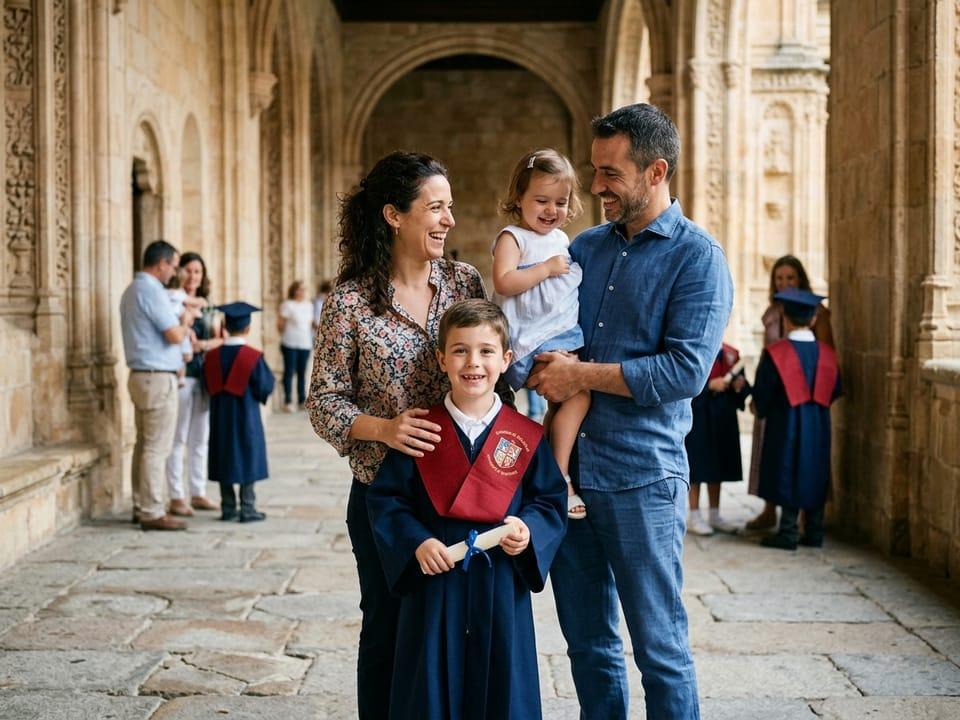
In Spain, the orla session photographs the graduate alone, in gown and beca, for the class composite; parents and grandparents are not in it. Family pictures are taken after the acto de graduación, on the faculty steps or somewhere nearby, because during the imposición de becas the organisers decide who photographs what. For most families a phone and twenty planned minutes after the ceremony are enough. A hired photographer earns the fee on the day the grandparents, siblings and everyone else are finally in one place.
The orla is a portrait of the graduate, not of the family
The orla is the framed composite of a graduating class: one small portrait per student, often with the teachers, under the name of the degree or school. Companies that specialise in it photograph each student individually, in their own studio or on set dates at the faculty, and supply the academic dress (toga, birrete and the beca, the coloured sash) so that everyone matches.
A 2021–22 dossier given to students of the Facultat de Matemàtiques i Estadística at the Universitat Politècnica de Catalunya, from the Barcelona firm Foto Grup, shows how the packs are built. The cheapest was an online pack at 15 €: you upload your own photo and they edit the academic dress onto it. In-person packs ran from 26 € to 38 €, VAT included, with printed orlas, individual prints and ID-size photos. Those were that year's prices for that faculty, checked in October 2026; packs and prices change by company and year, so ask for the current offer.
None of the packs include the family. A picture of the graduate with the people who paid the fees and drove them to every exam has to be planned separately.
During the imposición de becas, the organisers set the rules
The ceremony belongs to the faculty or the school. At the Universidad de Granada's school of computer and telecommunications engineering (ETSIIT), a graduation committee organises the act, which is held preferably in May so it doesn't clash with exams, and the number of guests per graduate depends on the space available. Each beca carries the colour of the graduate's field. The Universidad de Jaén lists red for law, light blue for humanities, dark blue (azul turquí) for sciences, yellow for medicine, orange for economics and business, and brown for engineering and architecture, and says the colour appears on the becas placed on graduates. ETSIIT's rules add that its brown becas carry the degree's emblem and official name.
Photography during the act may be contracted out. In a 2013 letter to graduates of the Complutense's faculty of commerce and tourism, the company Orla Magna said it would photograph each student at the moment the beca was placed and then the whole group on the entrance steps, and asked students to go to the steps without their families, whom they would see afterwards. Arrangements differ between faculties, so ask the committee whether guests may stand in the aisle, whether there is an official photographer and how to order their pictures. At a bachillerato ceremony in a secondary school, the school sets the rules; our guide to preschool graduations explains what Spain's data protection authority says about parents filming school events.
From your seat, zoom rather than walk. The beca goes over the shoulders in seconds: shoot it in burst mode, then put the phone down and watch.