
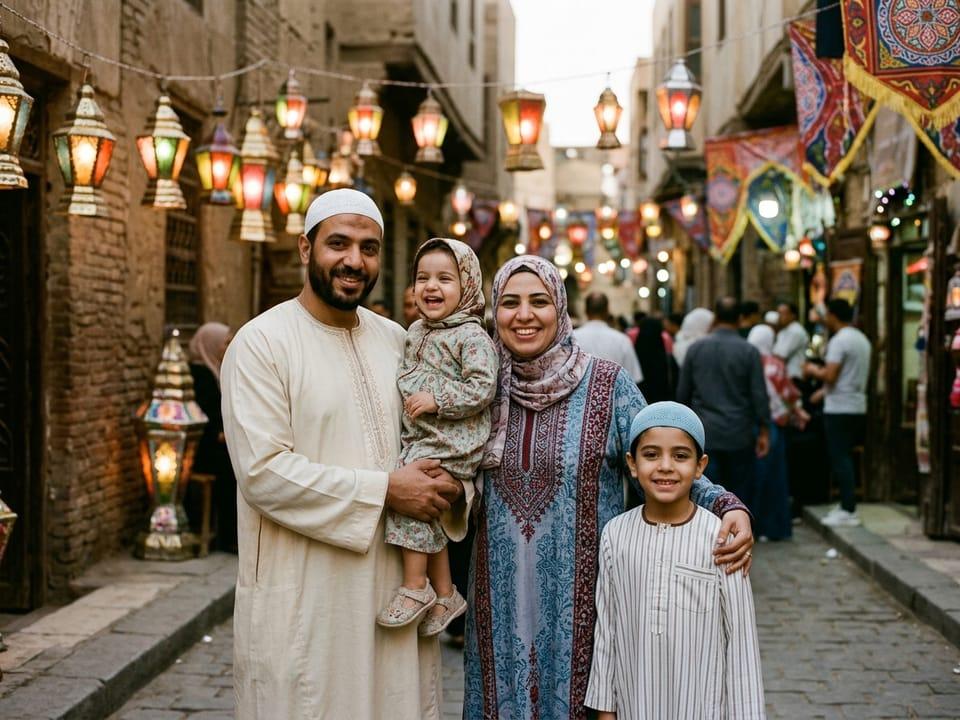
Families in Egypt usually choose between three ways to take a Ramadan family photo: a studio's Ramadan set, an evening in old Cairo with a hired photographer, or their own iftar table at home. With babies or toddlers, the iftar table wins: it costs nothing extra, it shows your own family's Ramadan, and nobody misses bedtime. The lantern-lit streets around Al-Muizz are better saved for when the children are older, and a studio set gives you a tidy portrait quickly, at the price of looking much like every other family's photo that month.
A studio set is quick and tidy, and looks like everyone else's
A Ramadan set brings the season's props together under controlled lighting: fanous lanterns, khayamiya appliqué fabric in red, blue and gold, floor cushions, maybe a crescent. The room is warm, the session is short, and the photographer has already worked out where to put a family of four or six. If the goal is a printed portrait for the grandparents' wall, this is the most predictable route.
The trade-offs are just as clear. Every family booked that month stands in front of the same backdrop, so the photo says "Ramadan" more than it says "us". The set only stays up for the season, which leaves little room to move a booking if a child gets ill; we cover that in what to do when a child is sick on the day of a Ramadan session. Studios usually price by session, with a set number of edited photos and extras for more images or prints, and they take a deposit. Compare what is included, not only the headline price, and ask about rescheduling before you pay.
Old Cairo at night has the atmosphere, plus the crowds and the dark
Al-Muizz Street is the classic backdrop. Starting in 1997 the government renovated it to turn it into an "open-air museum": 34 monuments along the street and some 67 nearby were restored, buildings were brought down to the height of the monuments, and the street lighting at night was modernised. In Ramadan the area around Khan el-Khalili glows with lanterns and busy stalls, and after iftar the streets fill up.
That is exactly what makes it hard with small children. The evening walk starts after the meal, when toddlers are winding down. The crowds put strangers in every background, and the light comes from shop fronts and lanterns, so the photographer needs to be good in low light and quick with children who won't stand still. Cairo nights are cooler than many people expect: at Cairo airport the average low is about 10 °C in January and 11 °C in February, so bring jackets and a blanket for the pram. The paving is uneven, and a tired four-year-old on stone steps is a carrying job.
On permits: in 2022 the Minister of Tourism and Antiquities said people can take pictures in public places without a permit. Filming inside archaeological and tourist sites is a different matter with its own licences and fees. If your photographer plans to take you into a monument rather than shoot on the street, ask before you book whether tickets or permission are needed and who arranges them.