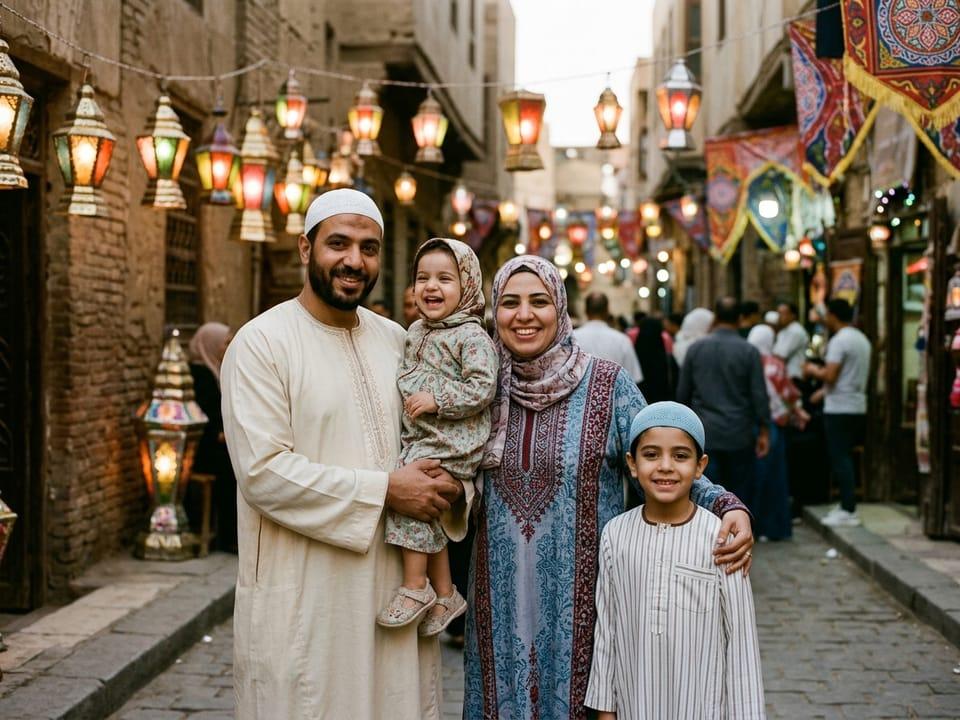
Ramadan Family Photos Before Iftar or After Taraweeh? Timing Around Fasting Adults and Sleepy Kids
pokesta Editorial Team · Updated November 4, 2026
In Ramadan, the youngest child's bedtime should decide when you take family photos. In Cairo in February 2027, Maghrib, the sunset prayer that breaks the fast, falls between about 17:38 and 17:53, Isha follows roughly an hour and twenty minutes later, and taraweeh prayers come after Isha. The soft light before sunset lands on the busiest hour in the kitchen, and by the time the family is fed and dressed again, the little ones are fading. The answer is to split the day: the iftar table in the last minutes before Maghrib, small children on a weekend afternoon, older children after iftar.
The best light of the day falls on the busiest hour
Ramadan 2027 is expected to start around 8 February, though in Egypt the month begins with Dar al-Ifta's moon sighting and can shift by a day. Through February, Fajr in Cairo is a little after 5 in the morning, so by late afternoon the adults have gone without food or water for about twelve hours. The hour before sunset gives warm, low light that flatters faces. It is also when someone is frying, someone is laying the table and everyone is watching the clock.
Asking a fasting household to stop and pose at 5 pm is the surest way to get tense faces. Children who haven't reached puberty aren't required to fast, so the kids are usually the ones with energy at that hour, and the grown-ups are not. Don't fight this. Plan a few short windows that suit each part of the family.
Photograph the iftar table in the last five minutes before Maghrib
The one photo that only Ramadan gives you is the table just before the fast breaks: dates on a plate, glasses of juice, a bowl of soup at each place, the fanous lit above it all. Give the job to someone who isn't cooking. Turn on every light in the room as well as the lanterns, hold the phone at table height so the dishes sit in the foreground, and take a handful of frames with the family sitting down and waiting. Small hands reaching for the dates make a better picture than a row of posed smiles.
When the call to prayer sounds, put the phone away. Nobody wants a camera on them while they take their first sip of water, and the meal is not the time to direct people. If you want a group photo with everyone relaxed, wait until the plates are cleared and the tea and sweets come out, usually within the hour after Maghrib.
Babies and under-fives: a weekend afternoon in daylight
For a baby or toddler, an evening session after iftar runs straight into bath and bedtime. Look instead at a weekend afternoon, after the midday nap. Asr in Cairo falls at about 15:15 in February, and the hour or so before it gives plenty of daylight by a window, on a balcony or on the roof, with no need for night mode.
Keep it to fifteen minutes and let the fasting adults sit. A grandmother on the sofa with a baby in her lap looks better than everyone standing in a line, and nobody has to pretend to eat. If you want the lanterns in the picture, hang a fanous by the window and switch it on; in daylight it adds colour rather than light. Galabeyas or matching outfits can go on just before the photo and come off straight after.
Older children: after iftar, before or after taraweeh
School-age children and teenagers can manage an evening out, and Ramadan evenings in Cairo are when the streets fill. After iftar the city comes alive with lanterns, shops stay open late, and families play cards and board games at home. If your family goes to the mosque for taraweeh, which is prayed in congregation after Isha, take photos in the gap between the meal and leaving, or plan your outing for another night. Late-night suhoor outings are a Ramadan classic too, but leave those to the teenagers.
When a photographer is worth it, and when your phone is enough
A professional earns their fee when you want the extended family in one frame with even lighting, or a print for the grandparents' wall. Ask for an afternoon slot if you have small children, and ask how the session can be moved if a child falls ill. For the table before Maghrib, though, a phone and the family's own lights are all you need, and no photographer would get that moment without being in your home at the busiest time of day.
The same thinking carries over to the end of the month. On the morning of Eid al-Fitr in Egypt, take the photo in new clothes before the visits begin and before anyone gets powdered sugar on their sleeves.
Let the youngest child's bedtime set the plan
Start with the hour your youngest goes to sleep, and work backwards to choose the window. When the timing never works out, pokesta can turn phone photos you already have into a Ramadan family portrait made with AI, with the fanous and the iftar table you didn't manage to capture. It's a created image rather than a record of the evening. Prices are $1 per photo with the first photo free, so try one with a recent photo of your children before you book a session.